

Port Erroll Past Times
Recollections of Ann and Gordon FindlayPort Erroll Past Times
Welcome to a journey through the rich and vibrant history of our coastal village. Below, you will find six captivating stories offering a glimpse into the heritage of Port Erroll. From the harrowing sea tragedies of the Hilda Carnegie and Wistow Hall to the colourful local characters, the bustling brickworks, and the deep community spirit that built the church hall, these historical vignettes capture the true essence of village life.
These reflections are just a few samples, drawn directly from “Port Erroll Past Times,” a remarkable publication of local recollections lovingly compiled by Ann and Gordon Findlay. Ann and Gordon are true local worthies who have spent their entire lives woven into the fabric of this community.
Ann was born in the village in 1942 at Beach View on Harbour Street, maintaining a lifelong connection to the Congregational Church, where she has proudly served as a Deacon since 1973. As lifelong members of the Cruden Bay Congregational Church, both Ann and Gordon were key participants in the transfer of ownership of the church buildings to the community following its closure in 2022.
To bring this history to life, the articles below also feature short videos of Ann and Gordon, filmed by Jill McWilliam of Doric Future in 2019, where they share their fondest memories of their beloved church community and the village of Port Erroll and Cruden Bay.
Her husband Gordon, whose phenomenal memory helped bring this archive to life, has a rich history of his own. He was born in Longhaven in 1938 and worked at P Scrogies the printers in Peterhead before enlisting for national service. On his return he moved to Cruden Bay where he married Ann and commenced his long career in the brickworks, staying there until its closure. Following his time at the brickworks, Gordon is fondly remembered by many as the janitor of Port Erroll Primary School from 1991 to 2004—a role he describes simply as “the best job I ever had!
With generations of local knowledge and a treasure trove of stories to tell, Ann and Gordon have now collaborated with Cruden Bay Life to enable the sharing of their memories to a wider audience than they ever thought possible.
If these short teaser articles capture your imagination, you will be delighted to know that their document is included in its entirety at the bottom of this page for you to read and enjoy.
We would like to extend our most sincere thanks to Ann and Gordon for generously allowing us to share their wonderful stories with you. We also wish to acknowledge Lindsay Savage, who first edited the work in 2016, and celebrate this new adaptation by Cruden Bay Life.
Please enjoy exploring the past times of Port Erroll!
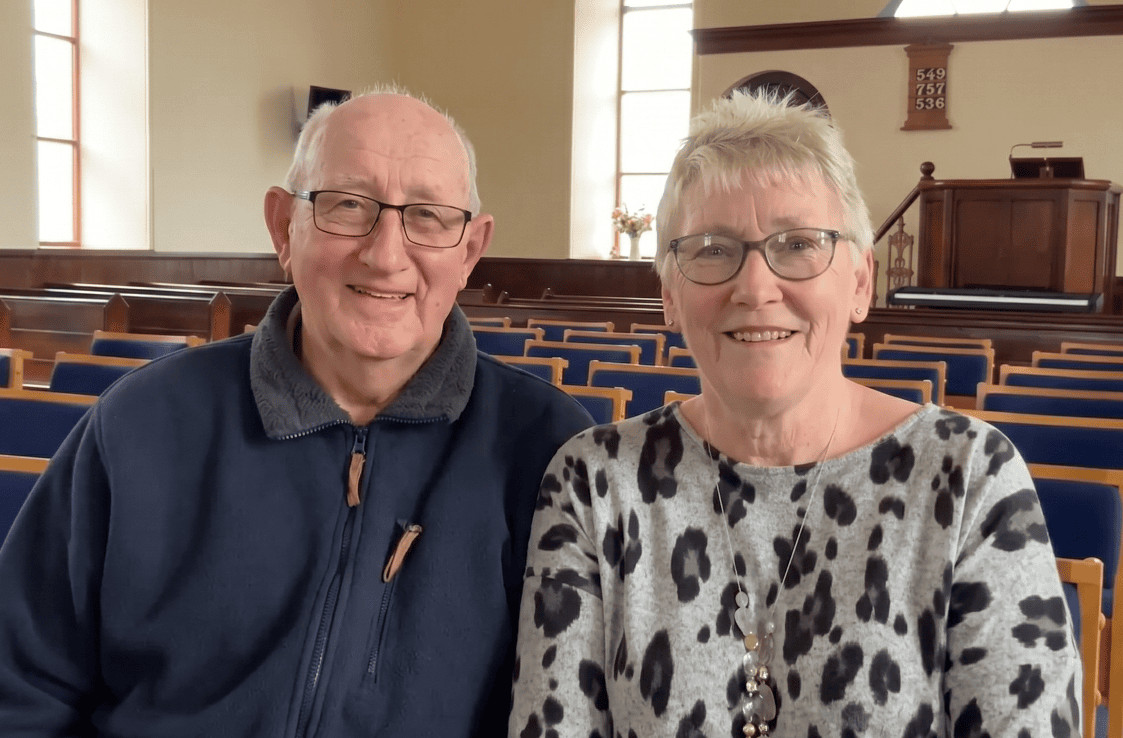
Gordon and Ann Findlay
A tragic collision in the fog shattered 52 years of peace on the waters of Port Erroll.
On June 19th, 1914, a terrible disaster struck the local sail boat, the Hilda Carnegie. While navigating through thick fog near the Sand Crags, the vessel was unexpectedly run down by the Kwasind, a massive American oil tank steamer bound for Norway. The impact was so severe that the Hilda Carnegie sank almost immediately into the murky depths.
The tragedy claimed the lives of two highly respected local fishermen: 39-year-old skipper David Alexander, who left behind two young children, and deckhand William Robertson. When the heartbreaking news reached the village via a telephone message, the community was startled and instantly plunged into mourning. The sudden loss cast a deep shadow over the tight-knit village, which had remarkably not lost a fisherman to the sea in over half a century, a testament to the men’s careful seamanship and temperate habits. At the Congregational Church, the pulpit was draped in black as the village gathered to mourn the untimely deaths.
Amidst the sorrow, a story of extraordinary heroism and resilience emerged. As the sail boat went down, five survivors desperately scrambled toward the bows of the towering Kwasind. It was then that George “Pot” Alexander, the mate, performed an astonishingly brave feat.

Showing incredible presence of mind, George dangerously crawled through the American steamer’s hawsepipe. Before the Kwasind’s own crew even came to their aid, he managed to haul three of his struggling shipmates up through the narrow pipe to safety. Experienced fishermen later noted that without George’s daring and perilous actions, the entire crew would likely have perished.
The survivors were eventually transferred to a nearby Lowestoft drifter, the Au Fait, bringing home a harrowing tale of loss and unforgettable courage.

Local Characters and Village Life in Old Port Erroll
Life in mid-20th-century Port Erroll was bursting with colourful characters, charming daily routines, and a deeply rooted community spirit. A familiar sight in the village was the older fishermen gathering in black wooden sheds near the sea, dressed in their traditional dark ganseys, worsted suits, and “bunnets”. Puffing on their pipes, they would huddle around a cozy fire and lum to debate the weather, the tides, and the latest local gossip. The intriguing hum of conversation from Tom Summers’ shed was so regular that one local mother playfully declared, “the house of parliament is convened!”.
Among the most memorable village personalities was William “Wakey” Summers of Harbour Street. Banished from the family home by his wife Elsie due to his pipe-smoking and spitting habits, Wakey spent his days happily lounging on a settee in his white garden shed, where he even cultivated Black Brunswick grapes in an adjoining greenhouse. Wakey was equally infamous for his driving. When his black Baby Austin was rear-ended because he failed to signal a turn into his own garage, his unapologetic defence was simply, “A’body kens I turn in here”.
The village’s bustling streets were also home to a vibrant array of businesses and unique hazards. Residents could buy fresh pies, “bradies”, and slab cakes from Simmers bakery. Meanwhile, an elderly lady named Hannah Duthie regularly sent local children up to the baker to buy “crimpets” (crumpets) to feed her enormous brood of cats. Down on Main Street, a trip to Jimmy Beagrie the cobbler came with a strict warning: he kept a mischievous pet monkey tied outside his shop that loved to lunge at the long hair of passing girls!
The evolution of education in Port Erroll is a fascinating journey that reflects a village constantly outgrowing its boundaries. The story begins in 1834 when the 18th Earl and Countess of Erroll founded the original Erroll School. Situated midway between the village and Saint James’s Episcopal Church, hardy pupils from all over the surrounding area would walk there in all weather conditions, winter and summer. Its final teacher, Miss Lobban, was a memorable character who rode a high-handled bicycle into the village, reminding locals of the famous Miss Jean Brodie.
By 1903, a new granite-built facility known as Port Erroll School officially opened on Serald Street, right in the heart of the village. However, as the community’s population steadily increased and families grew, this historic granite building became too small. To solve the overcrowding, a new facility was constructed on Braehead Drive for senior pupils, while the original 1903 building was repurposed as an infant and nursery school.
Tragedy struck the village’s educational heart in 2000 when the senior annexe on Braehead Drive was completely destroyed by fire. The community rallied, and a brand-new, state-of-the-art primary school was constructed on the same site. The staff and pupils moved into this modern facility in June 2003, which spelled the end of an era for the beloved 1903 Serald Street school. After marking its centenary year with a nostalgic open day for former pupils and staff, the historic infant school closed its doors for the last time. After lying empty for several years, the cherished old building was sadly demolished in 2009 to make way for a modern housing development.

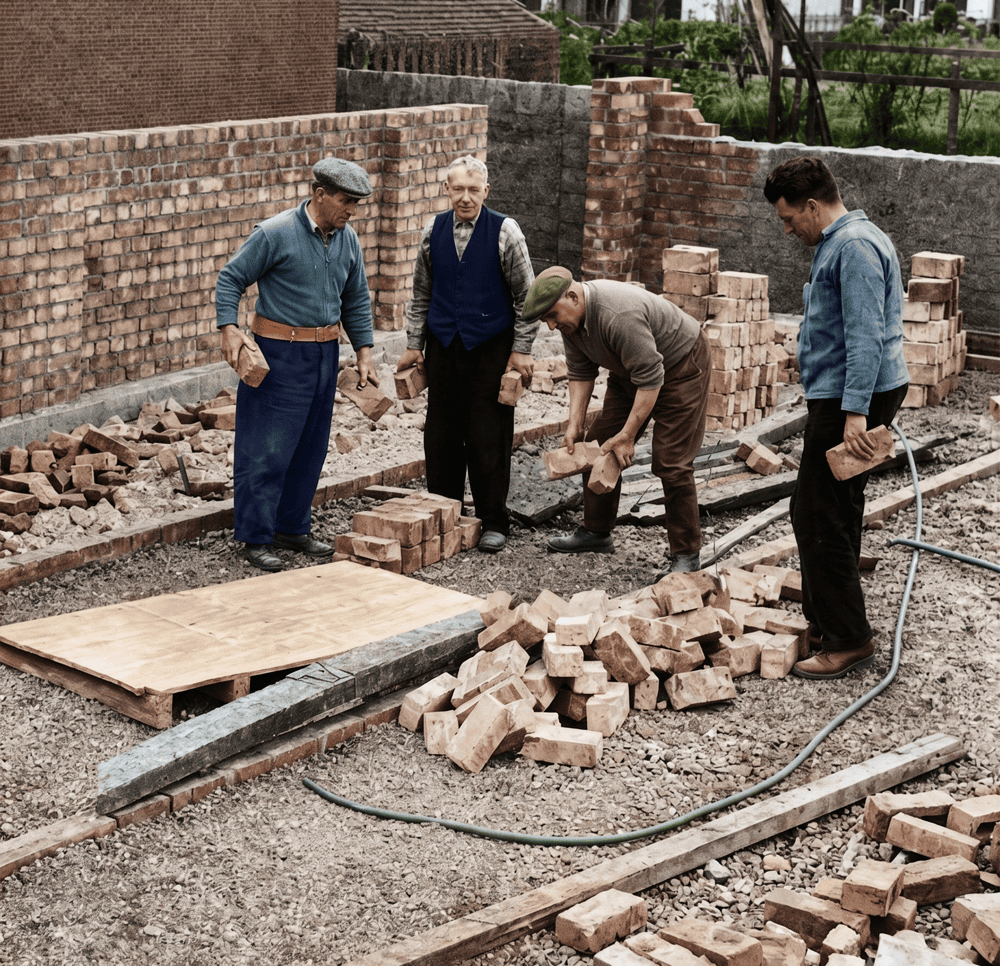
The Congregational Church and the “DIY” Church Hall
Built in 1884, the Congregational Church has long stood as the spiritual heart of Port Erroll. Affectionately known as the “fishermen’s church,” it originally seated 238 worshippers and hosted everything from bustling Sunday Schools to summer open-air services down at the harbour, complete with music provided by the Salvation Army.
By the 1950s, however, the beloved church was facing a practical crisis: it lacked a basic water supply, sanitation, and a dedicated hall for community activities like the Boys’ Brigade. Enter the Reverend Alexander Taylor, a minister who had recently arrived in the village following seven and a half years of missionary work in Nigeria. Drawing on his past experience of having to build his own mud-hut home from raw materials in Africa, Reverend Taylor made a startling suggestion to his congregation: they should simply build the much-needed church hall themselves.
What began in 1954 as a surprising idea quickly transformed into a remarkable display of village spirit. The construction project relied entirely on voluntary labour. Retired engineers like 68-year-old Mr. Cordiner and 67-year-old Mr. Nicolson rolled up their sleeves to lay bricks alongside teachers on holiday. Local farmers lent their lorries to transport rubble salvaged from a ruined hotel, boys carted materials, and local women kept the thirsty workers fueled with tea. Even the nearby Cruden Bay brickworks pitched in, generously supplying the materials at below contractor prices.
Working tirelessly in the evenings and their spare time, these dedicated locals successfully constructed a 50-foot by 27-foot hall from the ground up. This extraordinary “DIY” project stood as a profound testament to the resilience, ingenuity, and deep-rooted camaraderie of Port Erroll.
The Cruden Bay Brickworks: The Heart of Local Industry
For many families in Port Erroll, life wasn’t just tied to the sea; it was deeply rooted in the local clay. Outside of the traditional fishing trade, the Cruden Bay Brickworks provided the only other major source of employment for the men of the village. Finding the right home for this vital industry took some trial and error. The very first site near the present-day Aulton Road Garage was abandoned due to an issue with drifting sand, and a second site opposite Open Hearth eventually closed its doors in 1902. Finally, in the early 1900s, the Cruden Bay Brick and Tile Company established its third and most permanent location on the outskirts of the village along the road to Auchiries.
The brickworks practically dictated the daily rhythm of the entire community. Every morning at 7:00 am, the mighty “Brickers” steam horn would echo across the village, signaling the start of the working day. At midday, the horn sounded again, prompting a massive rush of workers pedaling their bicycles down Harbour Street to head home for their “denners” (dinner), before a final blast at 4:45 pm marked the end of their hard shift. The beloved steam horn even served a festive purpose, blasting at exactly midnight to welcome in every New Year.
However, the brickworks also saw its share of dark and difficult times. During World War II, the industrial site was struck by a bomb, tragically claiming the lives of foreman Mr. Macleod and a worker named Jimmy Gray. Another heartbreaking accident occurred later in the 1950s when Andy “Skip” Stewart was fatally injured after being caught in the heavy machinery belts. Despite these tragic losses, the “Brickers” remains a proud, foundational chapter in the village’s hardworking heritage.
Find out more about Cruden Bay Brickworks.


One of the most terrifying shipping disasters on the north-east coast took place on January 18th, 1912.
The 3,000-ton steamer Wistow Hall was enduring a perilous voyage from the Tyne to Glasgow when it was caught in a relentless gale. After drifting helplessly for 36 hours with its funnel and bridge washed away by mountainous waves, the doomed vessel was driven toward the jagged Aberdeenshire coastline.
The devastating climax occurred just miles from Port Erroll, where the ship was bludgeoned against the towering, tooth-like Tempion Rock.
Local coastguards and hundreds of villagers gathered on the cliffs, but they were tragically helpless against the fury of the storm. Rockets were fired in desperate attempts to establish a lifeline, but the massive waves snapped the ropes almost instantly. To the horror of the onlookers, the colossal steamer sank beneath the seething breakers in just ten to fifteen minutes.
The human toll was catastrophic. Out of the 57 crew members on board—a mix of European officers and Lascar stokers from India—an astonishing 53 lives were lost to the freezing, turbulent waters.
Only four men miraculously survived, including the injured Captain Stoddart. The captain had suffered a broken arm and spinal injury during the storm and had given his gold watch to his mate, believing he would not survive. The three other survivors were Lascar crewmen, who were pulled unconscious from the surf and revived by locals in the nearby village.
In the solemn days that followed, the recovered victims were respectfully laid out in the Mission Hall at North Haven. Today, their graves can still be found at Cruden Old Church and St James’s Episcopal Church, serving as a sombre reminder of the sea’s merciless power.
In 2019, local filmmaker and historian Jill Cramphorn (McWilliam) recorded a series of short interviews with local people who had a connection to the Congregational Church in Cruden Bay. Among those interviewed were Ann and Gordon Findlay, who shared their memories and recollections of the church and its place within the local community.
These recordings provide a valuable personal insight into the history of the Congregational Church and the people connected with it, preserving memories that might otherwise be lost with time.
We are extremely grateful to Jill for kindly allowing us to include these two interviews as part of the collection originally recorded for her Doric TV series, Historians of Cruden Bay. We are pleased to be able to share these recordings and, in doing so, help preserve and celebrate the history, stories and memories of Cruden Bay for future generations.
“Along with their written Port Erroll Past Times collection, Ann and Gordon Findlay also provided these newspaper cuttings to help keep the village’s stories alive”.
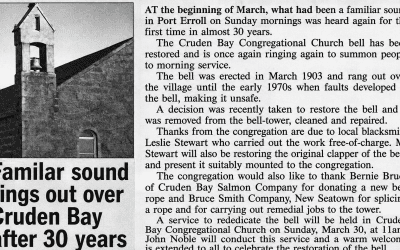
A Familiar Sound Rings Out After 30 Years
30th March 2003 AT the beginning of March, what had been a familiar sound in Port Erroll on Sunday mornings was heard again for the first time in almost 30 years.The Cruden Bay Congregational Church bell has been restored and is once again ringing again to summon...
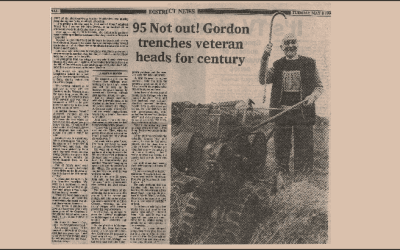
95 Not Out! Gordon trenches veteran heads for century
By ALISTAIR BEATON 8th May 1990John Brown, photographed in his Cruden Bay allotment as he approached his 96th birthday. A Gordon Highlander veteran of the First World War, he remained active in the garden every day, believing that fresh air, exercise and home-grown...
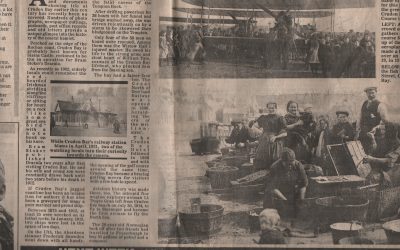
A Treasure Trove of North East History
A VERITABLE treasure trove of old photographs and documents showing life at Cruden Bay earlier this century has recently been uncovered. Hundreds of photographs, newspaper cuttings, postcards, post office records and old letters provide a unique glimpse into the...
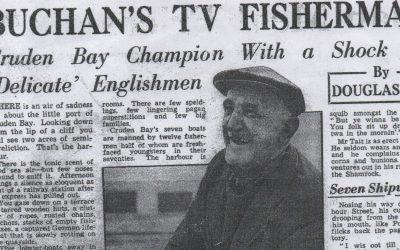
BUCHAN’S TV FISHERMAN
Mr William Tait—his retort to Gilbert Harding startled the television studio audience.Cruden Bay Champion With a Shock for 'Delicate' Englishmen — By — DOUGLAS RAE THERE is an air of sadness about the little port of Cruden Bay. Looking down from the lip of a cliff you...
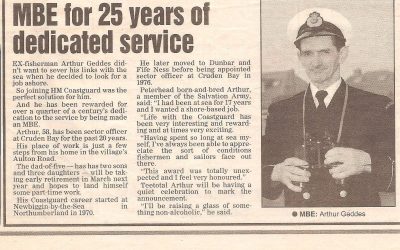
MBE for 25 years of dedicated service – Arthur Geddes
EX-fisherman Arthur Geddes didn't want to sever his links with the sea when he decided to look for a job ashore. So joining HM Coastguard was the perfect solution for him. And he has been rewarded for over a quarter of a century's dedication to the service by being...
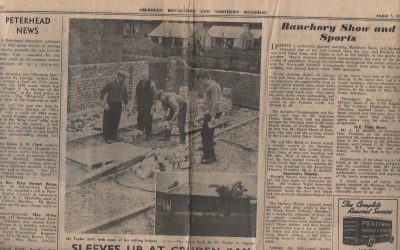
Sleeves Up At Cruden Bay
Mr Taylor (left) with some of his helpers (right) The house built by Mr Taylor in NigeriaAT the moment there's great activity going on, on the piece of land behind the Congregational Church at Cruden Bay. The reason — the Congregation are building themselves a church...
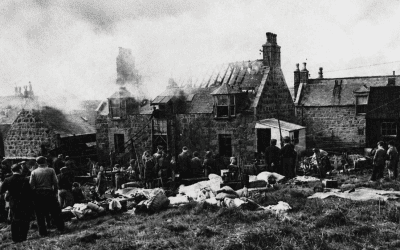
CRUDEN BAY FIRE – 21 HOMELESS
ALL THAT REMAINS OF FIVE FAMILIES’ POSSESSIONS Bedding, clothing, and furniture strewn over the braeside in the sunshine – the scene during yesterday’s fire at Cruden Bay, in which five families lost their homes. CRUDEN BAY FIRE – 21 HOMELESSFALLING SLATE STRIKES...
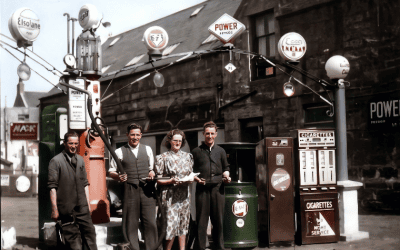
Edgars reaches the grand old age of 65 (1938 – 2003)
EDGARS in Cruden Bay reaches the ripe old age of 65 on Sunday. Current owner Aileen Ritchie and her husband Colin have absolutely no plans of retiring the ever-popular village shop - despite it reaching that age. But they took a trip down memory lane and came up with...
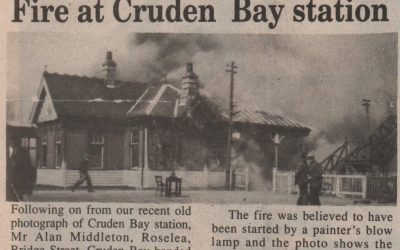
The Spark That Ended an Era: The Cruden Bay Station Fire
Fire at Cruden Bay station Following on from our recent old photograph of Cruden Bay station, Mr Alan Middleton, Roselea, Bridge Street, Cruden Bay, handed in this photograph of the fire at the station, taken around 1930. The fire was believed to have been started by...
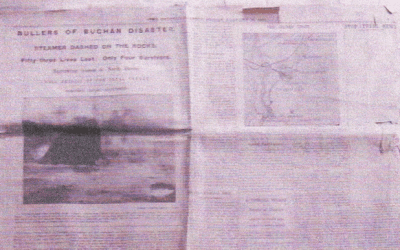
BULLERS OF BUCHAN TRAGEDY
Gordon Findlay has kindly provided a copy of The Evening Gazette, published in Aberdeen on Friday, January 19th, 1912 (cost one halfpenny). It features the following graphic account of the loss of the Wistow Hall and its crew on page 5 of this broadsheet publication,...