
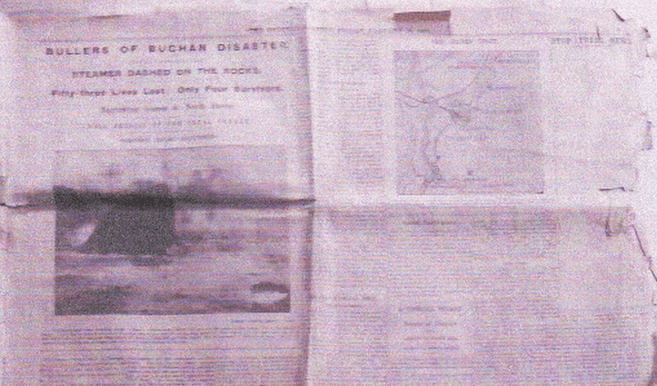
Gordon Findlay has kindly provided a copy of The Evening Gazette, published in Aberdeen on Friday, January 19th, 1912 (cost one halfpenny). It features the following graphic account of the loss of the Wistow Hall and its crew on page 5 of this broadsheet publication, a transcript of which is copied below VERBATIM. N.B. It is TEMPION ROCK (not “Tempin” as was stated in the newspaper)
BULLERS OF BUCHAN TRAGEDY
FIFTY-THREE LIVES LOST: ONLY FOUR SURVIVORS
HARROWING SCENES AT NORTH HAVEN
FULL DETAILS OF THE FATAL VOYAGE
THIRTEEN BODIES RECOVERED
The steamer Wistow Hall, of Liverpool, from the Tyne to Glasgow with ballast, was dashed on the rocks near the Bullers of Buchan yesterday, and went to pieces in a few minutes.
Of the crew of 57 all told, the captain and three Lascars alone survive, the death roll thus numbering 53.
Of the crew 14 were Europeans and 43 were Lascars. The following is a list of the European members of the crew:
Captain Stoddart, who appears to be the only white man saved
Chief Officer A. L. Clarke, Poulton, Cheshire
Third Officer T. S. Rose, Liverpool
Chief Engineer George W. Knight, Worksop
Second Engineer J. Gray, of Johnston, Renfrewshire
Third Engineer John Roberts, Liscard
Fourth Engineer W. S. Harris, Liverpool.
The names of the carpenter, the engineers, the storekeeper, and three quartermasters were not ascertainable in Liverpool, owing to the fact that the crew had signed articles at Newcastle-on-Tyne.
Captain Stoddart was making his first voyage in command of the steamer, having taken the place of the regular master.
The second officer, Clarke, only joined the vessel last Saturday, being transferred from the steamer City of Lahore. He leaves behind a young widow and baby.
Thirteen dead bodies have been recovered.
A GRAPHIC ACCOUNT
A special representative of the “Evening Gazette” writes:
One of the most appalling shipping disasters that has ever occurred on the north-east coast took place in the early hours of yesterday morning some distance north from Port Erroll, a large 3000 ton steamer going to wreck involving the loss of 53 lives. Terrible as was the wreck which occurred on Wednesday when a steamer whose identity has not yet become known foundered some few miles farther south with a crew supposed to consist of about 16 hands, it was completely eclipsed by the disaster of yesterday. The details of the wreck are of the most harrowing nature. The steamer Wistow Hall, registered at Liverpool and trading between this country and foreign ports, was bound from Jarrow-on-Tyne round the north coast of Scotland to Glasgow, where she was to take on a cargo for Bombay. She left the Tyne on Tuesday with a crew of 57 hands all told, and had not long been at sea when she encountered the gale which has been raging all along the east coast during this week. Her captain was William Stoddart, a native of Liverpool, who had temporarily taken charge of the vessel during the illness of her ordinary captain. Early on Wednesday morning very rough weather was experienced, and not only was heavy damage sustained by the vessel, but 2 of the crew were killed and the captain so severely injured that he was confined to his cabin. He had been carrying out his duties on the deck when the steamer was struck by a terrific sea, and he was driven with great force against one of the stanchions and sustained injuries to his spine. The subsequent navigation of the vessel was in the hands of the first mate, but his management of the vessel was greatly handicapped from the damage she had sustained at the same time that the captain was injured.
FUNNEL CARRIED AWAY
Her funnel was carried away and other minor damages all tended to make the vessel unmanageable. She drifted northwards all day on Wednesday, those in command endeavouring to keep her out to sea and on her northward course. The gale, which as stated by the crew, was of terrific force, gradually blew the vessel landward, and the heavy seas that repeatedly washed over her made it almost impossible for the men to effect any temporary repair or utilise to any advantage any auxiliary gear. In the early hours of yesterday morning the steamer was first sighted by the coastguards at Port Erroll. She was burning flares showing that she was in distress, and it was estimated that she was some five or six miles out at sea in a south-easterly position from Port Erroll. She was kept under observation and the coastguardsmen were some short time afterwards called out to be in readiness for action if she was driven on the rocks. The vessel gradually drifted northward in the direction of Port Erroll, and it was then seen by the coastguards that she was a steamer of large dimensions and at the mercy of the waves. The coastguardsmen stood in readiness, and, uncertain where the vessel was likely to come ashore they…… in the direction of Whinnyfold, where the vessel foundered on Wednesday. The Wistow Hall was, however, being carried northwards by the set of the tide and the strength of the gale, and it soon became evident to the coastguardsmen that she was to go ashore farther north. They accordingly returned the way they came, and carrying with them their life-saving apparatus, they kept the coast line abreast of the steamer for several hours in readiness to do all that was possible when the vessel, which it was seen was bound to get on the rocks, should strike. Slowly but surely the vessel was blown northward and nearer to the rocks, and those on the shore saw that it was only a matter of time when she would meet her doom. The Bullers of Buchan is a ragged part of the coast and has been in past years the scene of many shipwrecks. Towards this point the vessel had been carried, and about 8 o’clock she got amongst the rocks.
ON THE ROCKS
She first struck a jagged series of peaks known as the Mussel Rock some distance off the village of Northaven. She sustained some damage there, but by the force of the wind managed to get clear, and drifted farther inland to the more fatal peak known as the “Tempin” Rock. This rock rises like a massive tooth sheer out of the sea in a deep indenture in the coastline about two and a half miles from Port Erroll, and is only about 200 yards off from the beach. It is one of the most dangerous and, as its past history shows, one of the most disastrous of spots on the north-east coast. With such a gale and in such a sea as has been raging for the past few days, no vessel could possibly live in such a vicinity, and the villagers of Northaven, who know what it means when a vessel gets entangled in this place, realised that when the vessel struck a disaster of exceptional magnitude would be the consequence.
Caption beneath the main image:
This photograph, taken yesterday by the “Gazette” photographer, shows the scene of the wreck of the Wistow Hall at the Bullers o’ Buchan. The vessel is lying at the foot of the great rock on the north side of the creek known as North Haven. On the right hand side of the rock will be seen a low rock, just rising above the water. It was here the vessel struck. Part of the wreck is visible at low water. In the foreground of the photograph wreckage from the vessel is seen floating in the water.
The news of the danger that was so imminent to the steamer had been telephoned to the neighbouring villages and to Port Erroll, and hundreds of men were on the scene, early though the hour was, to give what assistance might lie in their power. The vessel having struck so near land, the action of those on board was distinctly seen by the crowd of spectators on the beach. The Coastguardsmen were ready with their rocket apparatus and amply provided with lifebuoys and other appliances for the rescue of the seamen. The storm still blew with all the fury of the previous day, and great waves kept tumbling shoreward with irresistible fury, the spray dashing over the adjoining rocks and rising to a height of some 40 or 50 feet.
A HARROWING SPECTACLE
The vessel struck the rocks shortly after 8 o’clock and between ten to fifteen minutes after had sunk. The Coastguardsmen, immediately reached the jagged margin of the “Tempin” rock, fired the rocket, and the line fell over the vessel, but was broken almost immediately by the waves. Another rocket was fired, and communication was again established with those onboard. It was, however, impossible to do anything. Just as the line fell, a series of mountainous waves washed over the vessel’s deck, gradually she began to settle and to get lower in the water, and in a few minutes to the consternation of all, who stood helpless not more than 200 yards away, the huge steamer sank beneath the waves, carrying with her her human freight of over 50 souls. In her last moments there was witnessed actions of frantic desperation by the members of the crew, who saw that death was inevitable. They were seen to stand huddled in groups near the stern, some ascended the rigging, and a few were washed overboard by the waves even before the vessel had got submerged. The captain was seen standing on the bridge, and just as the vessel’s deck disappeared in the surge, he raised one of his arms and almost at the same moment an incoming wave broke right over him and he was washed into the sea. Within a few minutes the bridge of the boat had disappeared from view, gradually the masts sank lower, and in half an hour’s time from the moment the vessel struck the edge of the “Tempin” rock all of her that was visible above the surf was the tip of the tall mainmast. In the sea there was presented a spectacle of human destruction that those who witnessed shall never forget. The members of the crew appeared every now and then as the waves broke battling for their lives against wind and tide. Many of them were unable to swim and soon got dashed to death against the sharp peaks of the terrible rocks. Others struck out with what power they possessed in the direction of the land, but in such a whirlpool of tumbling and seething breakers it was a human impossibility for anyone to make headway. Time and again the men were carried back on to the rocks, dashed by the waves against the deadly edges, and from the injuries they thus sustained, coupled with the intense cold of the water, they soon became inert and unconscious, and completely at the mercy of the gale.
Those on the shore were absolutely helpless, willing and ready as they were to save the unfortunate men, and they could only stand by in the hope of rendering assistance to any of the crew who might come near enough to catch a life-line. In the execution of such a service, they were, however, soon handicapped, the incoming wreckage becoming piled upon the strand and constituting a barrier between those on land and the drowning seamen.
RECOVERY OF BODIES
Within a short time after the wreck three black men were washed ashore. All were unconscious, and they were found to be Lascars. They were carried by willing hands to the adjoining small village of North Haven, where artificial respiration was resorted to with success, the men after a time regaining consciousness. The captain of the vessel was also washed ashore, and he was likewise carried to an adjoining house, where, after over an hour of patient labouring in the application of restorative means he regained consciousness. His right arm was broken, and when he became conscious of his surroundings it was seen that it was with great pain and difficulty that he could exert any motion. Dr Stewart from Hatton was on the scene, and found that, as already stated, he had also some injuries to his spine. Shortly after his first regaining consciousness he got quite delirious, and had to be held down, his action showing that he still had the belief he was battling with the sea and struggling for his life. He remained in that delirious state during the whole of the afternoon, but late in the evening had so far recovered as to be able to take some nourishment and to make a deposition to the Receiver of Wrecks from Peterhead.
Other bodies were washed ashore as the day advanced, and at 1 o’clock 17 all told had been thrown on the shore, all being dead with the exception of the four already mentioned. The corpses were carried to the small Mission Hall at North Haven and reverently stretched in a ghastly array in two rows of forms. Later in the evening they were examined by the police authorities for identification papers.
From the captain it was ascertained that there was a crew all told of 57 men, consisting as follows: four officers, four engineers, one artificer, one carpenter, three quartermasters, one saloon boy, two cooks, one mess-room steward, eighteen sailors, and twenty-two Lascars, who acted as stokers.
DETAILS OF THE WRECK
THE VESSEL FIRST SIGHTED
Mr Batting, the boatman who was on the lookout in the Coastguard Station overnight, stated he first saw a light on the vessel about 2 o’clock in the morning. There appeared to be another vessel of smaller dimensions some short distance from her, and he surmised that it was a trawler and that she tried to give her assistance. The trawler was burning flares for, as he thought, the object of showing her position to the Wistow Hall. As the hours wore on the trawler, finding it dangerous to come nearer the land, and being unable to give the larger steamer any material assistance, made out to sea, and he eventually lost sight of her. The wrecked vessel gradually drifted north, showing flares all morning. He kept her under observation, and at 5 o’clock in the morning telephoned to the chief coastguard officer, Mr Holland, informing him that there was a vessel in distress. The coastguard brigade was called out, and stood in readiness to render assistance. The vessel gradually came northward, drifting nearer the land and about daybreak disappeared out of sight round the headland.
COASTGUARDS POWERLESS
A LONG AND TRYING VIGIL
Mr Holland, the chief coastguard at Port Erroll, said he got a telephonic communication from his man at the look-out about 5 o’clock in the morning informing him that there was a vessel some miles to the southward showing signals of distress. He at once called out his men, and made ready for action. From the position of the vessel when he first saw her it looked as if she was drifting towards Whinnyfold, and he and his men proceeded along the coast in that direction. There was a terrific wind blowing, and the spray from the waves could be felt for a considerable distance inland. He soon saw that the vessel was being driven north and that she would go ashore, if she continued her course, at a point considerably beyond Port Erroll. He accordingly returned and proceeded along the coast, keeping abreast of the steamer, continuing thus for about two and three hours. When the vessel approached the Bullers she was caught in the current leading into the bay opposite North Haven, and afterwards she gradually came nearer to the danger rocks on which she eventually struck. He and his men were standing by on the shore with their life-saving apparatus, but so terrible was the… that they could never operate with any advantage. When the vessel struck the “Tempin” rock he at once fired a rocket, and it got over the ship, but the line was almost immediately broken by the waves. A second rocket was shot, and it also got over the steamer, but it had scarcely been fired when the steamer began to sink. All they could do was to stand by in readiness to render assistance to those who might be able to swim ashore. The desperation of the men on board the doomed vessel before she sank was terrible to witness. One man he saw cling for a time on to a spar, but a huge wave came and washed him off. The spectacle of so many men drowning right in front of their eyes and those on land powerless to help them was heartrending, and he would never like to witness such a sight again. He and his men were almost completely exhausted, some of them having never been off their feet for about three days.
AN EYE-WITNESS’S STORY
RESCUING THE BODIES
A graphic story of the wreck was given by an old fisherman, one of those who assisted to rescue the four survivors and to rescue the bodies that were washed ashore. It was about half-past 2 in the morning, he said, when a vessel in distress was first seen from the shore. He and others followed her along the coast as she drifted northwards, keeping as nearly as possible opposite to the vessel so that the rocket apparatus could be got into operation immediately should the vessel strike within reach of a line. All hope of rendering such aid as could be afforded by life-line and breeches buoy was rendered futile when the steamer was dashed on the “Tempin” rock, for, to this eye-witness, she seemed to stay there for only five or ten minutes, and then to disappear. The first survivor was washed shorewards before many minutes had elapsed. “We pulled him from the surf,” said the narrator, “and he appeared to be quite sensible. He was a coloured man and so were two others washed to the land. The fourth was an Englishman (the captain as it proved). He was unconscious and seemed to be sorely injured. One…. The funnel was washed away and the fires were drowned out, so they were no use against the wind and the sea. A lot of us helped to get the corpses ashore, and they came in very fast. Thirteen of them altogether we got, and we carried them up the steep road to North Haven, where they were laid out in the hall. There was a lot of stuff washing in to the shore, a spar or two and any number of matsand such like and a lot of broken-up wood. The boat must have been smashed to bits when she struck, and there will be little of her gear recoverable. It was a terrible night, and the worst sea we’ve had hereabout for a lot o’ years.
THE CAPTAIN’S CONDITION
INJURED FOR TWO DAYS
Andrew Keith, the quarryman to whose house the Captain was taken when recovered from the sea, stated later in the evening that Captain Stoddart had so far recovered and that he was able to talk sensibly. Mr Keith had been speaking to him and the captain had stated that he had been knocked against a stanchion during the gale two days previous. He had got injuries to his head which necessitated his remaining in his cabin. On account of the severity of the weather there was considerable disorder on the ship, which became greater as the vessel lost her funnel and subsequent damage. He had been without food for two days, and it was only a few minutes before the vessel struck the rocks that, with the assistance of the steward, he was able to dress and get on deck. He thought that if he had a tug or some other vessel to render him assistance the vessel could have been kept to sea and probably have been taken to the Pentland Firth. About 6 o’clock in the evening the captain had so far awakened to his position that on his being asked if he would like to have read to him a newspaper account of the wreck he expressed his desire for this to be done. He expressed his deep regret at the terrible disaster that had taken place. Early in the afternoon Mr Keith said Dr Stewart had telephoned Captain Stoddart’s father in Liverpool, and a reply had come back expressing gratification that his son had been saved.
RECORD FOR DISASTERS
A quarryman who had taken part in the work of rescue said that he had lived all his life in that quarter and he never remembered a storm of such fury that lasted for so long. This week, he said, would constitute a record for disasters along the Buchan coast.
THE NUMBER OF THE DEAD
It will be observed that according to one statement the ship’s company included a pilot, and it is not quite clear whether he has been included in the list of Europeans and Lascars, numbering 57, which is stated to be “all hands”. The fact that the majority of the crew signed on at Newcastle made it impossible to ascertain definitely the names and precise details as to the manning of the ship.
DISPOSAL OF THE BODIES
Many of the dead seamen had in their possession valuable property, including jewellery and watches. These were taken charge of by the police authorities who will retain possession of them until the bodies are identified and the articles claimed. All the bodies will be kept in the Mission Hall at North Haven until they have been identified, and it is possible the Lascars and the other seamen whose identity may not be established within a day or so will be buried in the Parish Churchyard.
ABERDEEN MAN SUPPOSED ABOARD
On one of the bodies were found papers bearing the name of Thomas Rose with discharges from several Aberdeen shipmasters. The police on making enquiries at the captain as to whether there were any north country men on board were told that one man of the name of Gray was from Aberdeen. So far as it has been ascertained no verification of this statement has been found in the course of the investigations which took place last night.
LATEST PARTICULARS
Early this morning it was stated that no further bodies have been secured off the wreck of the Wistow Hall. Several watchers were on the scene up to a late hour, and although some corpses were seen floating in the water, the backwash carried them out of reach. Inspector Middleton returned to Peterhead, and two other constables to their destinations some time after darkness fell, having made a search of the bodies which had been recovered and taken charge of all the valuables and other material likely to lead to identification. No names, however, of any of the bodies recovered, could be ascertained, but it is hoped with a considerable improvement in the condition of Captain Stoddart, the work of identification may be proceeded with this morning.
A TERRIBLE VOYAGE
Details of Disaster
Adrift in North Sea
SCENES AT NORTH HAVEN
Our Peterhead correspondent, who was on the scene of the disaster as soon as the first of the bodies were being washed ashore writes:
One of the most harrowing sea disasters chronicled in the memory of living man occurred yesterday at daybreak on the rocky coast of Aberdeenshire. The scene of the catastrophe was the hamlet of North Haven, about eight miles south of Peterhead and three miles north of Port Erroll. This hamlet is mainly occupied by workmen in the Longhaven and district quarries, and is adjacent to the picturesque Bullers o’ Buchan where a number of fishermen and other quarry workers reside. Besides the “Twa E’en” and “The Pot” at the Bullers, there is another deep gully to the north, which lies below the North Haven dwelling houses. The cliffs are perpendicular and about two hundred feet in height, and one pinnacle rock bears the name of the “Tempin”.
Round all the cliffs large crowds had been gathered from about 7 o’clock yesterday morning, watching a vessel using flare lights to signal distress. The vessel had also been sighted by the Coastguard at Port Erroll, who had watched it drifting helplessly in a northern direction, and had followed it to the point at North Haven.
As day broke, about a quarter to 8, the vessel was noticed to be a steamer which had lost its funnel, and several of the crew could be discerned clinging desperately to any ropes or rigging that could be got hold of. She drifted finally on to the “Tempin” rock, and, striking the bottom of the cliff, the stern of the vessel immediately went under. The rocket apparatus was brought into requisition, but in the heavy surging sea it was impossible for the crew to attach it to any part of the steamer. In the sight of all the anxious onlookers, the vessel gradually went down, and the crew, clinging in despair to the ropes around the deck and masts, the last hopes of life, were also taken below the surface. Several had succeeded in jumping into the water, and as the steamer sank others were seen to be clinging to ropes, ventilators, the derricks, and, indeed, anything by which they could get a secure hold.