

The Dardanelles
Tryggvie Gran MemorialThe Dardanelles video features original music from Cruden Bay Life inspired by the stories published on this page.
The Dardanelles
Nestled in the heart of Cruden Bay village, The Dardanelles is a charming riverside spot where Main Street meets Harbour Street. This peaceful location offers an inviting place to pause and take in the beauty of the area, with public benches overlooking the Water of Cruden and the 4th tee of the world-renowned Cruden Bay Golf Course.
The Dardanelles is more than just a scenic rest stop – it also holds historical significance. The name takes its origins from soldiers returning home from the 1st World War, having served during the Dardanelles Campaign on the Gallipoli Peninsula. Here you’ll also find the Tryggvie Gran memorial, commemorating the pioneering Norwegian aviator who, in 1914, completed the very first flight across the North Sea, from Cruden Bay to Norway.
A favourite with both locals and visitors, The Dardanelles is the perfect place to relax, watch the world go by, and enjoy the tranquil surroundings. On warm summer days, many choose to savour the experience with a refreshing ice cream from the nearby village shop, making it a delightful spot to pause before continuing your exploration of Cruden Bay
Why The Dardanelles? (1919)
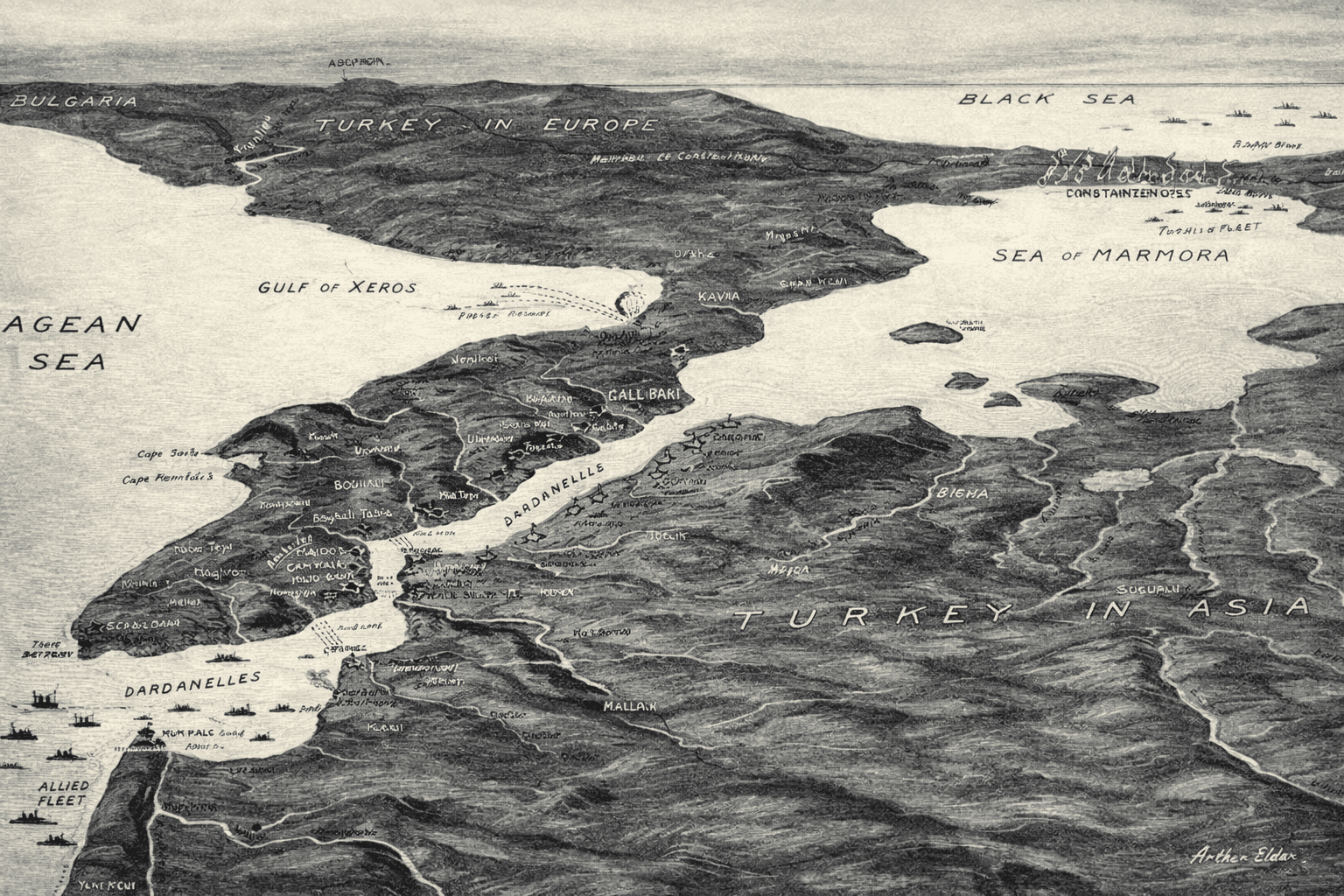
The name “The Dardanelles” in Cruden Bay is thought to have been given by soldiers returning from the First World War, reflecting a strong connection to their wartime experiences. Many local men had served in the Dardanelles Campaign on the Gallipoli Peninsula, a fiercely contested and costly conflict that left a lasting mark on those who fought there. The original Dardanelles is a narrow strait in north-western Turkey, linking the Aegean Sea with the Sea of Marmara and forming part of the boundary between Europe and Asia. Its strategic importance and the heavy loss of life ensured it became one of the most memorable theatres of the war.
On returning home, veterans often commemorated their service and fallen comrades by naming familiar places after significant battles. In Cruden Bay, the narrow stretch of land beside the flowing Cruden Water may have reminded soldiers of the confined and strategic nature of the Turkish strait. The area was therefore likely named “The Dardanelles” as a symbolic local tribute, preserving the memory of the campaign and the hardships endured far from home.
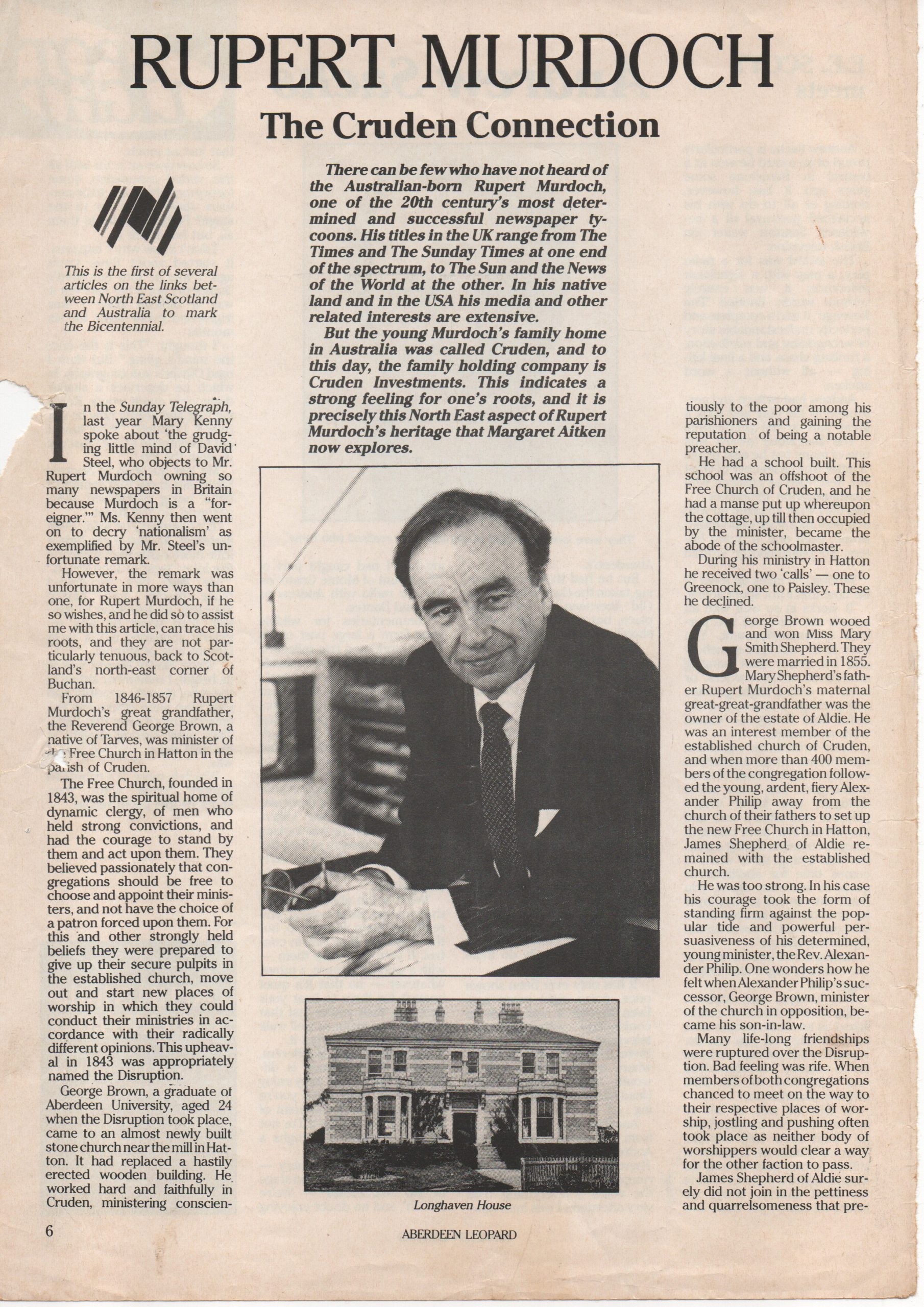
There is also a lesser-known historical connection between Cruden Bay and the Murdoch family. The Reverend Patrick John Murdoch, great-grandfather of Australian media figure Rupert Murdoch, served as minister of the Cruden Bay Free Church before emigrating to Australia in 1884. The family later named their estate near Melbourne “Cruden”, reflecting that connection to the village. Patrick Murdoch’s son, Keith Murdoch, became a war correspondent and reported from the Dardanelles Campaign during the First World War. Although Rupert Murdoch himself has no personal link with Cruden Bay, this family history provides an interesting thread between the village and events surrounding Gallipoli.

Cruden Farm, Victoria, Australia.
Cruden Bay’s history of conflict, however, stretches much further back. Long before Gallipoli, the area directly across from the Dardanelles, which is now the golf course, was the site of the Battle of Cruden in 1012, when Scots clashed with invading Danes on its shores. Though fought on very different scales and in very different centuries, both the Battle of Cruden and the Dardanelles Campaign reflect the area’s longstanding associations with struggle, resilience, and remembrance.
Is That The Fleet Passing Through The Dardanelles?
Another anecdotal explanation for the origin of the name “The Dardanelles” also dates from the time of the First World War. According to local tradition, a woman named Mrs Masson, renowned for being the mother of a remarkably large family, was walking one day with her long line of children following closely behind her. Their route took them along the bend in the Cruden Water where the burn turns south at the junction of Main Street and Harbour Street before flowing into the sea.
As the impressive procession made its way along the path, a nearby observer is said to have remarked, “Is that the fleet passing through the Dardanelles?”—a humorous comparison to the long line of Allied ships attempting to navigate the narrow Dardanelles Strait during the Gallipoli Campaign. Many local families, including that of Anne Findlay, have long believed that this light-hearted comment gave rise to the name by which the location is still known today.
Whether this story is fact or simply a cherished piece of local folklore is impossible to determine. In truth, no one can say with certainty where the name “The Dardanelles” originated. However, of the three traditional explanations that have been handed down through the generations, it seems likely that the true origin lies somewhere amongst them.

Image created by Cruden Bay Life
First Flight Across the North Sea in 1914
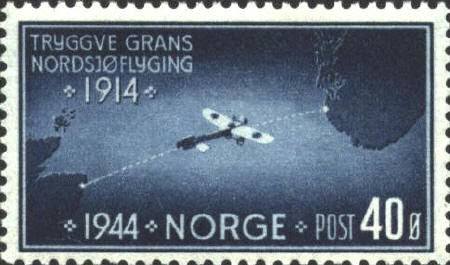
In the annals of aviation history, the year 1914 marks a significant milestone with the first successful flight across the North Sea from Cruden Bay, Scotland. This remarkable achievement was made by Tryggve Gran, a pioneering Norwegian aviator whose daring spirit and technical prowess established a new chapter in aviation. Gran’s historic flight not only highlighted his own bravery but also anchored Cruden Bay as a key location in the early days of aviation.
Tryggve Gran, born in 1889, was an adventurer with a passion for flight. Before his foray into aviation, Gran was known for his expeditions in the Arctic. His transition to aviation was driven by his ambition to push the boundaries of what was possible. In 1914, with the help of his pioneering spirit and a specially equipped aircraft, Gran set out to achieve a groundbreaking feat: crossing the North Sea from Cruden Bay to Norway.
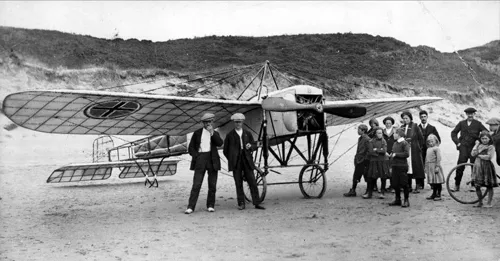
Cruden Bay, with its wide-open skies and strategic location, was chosen as the launch point for this ambitious flight. The small coastal village, with its natural harbor and proximity to the North Sea, provided an ideal setting for Gran’s departure. On July 30, 1914, Gran took off from Cruden Bay in his Blériot XI-2 monoplane, named Ca Flotte, a pioneering aircraft of the era. The journey, fraught with challenges and uncertainties, was a test of both human and mechanical endurance.
Gran’s flight covered approximately 320 miles of treacherous sea, with the aircraft battling strong winds and varying weather conditions for 4 hours and 10 minutes. After a grueling journey, Gran successfully landed in Jæren, near Stavanger, Norway, achieving the first trans-North Sea flight. This remarkable achievement demonstrated the feasibility of long-distance flights and paved the way for future aviation endeavors.
The significance of Gran’s flight extends beyond its technical accomplishment. It underscored Cruden Bay’s role in the early history of aviation, marking the village as a significant site in the evolution of flight. Today, the legacy of Tryggve Gran’s daring achievement is remembered with pride in Cruden Bay, and marked with a memorial located at The Dardanelles, which has become the focal point of anniversary celebrations over the years.
The village continues to celebrate its aviation heritage through the recently installed information boards that commemorate Gran’s historic flight. These connections to the past serve as a testament to Cruden Bay’s role in the broader narrative of aviation history. Visitors to Cruden Bay can explore these historical markers and reflect on the audacious spirit of Tryggve Gran, who, from this small Scottish village, took to the skies and made history.
This video includes a selection of photographs taken at the time of the flight in 1914 along with some later images taken when Tryggve Gran visited Cruden Bay again in 1971, and an annimated video created by Kjell Dahle @hobbykjelleren.
The video also features a new song, ‘The Flight From Cruden Bay’, created by Cruden Bay Life.
In addition, we have found TV interview with Tryggve Gran (unfortunately in Norwegian), however it is really interesting to watch and appreciate. Click here to view →
A Tribute to Courage: The Tryggve Gran Memorial at Cruden Bay
On 30 July 1914, Norwegian aviator Kommander Tryggve Gran made the historic first successful flight across the North Sea, taking off from the sands of Cruden Bay, Scotland. Flying a Blériot XI-2 monoplane named Ca Flotte, he crossed approximately 320 miles of treacherous open water in 4 hours and 10 minutes before landing near Stavanger, Norway. This daring aviation milestone forever anchored the small Aberdeenshire village in the annals of early flight.
Despite the magnitude of his feat, the memory of the flight faded over time. In 1971, however, the story was revived by Reverend Charles Miller, then the minister of Cruden Bay Parish Church. Reverend Miller tracked down the pioneering pilot and organized a special trip for Gran to return to Scotland, where he stayed with the minister’s family. This reunion galvanized the local community to establish a permanent memorial.
The construction of the monument became a unique community effort, proudly built by sixth-form pupils from Robert Gordon’s College (RGC). Crafted from local pink Peterhead granite, the structure features a small, elegant monolith set upright on a rotunda of masonry, resting on a pavement of irregular slabs. To immortalize the schoolboys’ hard work, the initials “RGC” were inscribed in smaller letters beneath the bronze commemorative plaque.
The culmination of this extraordinary project was a grand unveiling ceremony. A deeply moved Tryggve Gran was personally present to witness the unveiling of the monument. Standing alongside the RGC pupils who had built it, the veteran flyer was celebrated by the community he had inspired fifty-seven years prior.
Today, the pink granite monolith stands proudly at Cruden Bay, a beautiful tribute to human courage and the enduring connection between Scotland’s youth and Norwegian aviation history.


Take Notice
These noticeboards, erected by the Port Erroll Heritage Group, commemorate the daring 1914 flight of Tryggve Gran—the first to cross the North Sea, flying from Cruden Bay to Stavanger. On a crisp summer day, aviation history was made when Gran took off from this very shore, navigating the open sea to land safely in Norway. His feat showcased pioneering courage and skill, linking our coastal community to the skies and inspiring generations of aviators. May this tribute celebrate Gran’s bold spirit and remind all who pass by of the extraordinary bridge he forged between two nations.


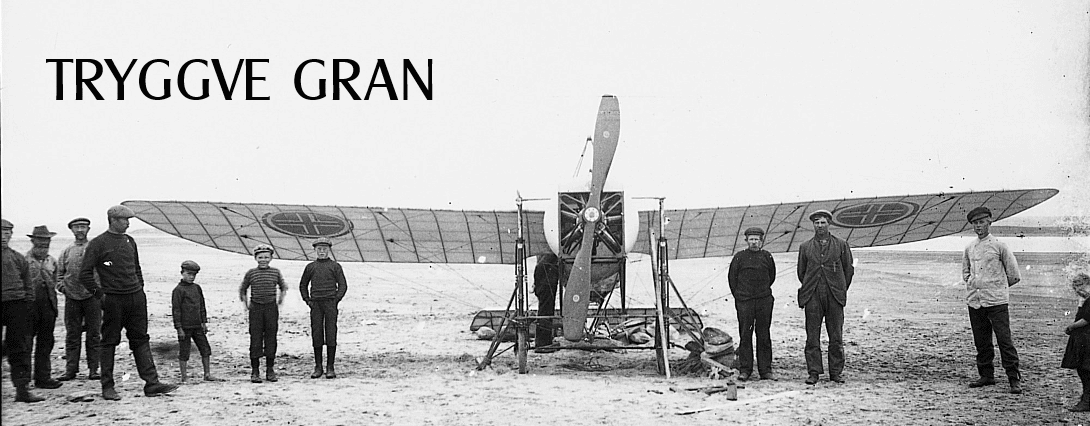
Tryggve Gran
Torsdag 30.juli i 1914 blei Tryggve Gran (1889-1980) den første til å fly over Nordsjøen. Han brukte 4 timar og 10 minutt på ferda frå Cruden Bay i Skottland til Maleneset ved Orrevatnet. Nordsjøflyginga var ei bragd på line med Louis Blériot si flyging over den engelske kanalen fire år tidlegare. Med det utstyret Gran hadde til disposisjon, var ferda eit vågestykke.
Nordsjø-flyginga til Tryggve Gran drukna i utbrotet av første verdskrigen, men i Klepp skapte den stor merksemd. Tre gutar som bada i Orrevatnet då flyet kom inn frå havet, blei skrekkslagne – dei trudde dette var «vondemannen sjølv» som kom farande over hustaka.
Minnesteinen som står omtrent der kor flyet landa i 1914, var det Norges turnveteraner som la ned i 1934. Tryggve Gran var elles kjend som polarforskar og deltok i Robert Scott sin sydpolekspedisjon.


Tryggve Gran
On Thursday 30 July 1914, Tryggve Gran (1889-1980) became the first to fly across the North Sea. He spent 4 hours and 10 minutes on the flight from Cruden Bay in Scotland to Maleneset by Lake Orrevatnet. The North Sea flight was an achievement on a level with Louis Blériot’s flight across the English Channel four years earlier. With the equipment Gran had at hand, this flight was a daring venture.
The news of Tryggve Gran’s North Sea flight drowned in the breakout of the First World War, but at Klepp it was quite a sensation. Three boys were swimming in Lake Orrevatnet when the plane came in from the sea, and were terrified – thinking it was the devil himself who came rushing in above the rooftops.
The memorial stone at the approximate site where the plane landed in 1914 was placed there by Norwegian Gymnastics Veterans in 1934. Tryggve Gran was otherwise known as a polar explorer, and took part in Robert Scott’s South Pole expedition.
THE FIRST CROSSING OF THE NORTH SEA BY AIR
On July 30ᵗʰ 1914, Tryggve Gran (1888 – 1980) piloting a Blériot monoplane took off at 8 a.m. from a field near the Cruden Bay Hotel. His aim: to make the first aircraft crossing of the North Sea. The flight was dramatic from the start; he narrowly avoided colliding with the overhead electric tram wires which connected the hotel and the station. Twenty miles out, he encountered sea fog and turned back. Landing on the beach, the aircraft overshot the sand, and to avoid hitting the rocks at the far end, Gran steered into the sea.
He took off from the beach for his second attempt just after 1 p.m. and headed towards his native Norway. All went well until halfway across when, after changing fuel tanks, the engine cut out because of low pressure in the tanks and the aircraft plummeted. The downdraft started the propellers going again, and he flattened out thirty metres above the sea. He had ‘prayed to the good Lord to help me’.
Tryggve Gran landed in a field on a farm at Jaeren near Stavanger in Norway, four hours and ten minutes after leaving Scotland. The 510 kilometre flight was one of the famous early air journeys including memorably Louis Blériot’s 37 kilometre hop across the English Channel in 1909, a non-stop flight from London to Paris in 1911, and the 1912 crossing of the Irish Sea.
At the age of 26 in 1914, Tryggve Gran had already taken part in a historical event. He had been a member of Captain Scott’s team, supporting their expedition to the South Pole in 1912.In 1971 Tryggve Gran returned to Cruden Bay to inaugurate the nearby memorial dedicated to his famous flight.


Klokken 08:00 den 30. juli 1914 tok pilot Tryggve Gran (1888-1980) av fra et jorde nær Cruden Bay Hotel i et Blériot monoplan (envinget fly). Hans mål: Å bli den første til å krysse Nordsjøen med fly.
Flygningen var dramatisk fra første stund. Han unngikk så vidt å kollidere med de elektriske kablene som hang mellom hotellet og trikkestasjonen like ved. Tjue miles (ca 32 km) ut i flygningen ble han overrasket av tykk tåke og ble tvunget til å vende tilbake. Da han skulle lande på stranden hadde flyet for høy fart, og for å unngå å krasje i steinuren ved enden av stranden måtte Gran styre ut i sjøen.
Motgangen til tross; Allerede like etter kl 13:00 tok Gran av fra stranden igjen, og satte kurs mot sitt hjemland, Norge. Denne gang så alt ut til å gå etter planen. Men omtrent halvveis, etter at Gran hadde byttet drivstofftank, stoppet flyets motor på grunn av lavt trykk i tankene og flyet stupte. Gran «ba til Vår Herre om hjelp». Heldigvis førte vindtrykket under stupet til at propellene roterte fort nok til at motoren startet igjen, og han klarte å rette opp flyet bare 30 meter fra havoverflaten.
Tryggve Gran landet på et jorde ved Jæren like utenfor Stavanger i Norge 4 timer og 10 minutter etter han forlot Skottland. De 510 kilometerne han hadde tilbakelagt er en av de mest berømte tidlige flygninger, sammen med Louis Blériots 37 km flygning over Den Engelske Kanal, en non-stop flygning fra London til Paris i 1911, og kryssingen av Irskesjøen i 1912.
Tryggve Gran var i 1914 kun 26 år gammel, men hadde rukket å ta del i to historiske hendelser. I 1912 var han også en del av kaptein Scott’s støttemannskap under deres ekspedisjon til Sydpolen. Gran returnerte til Cruden Bay i 1971 for å innvie minnesmerket dedisert til hans berømte flygning.
International Connections at The Dardanelles
Cruden Bay has a proud tradition of welcoming international visitors, with delegations most frequently arriving from Norway and France.
For many years, Norwegian guests have returned annually to commemorate a remarkable milestone in aviation history—the first successful flight across the North Sea, from Cruden Bay to Stavanger, achieved by Tryggvie Gran in 1914.
In more recent times, Cruden Bay has also developed a warm friendship with France, marked by the village’s twinning with Châtillon-sur-Indre. French delegations continue to visit, strengthening cultural ties and celebrating this enduring partnership.
The Dardanelles provides the perfect civic focal point for these occasions. As the setting for official ceremonies and acts of remembrance, it plays a vital role in honouring the village’s international connections and shared heritage.


Tryggve Gran Gallery

So, have you been paying attention?
What have you learned from our journey into the rich history and international connections of The Dardanelles in Cruden Bay?
From Tryggve Gran’s daring 1914 first flight across the North Sea to Norway, right through to the poignant World War I origins of the location’s name and its fascinating ties to both the Murdoch family and the ancient 1012 Battle of Cruden, there is a lot of extraordinary local history to uncover!
Why don’t you see how much you’ve remembered by taking part in the brand new Cruden Bay Life Quiz? Test your knowledge of this historic riverside spot and see if you are an ultimate local history buff.
Just click the link below to get started!
Principal Sources
- Historical accounts, aviation records and contemporary newspaper reports documenting Tryggve Gran’s first successful flight across the North Sea from Cruden Bay to Norway in 1914.
- Research relating to Tryggve Gran, his aircraft Ca Flotte, the circumstances surrounding the 1914 flight and his later connection with Cruden Bay and Norway.
- Historical references relating to the First World War Dardanelles Campaign, and the experiences of local soldiers whose memories helped inspire the naming of this riverside location in Cruden Bay.
- Records, photographs and interpretation associated with the Tryggve Gran Memorial at The Dardanelles and the information boards created to commemorate his pioneering achievement.
- Historical research relating to Cruden Bay’s international connections, including the longstanding relationship between the village and Norway, and the later friendship links with Châtillon-sur-Indre in France.
- Local historical research relating to the Water of Cruden, Harbour Street, The Dardanelles area and the changing character of this important village location.
- Archive photographs, historical images and video material documenting Tryggve Gran’s flight, later visits to Cruden Bay and the continuing remembrance of this aviation milestone.
- Original written content, photography, video production and music composition created by Cruden Bay Life to share the story of The Dardanelles and its place in the history of Cruden Bay.
Image References
Unless otherwise stated, images featured in this article are sourced from historical collections, archive material, community contributions, contemporary photography or original creative material produced for Cruden Bay Life.
The Dardanelles is a place where several strands of history meet — from the personal memories of First World War veterans to the pioneering spirit of early aviation and the continuing friendship between Cruden Bay and communities overseas. Images are intended to help connect these stories with the landscape in which they unfolded.
Historical photographs of Tryggve Gran, his aircraft and the 1914 flight provide an important visual link to the past, while contemporary images show how The Dardanelles continues to serve as a place of remembrance, gathering and community connection.
Where digital artwork, animation or creative interpretation is used, these images are intended to enhance storytelling and atmosphere rather than represent exact historical records.
We are grateful to historians, archives, photographers, community members and international contributors whose images, memories and knowledge help preserve the remarkable story of The Dardanelles and Tryggve Gran’s historic flight.
About Cruden Bay Life
Cruden Bay Life celebrates the history, landscapes, people and stories that make Cruden Bay and the surrounding Buchan coast unique.
Every article begins with curiosity, research and a desire to understand the places and events that have shaped this remarkable coastline. Some stories are rooted in archives, newspapers and historical records, while others are preserved through local memories, photographs and the connections between communities across generations.
The Dardanelles reflects the many layers of Cruden Bay’s heritage — a small riverside location connected not only to local remembrance, but also to one of the great moments in early aviation history and to enduring friendships that extend far beyond Scotland.
Alongside traditional research methods, we make thoughtful use of modern creative tools—including artificial intelligence—to assist with research, editing, illustration, music composition and visual presentation. These tools allow us to explore new ways of sharing local stories, while historical evidence, editorial judgement and respect for our sources remain central to everything we publish.
Researched by people. Enhanced with modern creative tools. Inspired by history. Created for today’s audiences.
Learn more about how we research and create our stories. Click here →