Ward Hill
Circular Walk from Castle Woods to Port Erroll Harbour
All images used on this website are subject to copyright
Introduction to Ward Hill and Its Setting
Ward Hill, a locally significant landmark rising gently behind Port Erroll Harbour in Cruden Bay, Aberdeenshire, offers sweeping views of the coast and the surrounding village. Despite its name, the “hill” is not a strenuous climb — the ascent from street level to the broad, flat plateau known as Ward Hill is only about 50 feet, and easily managed by most walkers. Gentle paths from both Castle Woods and Port Erroll Harbour make the area fully accessible to casual strollers, dog walkers, and families alike.
Nestled in a scenic area filled with natural and historical points of interest, Ward Hill lies between the North Sea, the ancient woodland of Castle Woods, and the ruins of Slains Castle, which, importantly, sits just to the north of the hill along the dramatic coastal cliffs. The entire area forms a natural loop that’s popular with locals and ideal for visitors exploring Cruden Bay on foot.
For those unfamiliar with the village, this hill offers a perfect introduction — easy to reach, rich in history, and offering some of the finest views in the area. It remains an unspoiled and often surprisingly quiet spot from which to appreciate both sea and sky.

Sun rising over Ward Hill with the rooftops of the houses along Harbour Street and Green Street in the forefront and the forboding ruin of Slains Castle in the distance.
The Natural Appeal: Flora, Fauna, and Views
Ward Hill may be small in stature, but it delivers rich rewards for nature lovers. The summit plateau, with its wide open sky and sea views, is surrounded by low grasses and seasonal wildflowers, creating a soft, breezy landscape. The birdlife here is active and diverse — skylarks, kestrels, and gulls are regular visitors, and on lucky days, you might spot marine life from the edge, including seals or even dolphins offshore.
To the north, Slains Castle looms romantically on the cliff edge, its weathered stonework drawing the eye and imagination alike. The castle’s proximity adds a gothic flourish to the natural beauty of the area, famously inspiring Bram Stoker’s vision of Dracula’s lair.
Nearby Castle Woods, through which many walkers begin their journey to Ward Hill and Slains Castle, is a serene pocket of broadleaf woodland — the most easterly of its kind in Scotland. Rich with biodiversity, these trees create a dappled transition between village and coast. The contrast between shaded woodland paths and the open, breezy summit of Ward Hill is part of what makes this area such a rewarding walk, regardless of the season.
Local Life: The Hill in Community and Culture
To Cruden Bay residents, Ward Hill is more than just scenery — it’s stitched into the rhythm of everyday life. Its easily navigable paths and modest height mean it’s accessible year-round, even for those with limited mobility. Whether it’s a daily dog walk, a favourite running route, or a quiet place for reflection, the hill has offered generations a simple but cherished refuge.
From the top, the views serve as a comforting constant. Looking out over the rooftops of Port Erroll, the working harbour below, and the rolling farmland beyond, locals often speak of the hill as a place to feel grounded — connected to both community and the wider world. Children sled down its snowy slopes in winter, while in summer, it’s a place for casual picnics and quiet moments of solitude.
Community groups and informal walking clubs frequently include Ward Hill on their routes, with the walk from Castle Woods to the harbour providing an ever-popular loop. The gradual, accessible paths — rising only about 50 feet from street level — make it an ideal location for those of all ages and fitness levels. It’s a meeting place, a viewing point, and, above all, a shared landscape woven into the village’s identity.

A Look Back: Historical Uses of Ward Hill
Though modest in height — rising only about 50 feet above street level — the flat plateau of Ward Hill has long served a strategic purpose, thanks to its commanding views over Port Erroll Harbour and out to the North Sea. Over the years, the hill has quietly played host to vital, if largely unseen, operations.
From around 1944 Ward Hill was home to a ‘LORAN’ (Long Range Navigation) station, operated by the Royal Observer Corps. This Cold War-era facility formed part of the UK’s nuclear early warning system. Staffed around the clock, the station’s role was to detect and confirm air attacks or nuclear strikes, report fallout conditions, and advise both civil and military authorities — including NATO — on strike locations and post-attack fallout patterns. It also offered critical meteorological data to predict the movement and intensity of radioactive fallout in the event of a nuclear event. While the bunker itself is now sealed and not accessible to the public, its entrance remains visible — a quiet but sobering monument to a tense period in recent history.
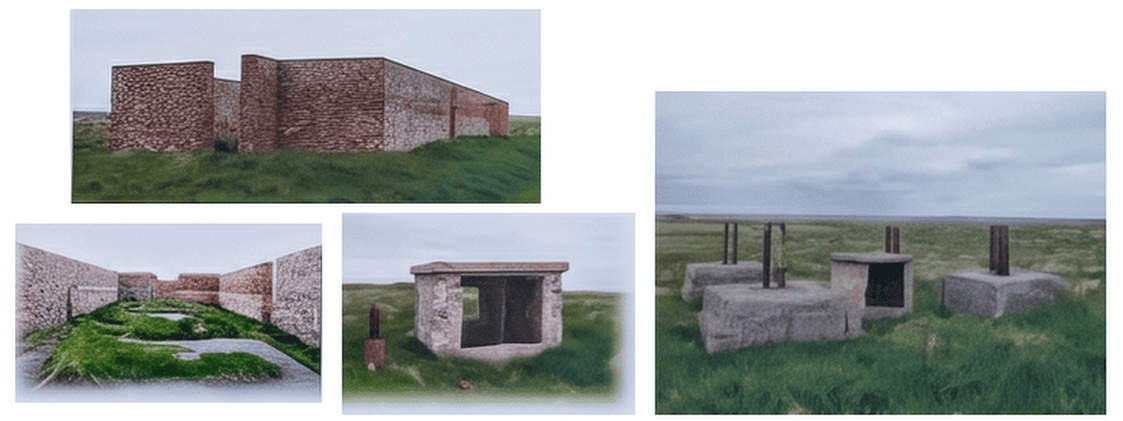
Remnants of brick-built structures on the hill, are connected to the nuclear monitoring station and the garrison once based here, it was built in 1959, but only it’s roofless walls are still standing today. Nearby, just the ruined footprint of an old dwelling overlooking the harbour can be found.
Taken together, these features highlight Ward Hill not just as a scenic rise above Cruden Bay, but as a vantage point woven into the national fabric of defence and watchkeeping — a quiet sentinel through both world wars and the Cold War.

David Brown, Formartine Country Side Ranger and poet
Ward Hill
(By David Brown)
Above Port Erroll stands Ward Hill, exposed.
We soon forget. The Hill remembers more;
When sister Norway’s shelf fell in the sea,
The silence after tidal wave’s great roar.
Yet further back in time, advancing weight
Of mile deep ice, a frozen tombstone’s sprawl.
Then melting trickle streams, eventual retreat.
This bastion of cliff and rock saw Danes;
For just one day it hears the fighting cries,
Briefly the sea foam turns a little pink.
Then peace, a pasture where goats graze and chew,
A writer looks far out to sea and dreams,
A mill for corn along the Watter’s Mou’,
The golf course on the Hill, as if had never been.
Bare hill, and barer still its concrete blocks
And oblong squares of roofless worn red bricks;
A Cold War castle’s radar vigilance,
Assured destruction’s early warning drill,
Here stood a radio mast’s high-tech surveillance.
Warheads remain but not the Cold War chill;
Long gone the garrison encamped upon the Hill.
And all around the eastern side’s hard edge,
The rushing sound of swelling wind and wave,
Relentless beat that takes its rolling time;
Booms hard and loud or easing to a sough
But ceaseless ever, a wayward, reeling knock
That’s spelling out in chant what’s coming down;
The waves are but an echo from the stars’ dark place.
The Hill Remembers
The poem ‘Ward Hill’ was written by former Formartine Country Side Ranger and poet, David Brown, ‘The Hill Remembers’ is Cruden Bay Life’s interpitation of his work, and we are grateful for his permission to share and adapt his wonderful words.
Tracing Port Erroll’s Silent Sentinels
Perched high above the waves on Ward Hill, Port Erroll’s quiet coastline holds the memories of Britain’s most intense 20th-century conflicts. To bring this hidden history to life, the Port Erroll Heritage Group has erected this particular one, amongst a series of Information Notice Boards around the village, inviting visitors to step back in time.
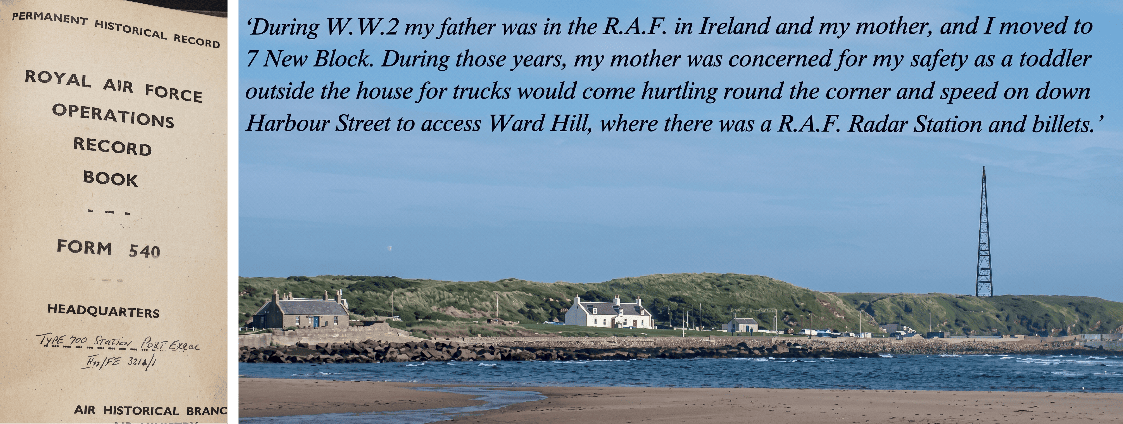
During World War II, Ward Hill served as an Air Ministry Experimental Station (Type 700). In 1944, it operated as a vital SS LORAN (Sky-wave Synchronised Long Range Navigation) Master Station paired with Tunisia. Sending night-time signals across thousands of miles, it guided allied bombers on long-range missions. Local RAF personnel lived on-site in Nissen huts, complete with a study, library, and maps tracking the war fronts—while supply trucks hurtled down Harbour Street, startling local families.
As the World War gave way to the Cold War, Ward Hill’s strategic importance evolved. Between 1959 and 1991, it housed a United Kingdom Warning and Monitoring Organisation (UKWMO) post. Staffed by the Royal Observer Corps, the underground bunker stood ready to detect nuclear detonations, track radioactive fallout alongside the Met Office, and sound public warnings.
Today, Ward Hill retains the remnants of these military installations alongside network wartime trenches. As you explore these historic structures, please tread carefully along the steep banks and slippery clifftops—and take a moment to reflect on Port Erroll’s pivotal role in national defence.

Port Erroll U.K.W.M.O. Post
1959–1991
In 1957, the United Kingdom Warning and Monitoring Organisation (UKWMO) was established under Home Office control. It was intended that the UKWMO would provide both civil and military authorities in the UK with essential information during a nuclear attack, with the Royal Observer Corps (ROC) providing primary data on the position and magnitude of atomic weapons detonated during any such attack. This data would be used by the UKWMO, in conjunction with weather information provided by the Meteorological Office, to produce a forecast of radioactive fallout. Fallout would be monitored as and where it occurred, with its actual location and strength mapped using data obtained from instrumentation at ROC posts. Such information when combined with ROCMet, (data concerning actual wind speed and direction obtained from cluster Master Posts equipped with wind anemometers and other basic meteorological instruments), would permit the dissemination of accurate forecasts predicting the distribution and strength of nuclear fallout.
Ward Hill
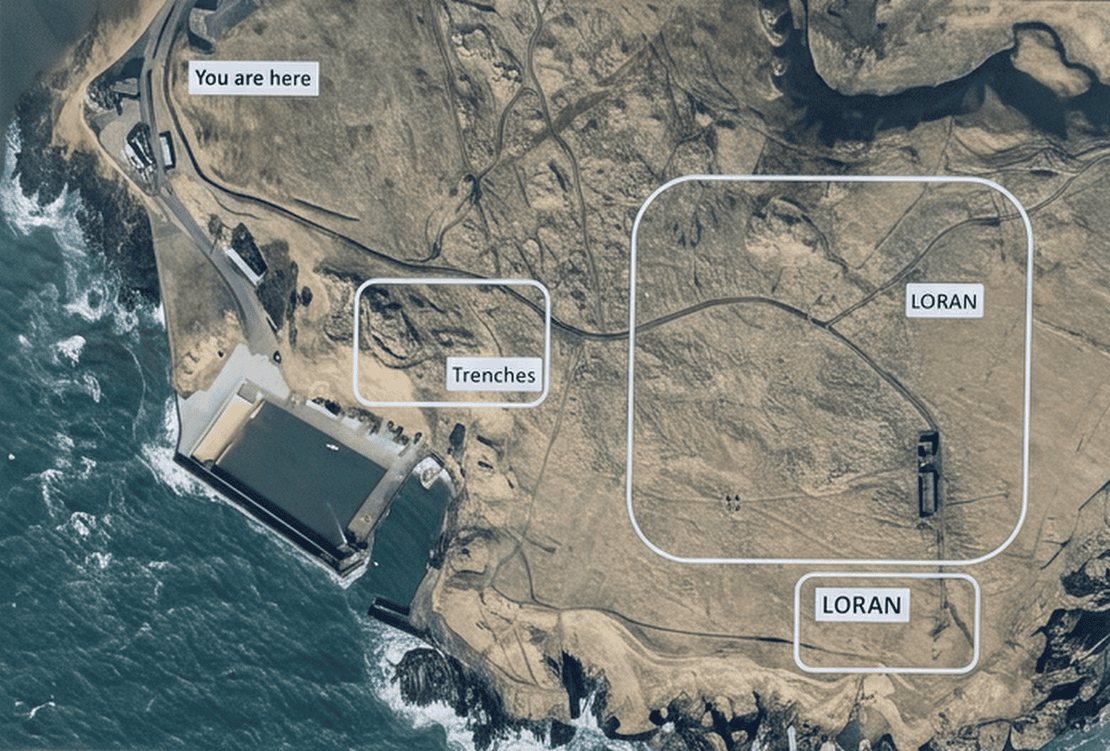
On top of Ward Hill, you will see some old structures. These are a cold war era nuclear monitoring post and the remains of a WW2 LORAN station. Above the harbour is a network of wartime trenches.
Port Erroll SS LORAN Station
Air Ministry Experimental Station type 700
1944
SS LORAN stood for Sky-wave Synchronised LOng Range Avigation. It only worked at night and it was found that by using long base lines between Master and Slave stations, great ranges could be achieved. Port Erroll was a Master Station and was associated with a Slave Station at Bizerta in Tunisia. The US Coastguard had reports of ships at sea receiving useable sky wave fixes 2 to 3,000 miles from baselines using this technique. The system was obviously very useful for long range night-time bombing missions.


This area of the coast contains natural hazards, i.e. steep banks, holes and slippery clifftop grass. Do not put yourself or others at risk
Port Erroll Heritage Group 2025

Cruden Bay Royal Observer Corps (ROC) monitoring post
Located on a mound in a square compound on a headland at Port Erroll in Aberdeenshire, often referred to as Ward Hill, the Cruden Bay Royal Observer Corps (ROC) monitoring post was a silent subterranean sentinel of the Cold War. Opened in 1959 and operated until its closure in 1991, this station was part of the wider United Kingdom Warning and Monitoring Organisation (UKWMO) network.
The presence of a dome and mast bracket on its surface ventilation shaft indicates that Cruden Bay was designated as a master post within its local communications cluster. During a strike, if landline communications to Aberdeen’s Group 29 Headquarters failed, Cruden Bay’s crew was responsible for collecting data from nearby posts and radioing readings to Group Control via a backup VHF radio.
The physical reality for the three observers stationed here was bleak. Accessed via a 20-foot vertical ladder, the underground bunker consisted of a tiny 7ft by 16ft concrete chamber. Conditions were incredibly primitive, lacking running water, gas, and mains electricity. Volunteers had to live and work in these cold, damp quarters for up to three weeks. They were tasked with operating specialized instruments, including a Bomb Power Indicator to measure blast overpressure, a Ground Zero Indicator pinhole camera to locate nuclear bursts, and a Fixed Survey Meter to monitor radiation. Additionally, they maintained public warning devices, including a hand-operated siren and explosive maroons to alert locals of impending danger or fallout.
Following the end of the Cold War and the ROC’s stand-down, the post fell into disuse. By 2001, the underground chamber was vandalized and its furniture smashed. By 2007, it had suffered severe internal fire damage. Today, all that remains of this once-vital station are flaking khaki paint and missing louvres, leaving it a silent, rusting monument to a bygone era of nuclear tension.

A Walk to Remember: Route from Castle Woods to the Harbour
This popular circular walk begins in the tranquil setting of Castle Woods, nestled on the edge of Cruden Bay. Here, beneath the leafy canopy of birch, oak, and Scots pine, the trail meanders through a piece of Scotland’s ecological past — one of the few remaining eastern remnants of native woodland. Birds flit among the branches and the earthy scent of moss and leaves creates an atmosphere of peaceful seclusion, perfect for easing into the walk.
As you follow the gently rising trail, the trees gradually thin out, revealing the open grasslands of Ward Hill. The change in scenery is striking: from shaded forest paths to the wide, airy openness of the hillside. Though called a hill, Ward Hill is modest in height, with a gentle ascent of around 50 feet from the woodland floor or nearby village streets. The well-maintained paths make it accessible for most walkers, including families and those seeking a leisurely stroll.
At the summit, you’re rewarded with sweeping views: the glimmering expanse of the North Sea to the east, the red-roofed cottages of Cruden Bay below, and the dramatic cliffs to the north, where the haunting silhouette of Slains Castle rises above the coastline. The breeze is often fresh here, and the sense of space invigorating.
The descent leads you down through grassy lanes and quiet village roads toward the quaint Port Erroll Harbour. With its bobbing fishing boats, stone quay, and occasional seal lounging on the rocks, the harbour offers a picturesque and fitting end to the walk. You might encounter local fishers mending nets or simply enjoy the salty air and sea views.
At a gentle pace, the entire loop takes less than an hour, a little longer if you pause to take in the natural beauty along the way.
Looking Forward: Conservation and Community Enjoyment
Ward Hill’s charm lies in its simplicity — an open, welcoming space shaped by nature and sustained by community. With such accessible paths and gentle elevation, it remains a rare and democratic green space: one that requires no special effort to enjoy, yet offers remarkable rewards in return.
Local efforts to maintain and preserve the area have quietly ensured its continued availability to the public. Castle Woods, as an ancient woodland, benefits from a growing awareness of its ecological importance. When combined with Ward Hill and the surrounding coastal paths, the area forms a vital natural corridor — rich in wildlife, heritage, and recreational value.
Future initiatives may see further efforts to protect the natural diversity here, encourage responsible tourism, and perhaps formalise its role in local heritage trails. As more visitors discover the hidden gems of Cruden Bay, Ward Hill remains an essential stop — one that connects sea, sky, and story.
For the local community, it is a familiar friend. For visitors, it is a quiet discovery — a place to slow down, take a deep breath, and look outward over a landscape that has always kept watch.
Visiting Tips and Access to the Ward Hill
Parking and Access Tips:
For those arriving by car, parking is available in the public car park beside the old Congregational Church, signposted from the main road on the north side of Cruden Bay. This spot offers easy access to Castle Woods, which forms the starting point for many Ward Hill circular walks. Additional parking is available near the Trygve Gran memorial by the Dardinels. Street parking is also possible along Harbour Street, but please park with care — many local homes rely on this shared space. Avoid blocking access to the narrow lanes off Harbour Street, including Hay, Ward, Green, and Hill Streets.
The Harbour Dunes Café has a dedicated parking area for customers during business hours. Please use this courteously and avoid parking there after hours. As always, respect the working nature of the harbour and ensure clear passage for emergency vehicles at all times.
Principal Sources
- Local historical research and interpretation relating to Ward Hill, its position above Port Erroll Harbour, its relationship with Castle Woods, Slains Castle and the wider Cruden Bay landscape.
- Historical and community knowledge relating to the role of Ward Hill as a local viewpoint, walking route and shared village landscape for generations of residents and visitors.
- Research into the Royal Observer Corps and Cold War monitoring network, including the former LORAN / nuclear early warning facility located on Ward Hill and the wider history of Britain’s Cold War defence infrastructure.
- Environmental and natural history references relating to the flora, fauna, coastal views and relationship between Ward Hill, Castle Woods and the surrounding Buchan landscape.
- Local knowledge and community contributions relating to the changing use of Ward Hill, including memories of childhood, recreation, walking routes and village life.
- David Brown, former Formartine Countryside Ranger and poet, whose poem Ward Hill provides a personal and reflective interpretation of the landscape, its history and the memories held within the hill. Cruden Bay Life is grateful for his permission to share and adapt his work through The Hill Remembers.
- Original written content, photography, music composition and digital storytelling created by Cruden Bay Life to explore Ward Hill as both a physical place and a repository of local memory.
Image References
Unless otherwise stated, images featured in this article are sourced from contemporary photography, community contributions or original creative material produced by Cruden Bay Life.
Ward Hill is a landscape where many layers of history exist together. From the open views across Port Erroll Harbour and the North Sea to the traces of military activity and the paths used by generations of walkers, the images in this article aim to capture both the beauty of the location and the stories embedded within it.
Contemporary photography helps document the changing character of the hill through different seasons, weather conditions and viewpoints, while creative interpretation may be used to explore aspects of the past where no photographic record exists.
Where digital artwork, animation or other creative interpretation is used, these images are intended to enhance storytelling and atmosphere rather than represent exact historical records.
We are grateful to photographers, historians, local contributors and community members whose images, memories and knowledge help preserve the continuing story of Ward Hill.
About Cruden Bay Life
Cruden Bay Life celebrates the history, landscapes, people and stories that make Cruden Bay and the surrounding Buchan coast unique.
Every article begins with curiosity, research and a desire to understand the places and people that have shaped this remarkable coastline. Some stories are discovered through archives, historical records and published sources, while others are preserved through personal memories, local knowledge, creative interpretation and the voices of those who know these places best.
Ward Hill represents one of the clearest examples of how a familiar landscape can hold many different stories. To some, it is simply a favourite walking route with spectacular views. To others, it is a place of childhood memories, wartime and Cold War history, natural beauty and quiet reflection. Its story reminds us that heritage is not always found in grand buildings or dramatic events — sometimes it is found in the everyday places that generations of people return to again and again.
Alongside traditional research methods, we make thoughtful use of modern creative tools—including artificial intelligence—to assist with research, editing, illustration, music composition and visual presentation. These tools allow us to explore new ways of sharing local stories, while historical evidence, editorial judgement and respect for our contributors remain central to everything we publish.
Researched by people. Enhanced with modern creative tools. Inspired by history. Created for today’s audiences.
Learn more about how we research and create our stories. Click here →