Slains Castle
Clifftop Ruins with a Haunting BeautyAll images used on this website are subject to copyright
Slains Castle
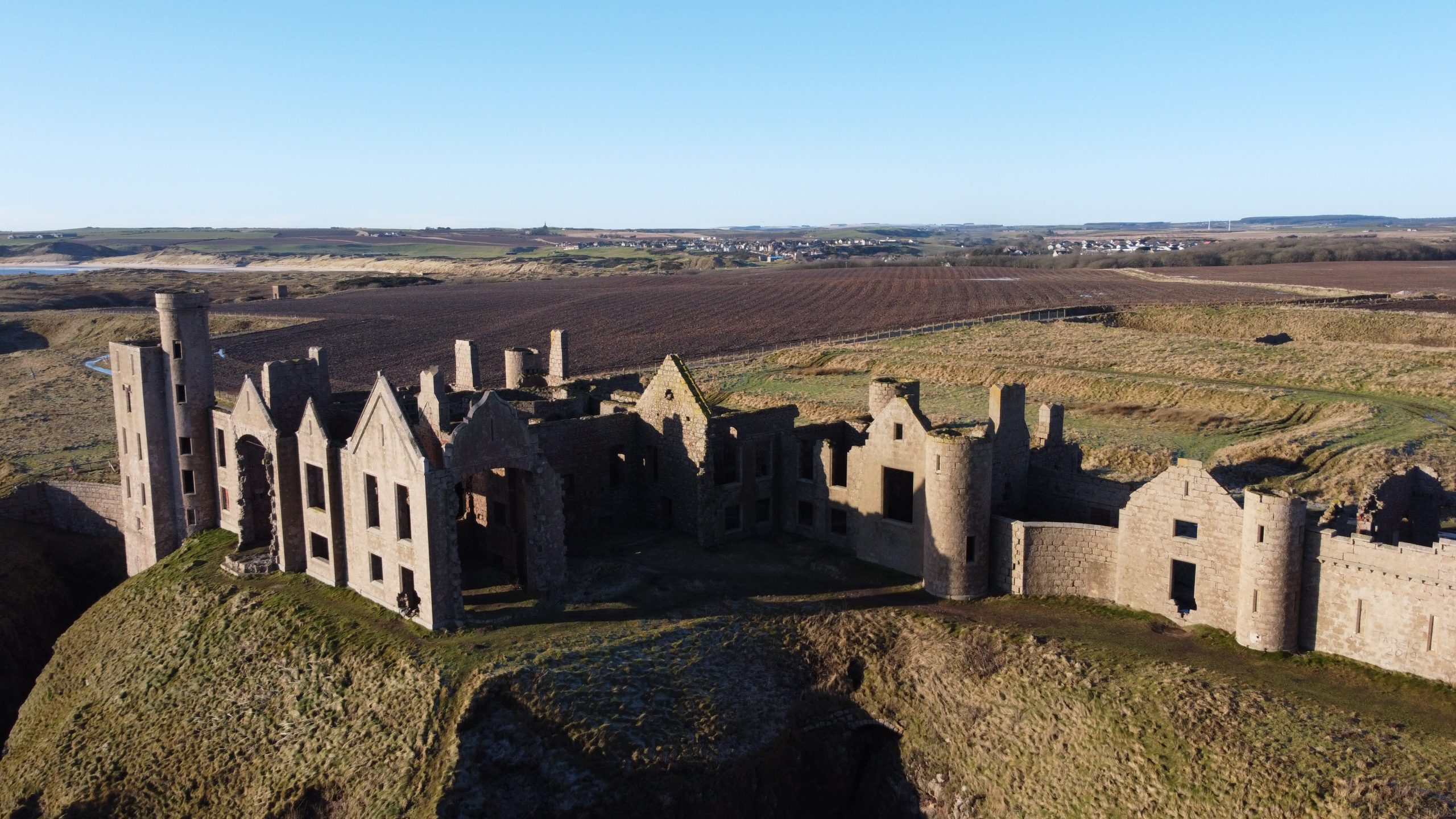
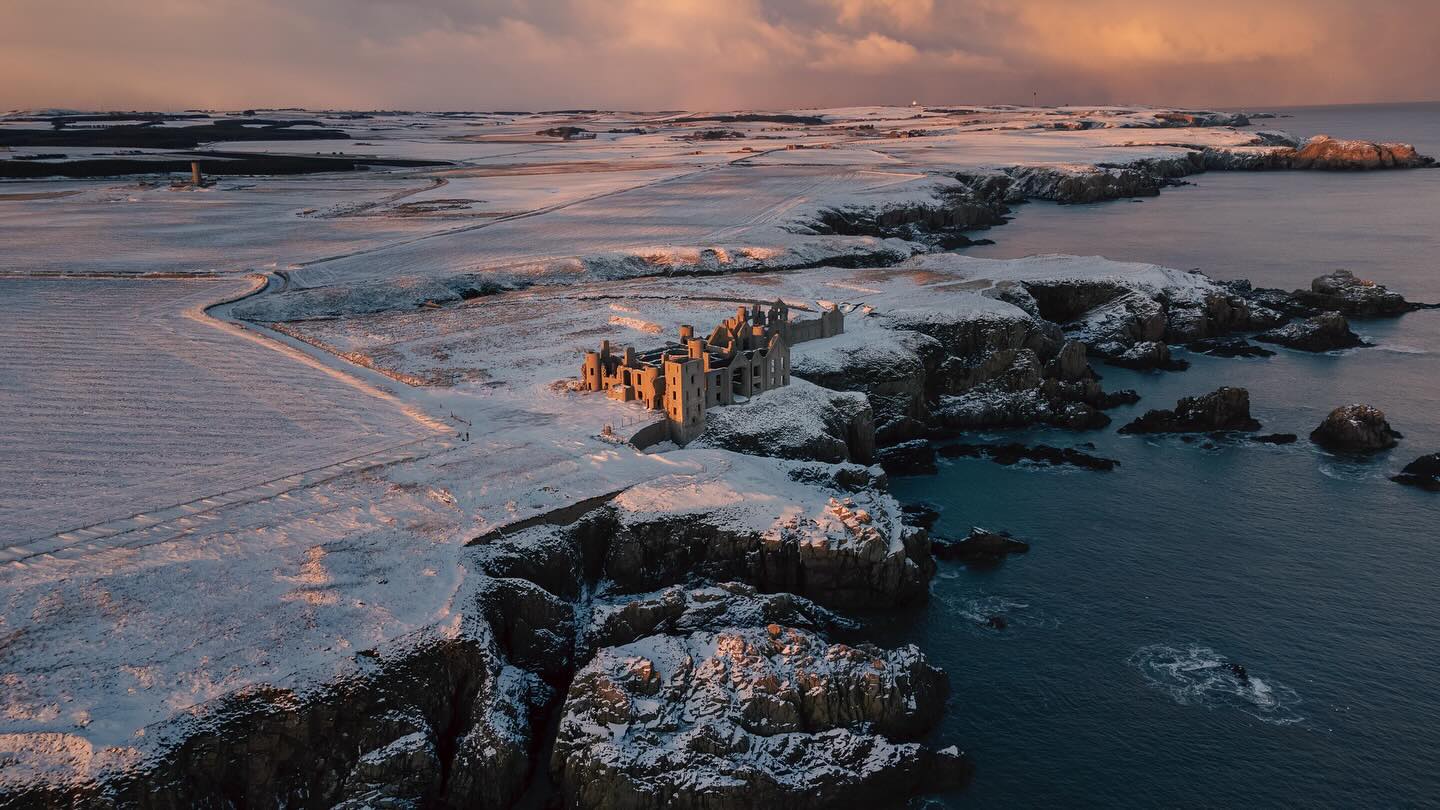
Perched dramatically on the edge of sheer sea cliffs just northeast of Cruden Bay village lies Slains Castle – a breathtaking, part-ruined mansion steeped in history, legend, and local lore. Its atmospheric presence, panoramic views, and ties to Bram Stoker’s Dracula make it one of the most iconic landmarks in Aberdeenshire.
A Castle Rich in History
Originally built in the late 16th century by the Earl of Erroll, Slains Castle was extensively remodelled in the 1830s into a grand Scottish baronial residence. Though it once hosted royalty and aristocracy, the castle was abandoned in the 1920s and later had its roof removed to avoid taxes. Today, its weathered stone walls and open chambers remain, creating a uniquely haunting setting that has inspired writers and artists for over a century.
Most famously, Bram Stoker visited Cruden Bay in the 1890s and is believed to have drawn inspiration from Slains Castle when creating Dracula’s Transylvanian fortress.
“The Ruined Walls of Slains”
The Ruined Walls of Slains is an original composition by Cruden Bay Life, created especially to accompany our page dedicated to the iconic Slains Castle. This hauntingly beautiful piece captures the mystery, history, and rugged splendour of the castle’s clifftop ruins, long said to have inspired Bram Stoker’s Dracula. The music blends atmospheric soundscapes with emotive melodies, reflecting both the grandeur and melancholy of this dramatic location on the Aberdeenshire coast.
The accompanying video features spectacular drone footage generously provided by James Duncan, Dawn-Marie Armour, and Alex Sniezek, whose stunning aerial views bring new perspective to this legendary site. Together, the music and imagery invite you to experience Slains Castle as never before — through sound, sight, and imagination.
Listen, watch, and be transported by The Ruined Walls of Slains.
A Potted History of Slains Castle
The Haunting Beauty of Slains Castle
Perched dramatically on the windswept cliffs of the Buchan coast in Aberdeenshire, the ruins of Slains Castle possess a haunting beauty that has captivated visitors for centuries. The story of the castle is actually a tale of two fortresses. The original stronghold, Old Slains, was located a few miles south near Collieston and was destroyed by King James VI in 1594. This was in direct retribution for the treasonous Catholic rebellion led by its owner, Francis Hay, the 9th Earl of Erroll.
Upon his return from exile around 1597, rather than rebuilding the shattered old fortress, the Earl chose to construct a new courtyard and tower house on a dramatic rocky peninsula further north. Over the next three centuries, the Hay family continually expanded their spectacular coastal seat. In 1664, a classical gallery was added around the courtyard, and in 1836, the 18th Earl commissioned the prominent Aberdeen architect John Smith to completely remodel the building. It was transformed into a magnificent Scots Baronial mansion faced with elegant pink granite, boasting grand bay windows and elaborate chimneys.
During its heyday, the castle was a centre of high-stakes politics, Jacobite espionage, and grand society, hosting notable figures like Dr. Samuel Johnson and James Boswell during their 1773 tour of Scotland. Most famously, the brooding atmosphere of the castle profoundly inspired the Irish author Bram Stoker. Holidaying in nearby Cruden Bay in the 1890s, Stoker used the castle’s sheer cliff drops and its distinctive windowless octagonal hall as a direct blueprint for Count Dracula’s Transylvanian fortress.
Tragically, the immense cost of the castle’s upkeep, compounded by an agricultural recession and heavy inheritance taxes, forced the 20th Earl of Erroll to sell the estate in 1916, severing a 300-year connection between the family and the site. By 1925, the roof and valuable interior fittings had been deliberately removed and sold by a demolition firm to avoid paying property taxes, leaving the building exposed to the fierce North Sea elements. Today, its weathered, roofless walls remain one of Scotland’s most evocative ruins.
Read on to discover the stories of the fascinating characters whose lives were intertwined with this magnificent coastal fortress…
Josslyn Victor Hay: The Exiled Earl and the Happy Valley Murder (1901-1941)
The story of Josslyn Victor Hay, the 22nd Earl of Erroll, reads less like traditional aristocratic history and more like a dark, scandalous thriller. Born in 1901, Josslyn inherited a title weighed down by the financial ruin of his ancestors. The magnificent family seat of Slains Castle had been sold off by his grandfather, the 20th Earl, in 1916 due to mounting debts, severing a three-hundred-year bond between the Hay family and their cliffside fortress.
With the ancestral home gone, Josslyn forged a notorious path of his own. He relocated to Kenya in the 1920s and became a central figure in the infamous “Happy Valley set”, a group of wealthy expatriates legendary for their hedonistic lifestyle of heavy drinking, drug use, and rampant adultery. His political life was equally controversial; he openly sympathized with fascist ideologies and joined the British Union of Fascists in 1934.
Josslyn’s turbulent life came to a violent and mysterious end on January 24, 1941. He was found shot dead in his Buick on a road outside Nairobi, shortly after leaving the home of Lady Diana Broughton, a married woman with whom he was having a highly publicized affair. Though Diana’s husband was tried for the crime, he was acquitted, leaving the murder of the 22nd Earl of Erroll officially unsolved to this day. His death marked the tragic, glamorous end of an era, passing the earldom to his 15-year-old daughter, Diana.
The Final Guardian of Slains: Charles Gore Hay and the Legacy of the Hay Clan (1852–1927)
Charles Gore Hay, the 20th Earl of Erroll, stands as a poignant figure in Scottish history, representing the twilight of the Hay Clan’s centuries-long dominion over Slains Castle. The Hay family’s noble lineage is incredibly deep-rooted, tracing back to the era of Robert the Bruce, who historically granted the family their lands along with the prestigious, hereditary title of Lord High Constable of Scotland.
While the accompanying portrait captures the 20th Earl projecting quiet authority in the full ceremonial regalia of his noble station, his true historical significance goes far beyond his titles and attire. He holds the bittersweet distinction of being the very last member of the Hay Clan to actually reside at their magnificent cliffside ancestral seat.
Over the centuries, the Hay family’s formidable estate was known to host a variety of distinguished guests. In earlier generations, Slains Castle notably entertained the famous literary duo Samuel Johnson and James Boswell during their 1773 tour of Scotland. Later, during the tenure of Charles Gore Hay in the 1890s, the castle and its atmospheric coastal setting famously captivated the Irish author Bram Stoker. Stoker frequently vacationed in the nearby village of Cruden Bay and was known to walk the grounds, with the castle’s dramatic, octagonal hall widely believed to have served as a direct inspiration for the fortress in his classic novel, Dracula.
However, the grandeur of the Hay family’s tenure at Slains was coming to an end. Following Charles Gore Hay’s departure, the property was sold, permanently severing the clan’s physical tie to the estate. The castle subsequently changed hands among three different owners, yet tragically, none of them ever took up residence within its walls. Left abandoned, the once-great fortress was ultimately surrendered to the elements and eventual demolition, closing the book on an era of great Scottish nobility.
Bram Stoker: The Birth of a Vampire on the Buchan Coast (1847–1912)
Backing up from the twentieth-century scandals of Josslyn Hay, we arrive in the late nineteenth century, when the rugged Buchan coast attracted a rather different sort of character: the Irish theatre manager and author, Bram Stoker. Seeking a retreat from his stressful responsibilities at the Lyceum Theatre in London, Stoker first came to the remote fishing village of Cruden Bay in the summer of 1892, beginning an annual holiday tradition that lasted until 1910. It was here, taking residence at the Kilmarnock Arms Hotel and later at nearby cottages, that he penned the early chapters of his gothic masterpiece, Dracula.
The forbidding ruins of Slains Castle cast a profound spell over the author’s imagination. Stoker would sit in the garden of Hilton Cottage, writing at a small table with the imposing fortress in full view. He was so captivated by the castle that its unique architectural features crept directly into his novel; the distinctive, windowless octagonal reception hall of Slains Castle provided the exact blueprint for the very room where the hapless Jonathan Harker first meets Count Dracula.
Stoker was an imposing figure himself, describing his own appearance in a letter to Walt Whitman as standing six feet two inches tall, heavily built, and possessing a heavy jaw, thick lips, a snub nose, and a large bump above his eyebrows. He masterfully translated his own intense physicality into the terrifying, commanding presence of his fictional vampire nobleman
Image created by Cruden Bay Life Read More →
A Royal Visit to Cruden Bay
On July 23, 1885, Princess Beatrice, the youngest of Queen Victoria’s children, married Prince Henry of Battenberg in a beautiful ceremony at Saint Mildred’s Church on the Isle of Wight. Following their summer wedding and a honeymoon at nearby Quarr Abbey House, the royal newlyweds journeyed north to the rugged Aberdeenshire coast.
On September 18, 1885, Beatrice and Henry arrived at the majestic Slains Castle for a two-night stay as the guests of Lord Erroll. Princess Beatrice was already familiar with the region’s charm, having previously visited nearby Aberdeen to officially open Duthie Park on September 27, 1883.
Slains Castle, the grand clifftop seat of the Earls of Erroll, offered the royal couple a dramatic and awe-inspiring retreat. Rebuilt and expanded over the centuries, the castle featured a large bow window that commanded striking, uninterrupted views over the crashing waves of the North Sea. Perched on the coastal cliffs near the village of Cruden Bay, the formidable fortress was steeped in a powerful, brooding atmosphere—the very same haunting coastal beauty that would famously inspire author Bram Stoker to write his gothic masterpiece Dracula just a decade later
William George Hay (1801–1846), and Elizabeth FitzClarence (1801–1856) : Royal Ties and Grand Illusions
Moving back to the early nineteenth century, the story of Slains Castle becomes deeply intertwined with the highest levels of the British monarchy through the marriage of William George Hay, the 18th Earl of Erroll, and Elizabeth FitzClarence. Born in 1801, Elizabeth brought a touch of royal scandal to the rugged Buchan coast, as she was the illegitimate daughter of King William IV and the celebrated comedic actress Dorothea Jordan.
The 18th Earl was a man of considerable ambition and status, serving as Lord Steward to Queen Victoria. Driven by a desire for an ancestral seat that matched his elevated societal standing and his wife’s royal parentage, William George embarked on a massive architectural project. In 1836, he hired the prominent Aberdeen-based architect John Smith to completely remodel New Slains Castle.
Under Smith’s direction, the structure was transformed from a coastal fortress into a grand nineteenth-century country house in the neo-Tudor and Scots Baronial styles. The castle was given elegant new facings of ashlar-dressed pink granite, alongside elaborate features like diamond chimney stacks, large bay windows, and an imposing new entrance porch flanked by octagonal buttresses. However, the sheer expense of reconstructing Slains Castle, coupled with a lavish lifestyle, placed a crushing financial strain on the Hay family’s fortunes. This magnificent granite mansion would permanently weigh on the family, eventually forcing his grandson to sell the beloved estate decades later.
James Hay, 15th Earl of Erroll: The Divided Family and the Giant’s Portrait
The story of James Hay, 15th Earl of Erroll, is a tragic tale of a family torn apart by civil war. Born James Boyd in 1726, he was the eldest son of the 4th Earl of Kilmarnock. During the 1745 Jacobite Rebellion, his father took up arms for Prince Charles Edward Stuart, while James fought for the Hanoverian government. In the aftermath of the Jacobite defeat, his father was captured and eventually beheaded for treason on Tower Hill in 1746.
Despite his father’s attainder, James inherited the Kilmarnock estates, and in 1758, he succeeded his great-aunt, Mary Hay, to become the 15th Earl of Erroll. Following family tradition, he changed his surname to Hay and took up the hereditary office of Lord High Constable of Scotland. Renowned for his massive height and commanding physical presence, he was likened by Dr. Samuel Johnson to the “Great Sarpedon”.
In 1762, the celebrated artist Sir Joshua Reynolds painted a magnificent full-length portrait of the Earl in his lavish coronation robes, his right hand firmly clasping the Constable’s baton. Hanging proudly in the dining room of Slains Castle, this masterpiece served as a powerful visual assertion of loyalty to the Crown. The painting visually erased the trauma of his father’s execution, ensuring that visitors—including Samuel Johnson and James Boswell in 1773—saw him not as the son of a traitor, but as the ultimate guardian of the British constitution.
Mary Hay (Died in 1758), 14th Countess of Erroll: The Jacobite Secret Agent
Mary Hay, the 14th Countess of Erroll, was a formidable woman who succeeded her brother in 1717 to become the 18th Hereditary Lord High Constable of Scotland. Beyond her fierce personal reputation, Mary was a dedicated secret agent for the exiled Stuart court.
Operating from the dramatic, isolated cliffs of the Buchan coast, the “Jacobite Countess” transformed New Slains Castle into the premier northern hub for Jacobite intelligence and smuggled supplies. She arranged a clever, tacit understanding with the naval officers patrolling the coast to signal her when their ships passed the castle. Once foreign agents landed safely at Slains, they were hurried inland to the safety of Delgatie Castle, utilizing its network of secret passages and hidey-holes.
To deliver covert correspondence across Aberdeenshire, Mary employed Jamie Fleeman, famously known as the “Laird of Udny’s fool”. Because of his perceived simple-mindedness, government troops completely ignored him, allowing him to roam the countryside unquestioned as a rebel messenger. When the 1745 Jacobite Rebellion erupted, Mary successfully recruited an entire regiment of local Buchan men to fight for Prince Charles Edward Stuart. Astonishingly, following the devastating defeat at Culloden, Mary’s strategic acumen allowed her to evade severe government reprisals; she successfully masked her leadership role and kept her vast estates intact until her death at Slains Castle in 1758.
Lady Anne Drummond (1656–c. 1719) : The Naturalist and the Invisible Ink Spymaster
Lady Anne Drummond, Countess of Erroll, led an extraordinary and highly dangerous double life. To the polite world, she was a pioneering seventeenth-century naturalist who contributed texts and illustrations of local wildlife—such as the redwing and black-winged stilt—to Robert Sibbald’s 1684 collaborative natural history book, Scotia Illustrata. However, her keen intellect was also put to use in high-stakes treason.
As a fierce Jacobite loyalist, Anne transformed New Slains Castle into a clandestine “secret post office” and the premier northern hub for espionage. She served as a primary Scottish representative for the exiled Stuart court in France, coordinating a vast intelligence network. Anne managed these covert communications using encrypted messages disguised as routine household letters, often written in invisible ink made from lemon juice to evade detection by the authorities.
These secret missives were ingeniously smuggled across the sea to the continent, hidden within commercial shipments of Aberdeen salmon. Anne utilized Slains Castle’s isolated coastal position to safely host French envoys, twice receiving Colonel Nathaniel Hooke in 1705 and 1707. She even communicated with Hooke using linen signals hung in the castle’s seaward windows. Her intelligence gathering directly facilitated the 1708 Franco-Jacobite invasion attempt.
Francis Hay (1564–1631), 9th Earl of Erroll: The Catholic Rebel and the Fall of Old Slains
Stepping back to the turbulent late sixteenth century, the story of the Hay family takes a violent turn under Francis Hay, the 9th Earl of Erroll. After inheriting the title in 1585, Francis converted to Roman Catholicism and quickly emerged as a militant leader of Scotland’s Catholic faction. He engaged in a highly dangerous, treasonous conspiracy with King Philip II of Spain. Through the infamous “Spanish Blanks” plot of 1592, Erroll and his allies sought Spanish military intervention to unseat the Protestant Queen Elizabeth I of England and restore the Catholic faith in Scotland.
This religious defiance soon culminated in open rebellion. At the Battle of Glenlivet in 1594, Erroll and the Earl of Huntly successfully routed the king’s Protestant forces. During a fierce mounted cavalry charge, Francis was severely wounded in the leg by a MacLean arrow. However, the rebels’ victory was unsustainable. An enraged King James VI personally marched his royal army north and used heavy artillery to completely obliterate the family’s medieval stronghold, Old Slains Castle, leaving it in absolute ruins.
Forced to flee into exile, the wounded Earl eventually returned to Scotland in 1597. Rather than attempting the costly reconstruction of his shattered ancestral home, he laid the foundations for a fresh courtyard stronghold on a clifftop peninsula further north—the very building that would grow into the hauntingly iconic New Slains Castle
A Place of Wild Beauty and Inspiration
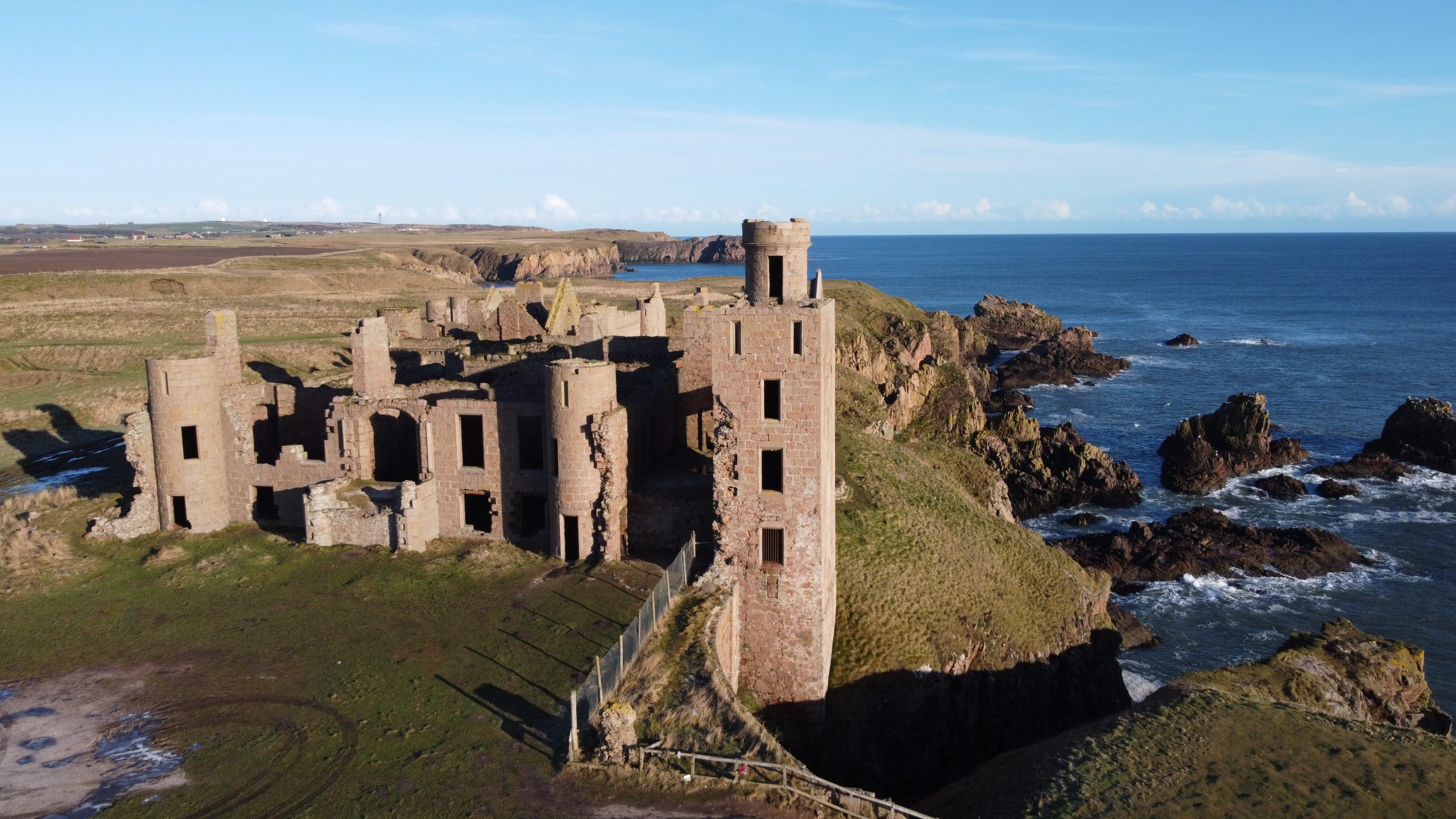
Slains Castle is more than just a ruin – it’s a place where history meets imagination, where nature reclaims grandeur, and where every visit offers a new perspective. On a bright, clear day, the expansive blue sky creates a striking contrast with the weathered stone walls, making it a favourite subject for landscape photographers. On misty evenings, the castle takes on an eerie, gothic quality – shadows drifting through its empty chambers, echoing its literary connections and haunting past.
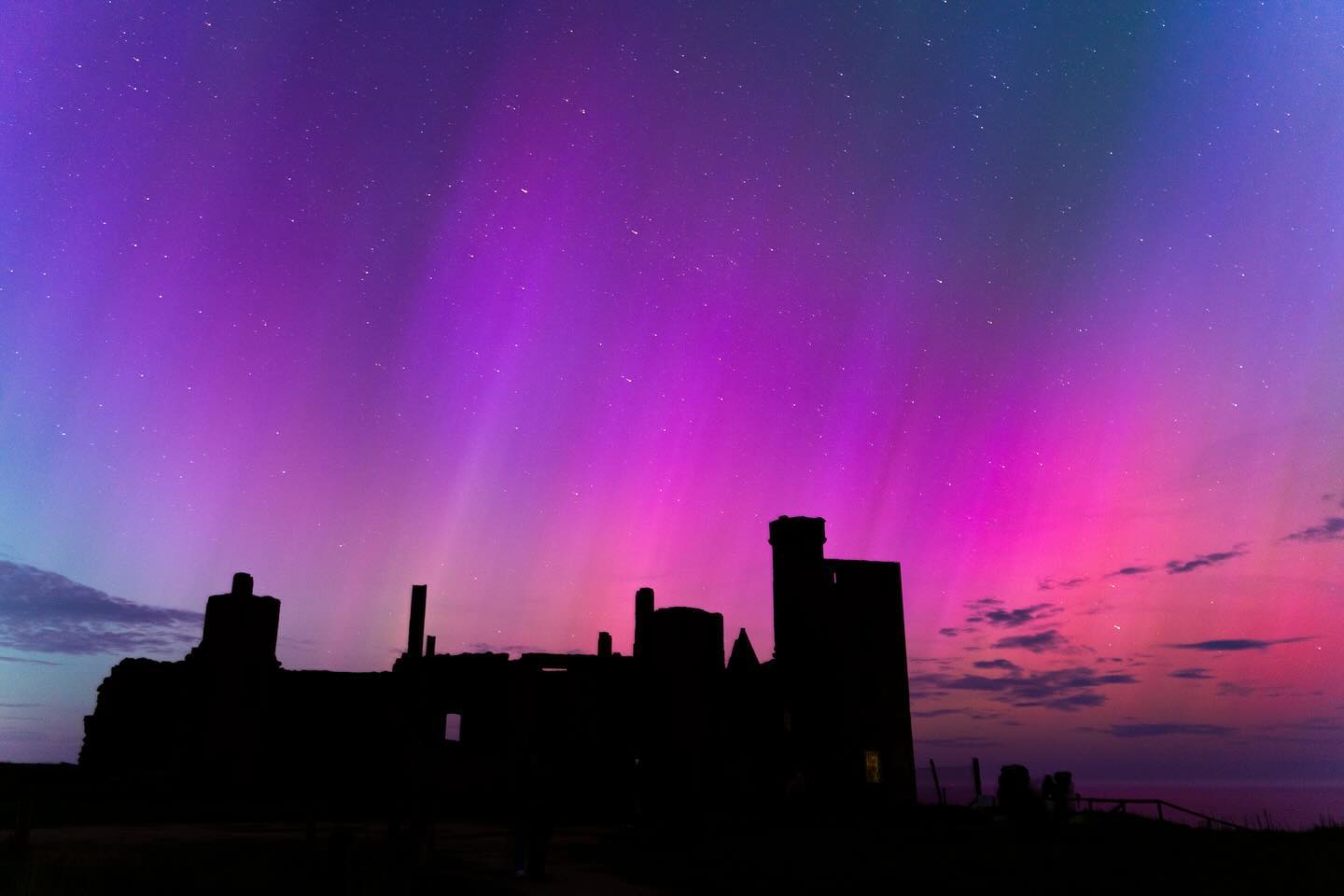
The image shown captures one of the most magical sights occasionally visible from the castle grounds: the Aurora Borealis, or Northern Lights. Cruden Bay’s dark northern skies and low light pollution provide the perfect conditions for spotting this rare natural phenomenon. When they appear, the dancing ribbons of green and violet light above the castle transform the landscape into something truly otherworldly.
Whether you’re a history buff, photographer, walker, or literary enthusiast, a visit to Slains Castle is an unforgettable part of the Cruden Bay experience – steeped in atmosphere, wonder, and the raw beauty of the northeast coast.
Safety and Accessibility
While exploring Slains Castle is a memorable experience, it’s important to take extreme care during your visit:
-
The castle is an unmaintained ruin – there are no barriers, safety rails, or signage inside.
-
Open drops and crumbling walls pose a serious risk, especially near the cliff edge.
-
Supervision is essential for children and pets, and the site is not suitable for those with limited mobility due to uneven ground and potential hazards.
-
In windy or wet weather, the cliffs and open rooms can become dangerous – avoid getting too close to the edge.
Despite these risks, for those who take appropriate caution, the castle offers an unparalleled vantage point to admire the North Sea coastline, nearby Dunbuy Rock, and wide stretches of sky and sea.
Getting to Slains Castle
Access to Slains Castle is via a well-trodden footpath that begins from the northern end of Cruden Bay. There are two main walking routes:
-
From the village, there is a carpark located in the heart of the village, next to the old Congregational Church. From there you will find access to the costal path which continues along the clifftop trail to the castle itself, a short walk of approx 1 mile. The route is scenic and straightforward but can be exposed and uneven in places.
-
From the A975 car park (between Cruden Bay and The Bullers of Buchan), a shorter, direct path leads between fields to the castle. Parking here is limited to approximately 10 spaces.
There is no car park at the castle itself, and vehicles should not attempt to drive beyond the A975 car park along the single track towards the castle, or onto farmland.
So, have you been paying attention?
What have you learned from our journey through the rise and fall of Slains Castle? From the dramatic destruction of the original fortress in 1594 and its rebirth on the cliffs, right through to its days harbouring Jacobite spies, inspiring Bram Stoker’s Dracula, and its eventual fate as a haunting roofless ruin, there is a lot of local history to uncover!
Why don’t you see how much you’ve remembered by taking part in the brand new Cruden Bay Life Quiz? Test your knowledge of our castle’s rich heritage and see if you are an ultimate local history buff.
Just click the button below to get started!
Principal Sources
- Historical research and architectural references relating to New Slains Castle, including its construction by the Hay family, Earls of Erroll, its later remodelling, abandonment and continuing presence on the Aberdeenshire coastline.
- Research relating to the Hay family, the Earls of Erroll and the wider social and political history connected with Slains Castle and the surrounding lands.
- Historical accounts and literary research relating to Bram Stoker’s visits to Cruden Bay, his time spent in the area and the long-established connection between Slains Castle, the local landscape and Dracula.
- Research and interpretation by Mike Shepherd and Dacre Stoker relating to Bram Stoker’s connection with Cruden Bay, Slains Castle and the inspiration behind his writing.
- Historical references relating to the development of the castle from a grand coastal residence to the atmospheric ruin visible today.
- Local historical knowledge and community contributions relating to Slains Castle, the surrounding coastline, walking routes and its importance within the identity of Cruden Bay.
- Contemporary photography, aerial footage and creative contributions used to showcase the castle’s dramatic setting and relationship with the North Sea landscape.
- Original written content, photography, video production and music composition created by Cruden Bay Life to celebrate the history, atmosphere and enduring mystery of Slains Castle.
Image References
Unless otherwise stated, images featured in this article are sourced from historical collections, contemporary photography, aerial footage provided by contributors or original creative material produced by Cruden Bay Life.
Slains Castle is a place where history, landscape and imagination come together. The images used throughout this article aim to capture not only the physical remains of the castle, but also the atmosphere created by its dramatic clifftop setting, changing light, surrounding coastline and connection with generations of stories.
Historical images and illustrations help provide context for the castle’s earlier life as a grand residence, while contemporary photography and aerial views reveal the scale, beauty and vulnerability of the ruins as they stand today.
Where digital artwork, animation or creative interpretation is used, these images are intended to enhance storytelling and atmosphere rather than represent exact historical records.
We are grateful to photographers, historians, archive holders and creative contributors whose images, knowledge and expertise help preserve and share the remarkable story of Slains Castle.
About Cruden Bay Life
Cruden Bay Life celebrates the history, landscapes, people and stories that make Cruden Bay and the surrounding Buchan coast unique.
Every article begins with curiosity, research and a desire to understand the places, events and people that have shaped this remarkable coastline. Some stories are discovered through archives, historical records and published sources, while others are preserved through local knowledge, photography, memories and the continuing relationship between communities and the places around them.
Slains Castle represents one of the clearest examples of how landscape and storytelling become intertwined. Its weathered walls tell the story of centuries of history, while its dramatic position above the North Sea has inspired artists, writers, photographers and visitors for generations. Its association with Bram Stoker and Dracula has given the castle a place in literary history, while its deeper significance remains rooted in the people and events that shaped its past.
Alongside traditional research methods, we make thoughtful use of modern creative tools—including artificial intelligence—to assist with research, editing, illustration, music composition and visual presentation. These tools allow us to explore new ways of sharing local stories, while historical evidence, editorial judgement and respect for our sources remain central to everything we publish.
Researched by people. Enhanced with modern creative tools. Inspired by history. Created for today’s audiences.
Learn more about how we research and create our stories. Click here →