Cruden Bay Railway Hotel
Introduction to the Cruden Bay Resort
Perched on the rugged Aberdeenshire coast, the story of the Cruden Bay Resort is a fascinating tale of Victorian ambition, unparalleled luxury, and eventual loss. Conceived by the Great North of Scotland Railway (GNSR) in the late 19th century, the resort was designed to be the “Brighton of Aberdeenshire,” a premier destination that would draw affluent tourists and golfers to the remote Scottish northeast. At the heart of this grand vision was the magnificent Cruden Bay Hotel, a sweeping baronial structure built from pink Peterhead granite, which offered guests the height of luxury when it officially opened in 1899.
To connect arriving passengers from the newly built Boddam branch railway line to the hotel doors, the GNSR constructed an electric tramway—notable for being one of the smallest and most northerly tramways in the British Isles. The resort attracted high-profile guests, including British prime ministers H. H. Asquith, David Lloyd George, and Winston Churchill, while the haunting local landscape famously inspired author Bram Stoker to write his Gothic masterpiece, Dracula.
However, despite its grandeur, the resort’s remote location and short tourist seasons plagued its financial viability from the start. Changing travel habits, the cessation of local passenger trains in 1932, and the devastating impact of military requisition during the Second World War sealed the hotel’s fate. By 1952, the opulent palace had been completely demolished. Yet, the GNSR’s grand vision was not entirely lost to history. Today, the legendary Cruden Bay Golf Club endures as a world-renowned links course, and the remnants of its unique tramway survive in preservation.


Image created by Cruden Bay Life
A Luxurious Vision Takes Shape Date: 1891–December 1898
Following the lucrative modernisation of its Palace Hotel in Aberdeen in 1891, the Great North of Scotland Railway (GNSR) set its sights on a highly ambitious new project. In October 1892, the company’s board decided to create a pioneering luxury destination on the Aberdeenshire coast, designed to offer sea bathing, a spa, and a championship golf course. This grand vision was to become the Cruden Bay Hotel, though it was initially provisionally named the Port Erroll Hotel.
Construction of the magnificent building began in 1897. Designed in a sweeping baronial style, the resort was built using distinctive pink Peterhead granite. The project was a massive financial undertaking; the building itself was estimated at £16,000, with an additional £5,000 allocated for lavish furnishings, heating, and modern hydraulic lifts. To ensure the utmost comfort, the GNSR also invested £1,200 to provide its own water and sewerage connections, and installed a dynamo to power early electric lighting alongside a large on-site laundry.
However, a logistical challenge remained. While the newly built Boddam branch railway line opened to traffic in August 1897, the Cruden Bay station was situated roughly a third of a mile away from the hotel site. Seeking a seamless travel experience for their elite guests, GNSR directors travelled to the Isle of Man in August 1898 to inspect its electric light railways. Inspired by this trip, the board approved a £9,005 plan in September 1898 to build a unique narrow-gauge electric tramway connecting the station directly to the hotel doors.
By late December 1898, the majestic pink granite structure was nearing completion, and a special train of “luxurious bogie saloons” brought directors and guests to marvel at the almost-finished resort. The stage was finally set for the grandest hotel in the northeast to open its doors to the world.
The Grand Opening (March–June 1899)
On March 1, 1899, the magnificent Cruden Bay Hotel finally opened its doors to the public. Built by the Great North of Scotland Railway using distinctive pink Peterhead granite, the luxurious 55-bedroom resort was a masterpiece of Victorian ambition, costing an estimated £22,000 to complete. Designed to be a high-end destination—often dubbed the “Brighton of Aberdeenshire”—it offered guests supreme comforts including hydraulic lifts, early electric lighting, tennis courts, and croquet lawns. To mark the opening, a two-day open golf tournament was held on the newly commissioned links course, which had been laid out by Old Tom Morris and Archie Simpson. The tournament was famously won by the legendary six-time Open Champion, Harry Vardon.
Just a few months later, in June 1899, the resort introduced its most unique feature: an electric tramway. Operating on a narrow 3ft 6.5in gauge track, the tramway connected the nearby railway station directly to the hotel’s front doors, ensuring an elegant and seamless arrival for weary elite travellers. Powered by the hotel’s own generating station, the two pristine tramcars were built at the railway company’s Kittybrewster workshops and sported a striking livery of purple lake and cream. Notably, the tramcars featured an elongated open platform specifically designed to carry passenger luggage and laundry baskets, solidifying the resort’s status as the ultimate, self-sufficient Victorian coastal retreat.

Image created by Cruden Bay Life
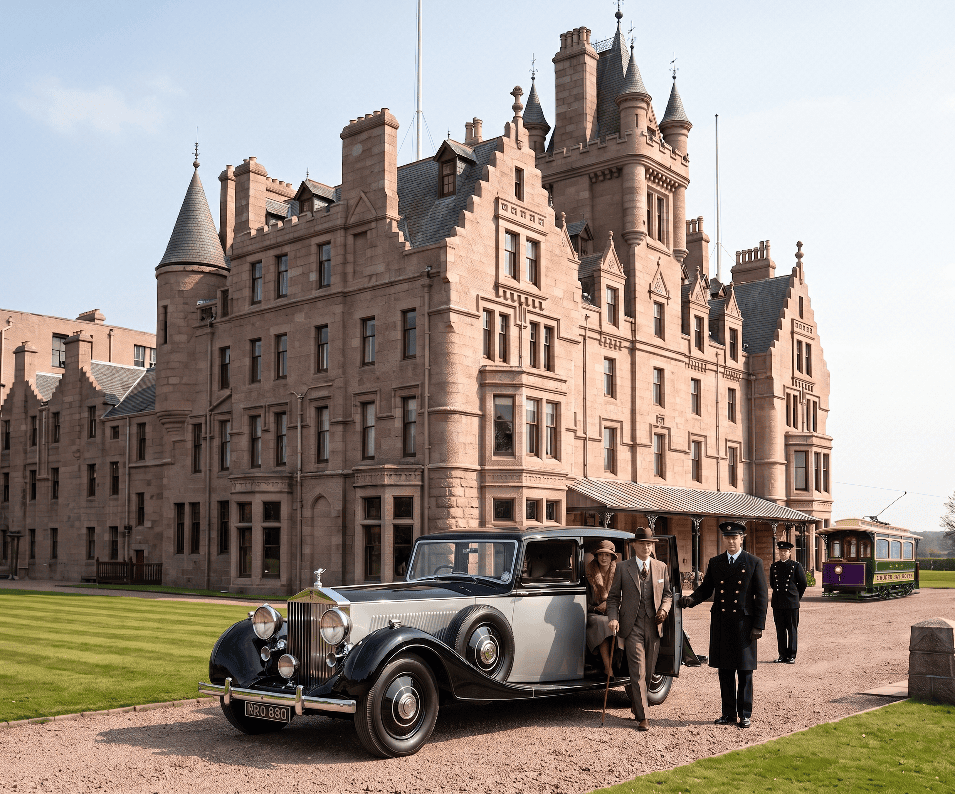
Image created by Cruden Bay Life
The End of Passenger Rail (October 31, 1932)
The Cruden Bay Resort was originally envisioned to be a luxurious, seamlessly connected haven, yet its remote location and the inherently short Scottish tourist season posed severe financial challenges right from the beginning. Despite the supreme comforts of the pink granite hotel and the world-class quality of its championship golf course, the Boddam branch railway line failed to attract the expected passenger numbers or the hoped-for local freight traffic.
Consequently, the railway company was forced to make drastic cuts. On October 31, 1932, passenger train services along the highly unprofitable Boddam branch line were permanently withdrawn. Simultaneously, the resort’s unique 3ft 6.5in gauge electric tramway ceased carrying hotel guests.
However, the elite clientele were not left to fend for themselves. To maintain the resort’s high standards of luxury, a chauffeur-driven Rolls-Royce motor car was introduced to collect wealthy patrons directly from Aberdeen station and transport them in style to the hotel doors. Meanwhile, the electric tramway was not entirely abandoned. Because the railway branch remained open for freight traffic, the tramway was relegated strictly to utility purposes, continuing to operate out of public sight to haul coal, goods, and laundry between the station and the hotel’s extensive laundering facilities. This pivotal shift marked the end of the grand, integrated Victorian rail-to-resort travel experience that the original founders had so ambitiously envisioned.
Requisition by the Army (1940–1945)
The outbreak of the Second World War brought an immediate and transformative change to the Cruden Bay Railway Hotel. The luxurious property was abruptly closed to civilian guests and officially requisitioned by the military authorities to support national wartime defence efforts. Under army control, the opulent coastal building was repurposed to serve as an intensive field training centre and operational barracks, primarily accommodating troops from the renowned Gordon Highlanders.
Throughout the prolonged war years, the hotel’s elegant rooms, expansive corridors, and manicured grounds were fully given over to rigorous troop exercises, military quartering, and constant wartime activity. The daily wear and heavy footfall of hundreds of soldiers stationed within the complex exerted a severe toll on the fine Victorian furnishings, ornate interior finishes, structural fabric, and surrounding estate. What had once functioned as a peaceful and fashionable destination for holidaymakers was wholly subordinated to the practical demands, administrative needs, and physical strains of wartime service.
When the military authorities concluded their wartime operations and the army finally vacated the requisitioned premises in the autumn of 1945, the railway company finally regained official possession of their property. However, the prolonged years of continuous military occupation and relentless troop usage had inflicted immense structural and cosmetic damage across the entire site. Upon inspecting the complex, the company found that their once-magnificent luxury railway hotel had ultimately been left in an utterly battered, neglected, and severely dilapidated state.

Image created by Cruden Bay Life

Demolition (1947)
A Midnight Rescue (July 1950)
After the military vacated the Cruden Bay Hotel following the Second World War, the property was left in a heavily dilapidated state. The railway company decided to cut its losses and sold the entire site to the demolition contractor Adams & Sons. After the hotel was meticulously asset-stripped for its lead, stone, and slates, the contractors were left holding the spectacular golf course. Shockingly, the land was at imminent risk of being sold off and converted into sheep farming land, which would have erased the area’s rich golfing heritage forever.
Enter Quintin Murray, a “colourful” Aberdeen stockbroker, who his own solicitor joked would have been a pirate had he lived a century earlier. In July 1950, upon learning of the agricultural plans for the golf course, Murray arranged a meeting with Jock Comrie, the acting agent for Adams & Sons. The two men met at the local Kilmarnock Arms pub, where they had a chat and eventually shook hands on a deal at 2:00 AM.
Wasting no time, Murray used the pub’s telephone to call John Glennie, a Peterhead solicitor, who immediately drove down to Cruden Bay in the middle of the night. There and then, Murray wrote a cheque for £2,750 to acquire the course and its land. This dramatic, late-night intervention successfully saved the Cruden Bay golf course by the skin of its teeth, preserving its championship links for future generations to enjoy.

Image created by Cruden Bay Life
The Legacy Lives On: Trams and Tees (1988–Present)
While the grand Cruden Bay Hotel was completely dismantled by 1952, the Great North of Scotland Railway’s ambitious Victorian vision is far from forgotten. Today, the resort’s legacy proudly lives on through two remarkable survivors: its world-renowned championship golf course and a meticulously restored electric tramcar.
The Cruden Bay Golf Club continues to draw players from around the globe, maintaining its status as a premier links destination. Ranked highly among the top courses in Great Britain and Ireland, the club boasts a strong international standing, even forming reciprocal relationships with courses as far away as Australia and the United States. To serve this growing membership, a modern clubhouse was officially opened in 1998 by Sir Michael Bonallack. Perched on an elevated bank, its panoramic windows offer breathtaking views over the pristine duneland and the North Sea, ensuring the spectacular coastal setting remains the star of the show.
Meanwhile, a fascinating piece of the resort’s unique transport history was also rescued from obscurity. After the tramway closed to passengers and was later requisitioned by the military, the two original tramcar bodies, which had operated since 1899, were sold off and repurposed as a garden shed and a summer house. Fortunately, both were saved for preservation in 1988. Experts meticulously combined the best surviving parts of the two vehicles to resurrect a single, pristine tram. Painted in its original Great North of Scotland Railway livery of purple lake and cream, the restored tramcar is now proudly displayed at the Grampian Transport Museum in Alford. It serves as a vivid reminder of what was once the most northerly tramway in the British Isles.

Image courtesy of Alford Transport Museum
So, have you been paying attention?
Principal Sources
- This work makes use of historical research and discoveries regarding Bram Stoker’s Aberdeenshire connection by local historian Mike Shepherd, as published and discussed in Joanna Moorhead’s “Cutting his teeth: how Bram Stoker found his inner Dracula in Scotland” in The Guardian, 2022
- Inside Britain’s greatest courses: Provided details on the golf course purchases
- Boddam branch line – Wikipedia: Supplied crucial dates and railway operational details
- Cutting his teeth: Detailed Bram Stoker’s visits and Dracula inspirations
- LNER Encyclopedia: Provided technical details concerning the electric tramway
- In Pictures (British Trams Online): Confirmed the survival and restoration of tramcars
- Cruden Bay Tramway: Corroborated track gauge and tramway laundry operations
- Cruden Bay Hotel – Wikipedia: Verified baseline facts about the hotel’s construction
Image References
The images accompanying this timeline were created to visually explain the rise and fall of the Cruden Bay Resort and its relationship with the surrounding Aberdeenshire coastline. Drawing on historical records, architectural descriptions, and the surviving remnants of the tramway and golf course, these photorealistic illustrations help recreate a lost era.
Please note that these images are AI-generated visual interpretations designed to capture the authentic atmosphere of the period. They should be viewed as illustrative representations of the available evidence rather than exact historical photographs.
About Cruden Bay Life
Cruden Bay Life is a digital storytelling project celebrating the history, folklore and landscapes of northeast Scotland. Our articles combine historical research, local tradition, original photography, AI-assisted artwork, music and modern storytelling techniques to bring forgotten stories to life.
Where historical evidence is incomplete, we clearly distinguish documented fact from local tradition and informed interpretation. We welcome constructive feedback and are always happy to correct genuine factual errors as new information becomes available.
Learn more about how we research and create our stories. Click here →