
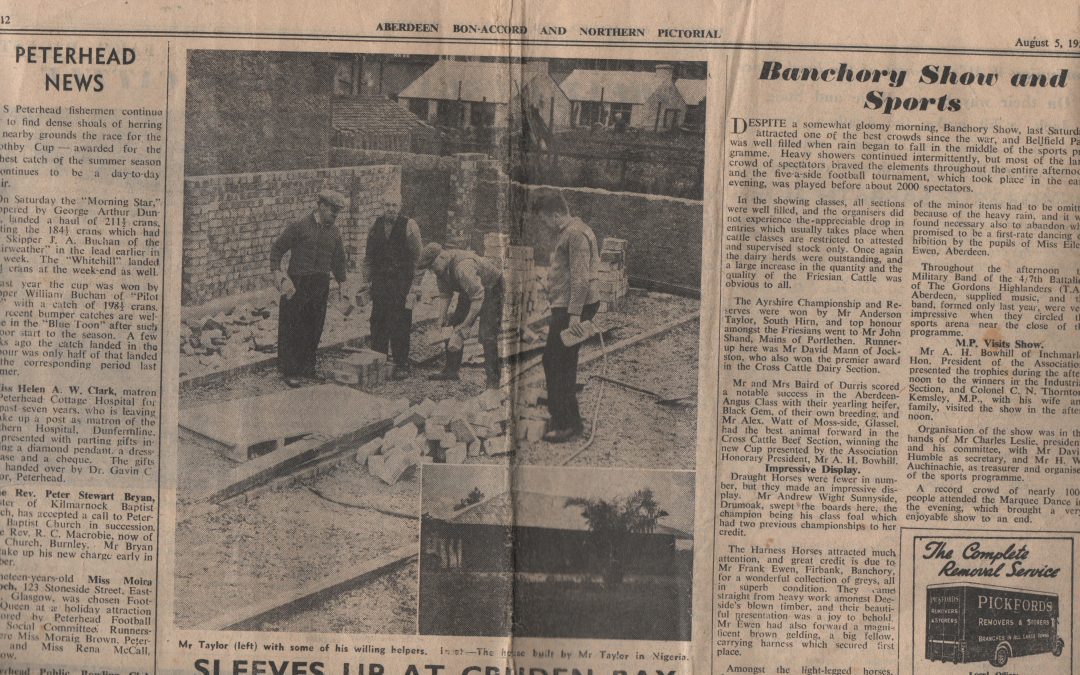
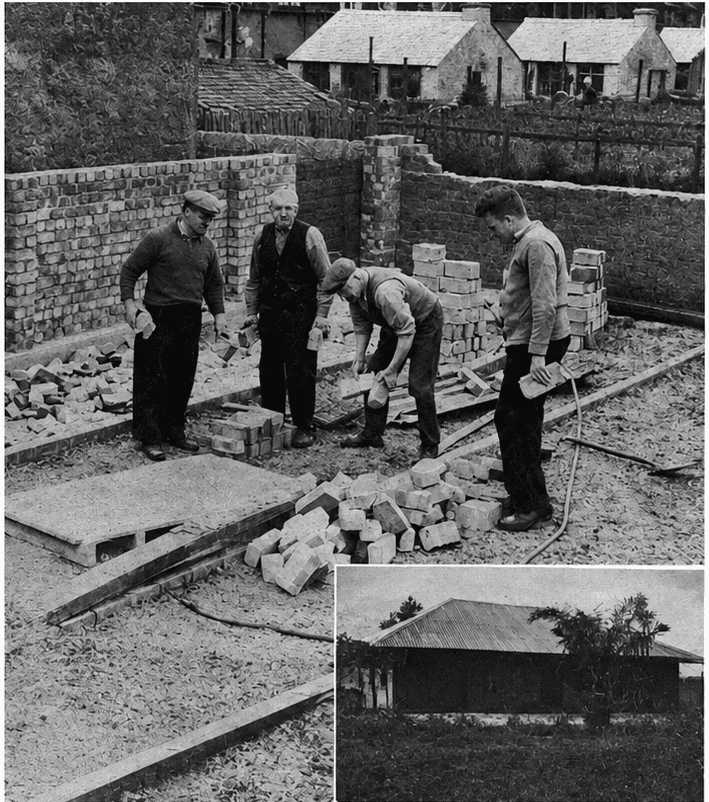
Mr Taylor (left) with some of his helpers (right) The house built by Mr Taylor in Nigeria
AT the moment there’s great activity going on, on the piece of land behind the Congregational Church at Cruden Bay. The reason — the Congregation are building themselves a church hall on a piece of land that a few weeks ago was just a garden.
Man in charge of the work is the minister, the Reverend Alexander Taylor who came to Cruden Bay just a year ago after putting in seven and a half years’ missionary work in Africa before a dose of blackwater fever affected his health. He is no stranger to these parts, however, as he was born in Hatton and brought up in Aberdeen.
The Congregational Church’s, Mr Taylor explained to a “Bon-Accord” reporter, was built some seventy years ago, and as it was minus water supply, sanitation, and so on, a church hall has been badly needed for some time, especially for Boys’ Brigade and other church activities.
Everybody was agreed on that — but it didn’t seem likely that anything could be done in the near future — until Mr Taylor suggested that the congregation should build it themselves. The first reaction was startled surprise — the second enthusiasm.
Two-thirds of the cost of building a church hall, Mr Taylor reckoned, would be labour costs, and though funds are still a problem, in spite of generous donations and money-raising efforts, labour costs on this project are nil. All the work is being done voluntarily by members and friends of the Church in their spare time.
Retired Folk Help.
Working on the site, for instance, when the “Bon-Accord” called one afternoon, were Mr Taylor himself, 68-year-old Mr Cordiner, 67-year-old Mr Nicolson—both retired engineers, and a teacher on holiday from Tullos School, Mr W. Wilkins. At night there are usually about six or seven men there, each putting in a few hours’ work.
Materials? “We have been very lucky,” said Mr Taylor. “The local brickworks have been very generous and let us have bricks at less than contractor’s price.” Some of the rubble for the foundations comes from there, too, some has been salvaged from the ruins of the old hotel nearby, and some from the sea.
Everyone helps in his or her way—from the farmers who lend their lorries and the boys who cart the rubble, to the firm which is lending scaffolding and the ladies who supply tea to the thirsty workers.
How long will it be before the hall is completed? “Difficult to say,” was the answer, “though we hope to have the roof on by November.”
When the hall is completed, it will measure 50 feet by 27 feet and the inside height from the floor to the ceiling will be 12 feet. The side walls will be of rough-cast brick, the inside ones of plasterboard, and the roof of corrugated asbestos. As with the bricklaying, the painting, carpentry, and electric wiring will be done with local help. Only men the Church doesn’t seem to have on the spot seem to be the architect and plumber!
“Do It Yourself” Man
Mr Taylor himself has already had some experience in doing things for himself. When he arrived in Nigeria his home was a mud hut, already condemned, but within a very short time he had a new home built, for which he enlisted the aid of native labour. And that was some problem as practically everything, from cement blocks to door and window frames, had to be fashioned out of the raw materials. Little wonder that the idea of building a church hall here came so readily!