
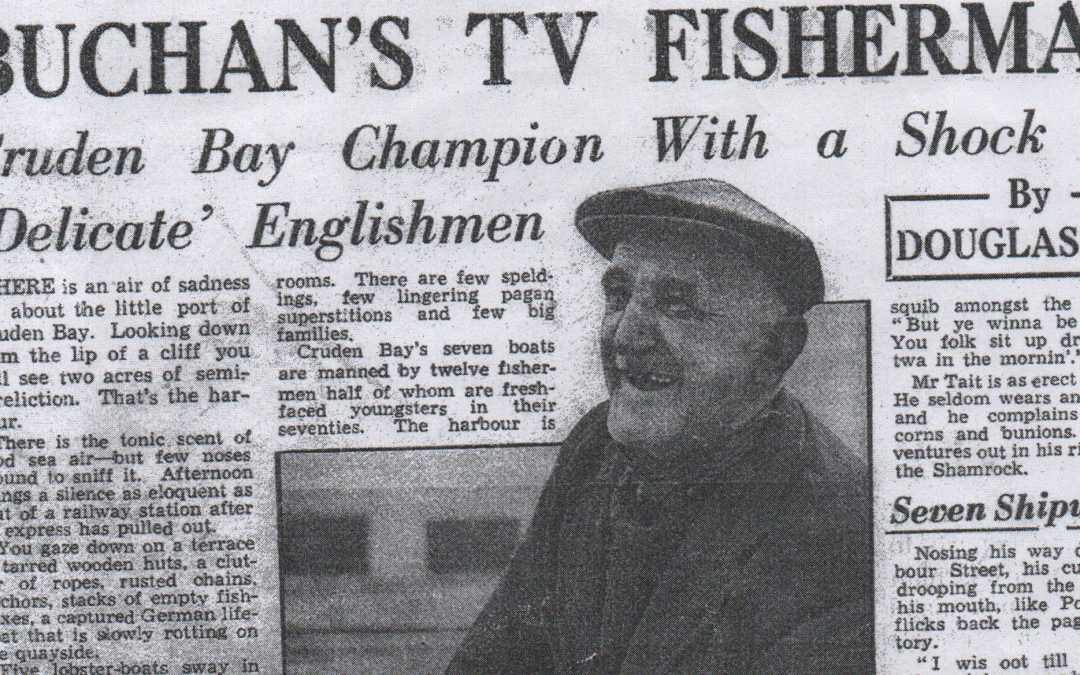
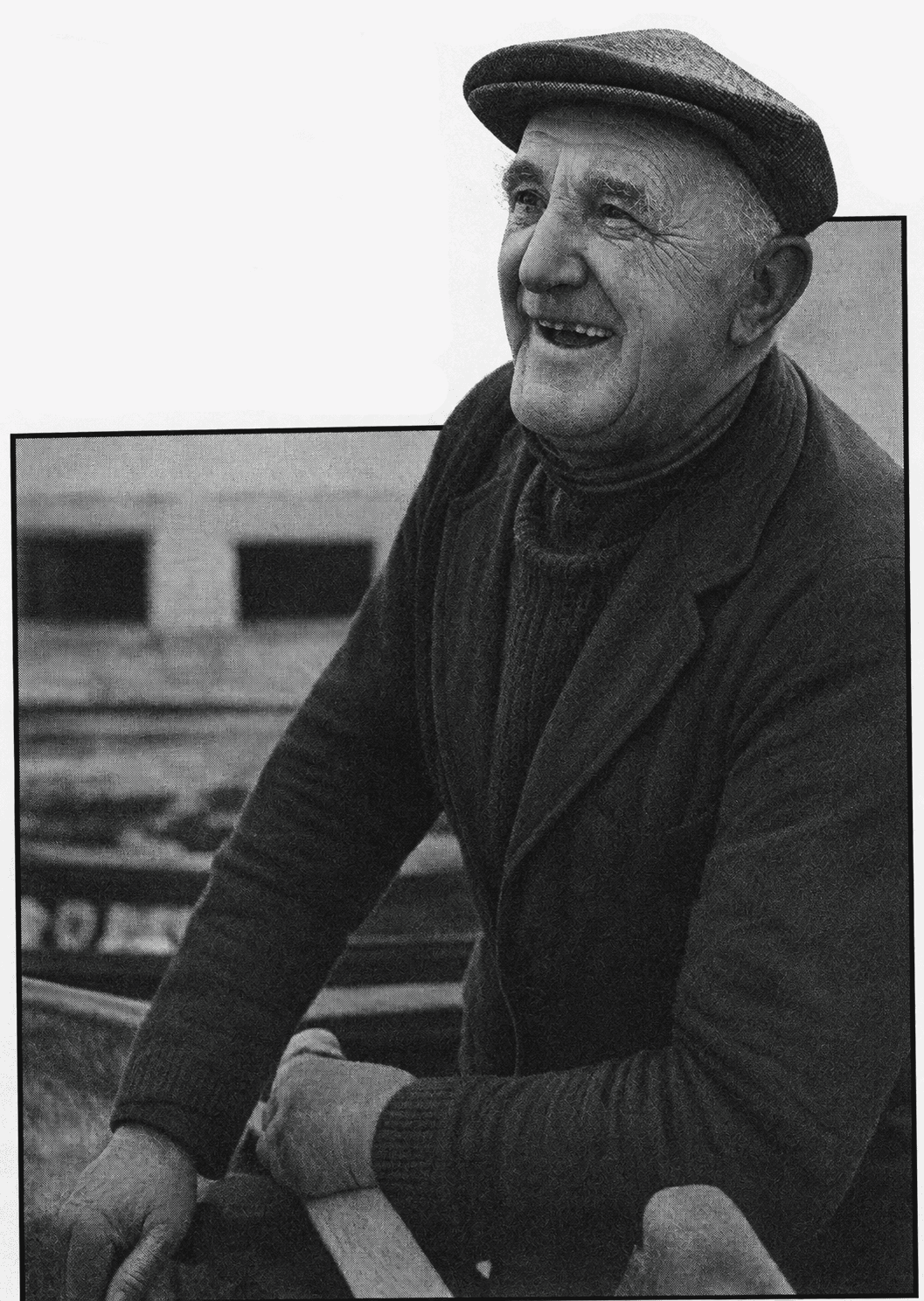
Mr William Tait—his retort to Gilbert Harding startled the television studio audience.
Cruden Bay Champion With a Shock for ‘Delicate’ Englishmen
— By — DOUGLAS RAE
THERE is an air of sadness about the little port of Cruden Bay. Looking down from the lip of a cliff you will see two acres of semi-dereliction. That’s the harbour.
There is the tonic scent of good sea air—but few noses round to sniff it. Afternoon brings a silence as eloquent as that of a railway station after an express has pulled out.
You gaze down on a terrace of tarred wooden huts, a clutter of ropes, rusted chains, anchors, stacks of empty fish-boxes, a captured German lifeboat that is slowly rotting on the quayside.
Five lobster-boats sway in the greenish water in the harbour basin. There is space for 100 more. There are seagulls, but they see nothing to squawk about. The only ripple of life in this mute landscape is the movement of a youngster kicking a white bird-shape along a lonesome breakwater.
Expectancy
But things are happening up-town. The atmosphere there is full of expectancy, for the two seine-netters should be in with their catches soon. Four fishermen in dark knitted jerseys and cravats chat at the corner of Hay Street. How many boxes? Their eyes squint seaward. There is ’baccy in their mouths.
The women who wait for the boats nowadays are much more sophisticated than the old-time fish-wives in shawls and white mutches who carried wicker-creels on their backs and smoked clay cutties.
In common with a score of little ports along this crooked elbow of North-east coast, Cruden Bay’s harbour is too big for the boats that are in it. Village manpower is sapped by the exodus of restless youth.
The result is that the knights of the sea are vanishing. Few houses now are red-tiled and white-washed. Pious texts no longer monopolise the walls of the cottage living-rooms. There are few speldings, few lingering pagan superstitions and few big families.
Cruden Bay’s seven boats are manned by twelve fishermen half of whom are fresh-faced youngsters in their seventies. The harbour is theirs and they must look after it. A recent repair job cost £2000. The seas have scratched another hole in the outer buttress.
Village Oracle
Village oracle and blunt spokesman of these dozen men is a six-foot mariner who looks as indestructible as the sea itself.
Mr William Tait knows every creek and cove of the Buchan coast, every local fisher’s lineage. Seventy-five years old, he has fished in the North-east since he was twelve.
On recent television business in London, Mr Tait had the experience of telling Gilbert Harding and the studio audience that Englishmen were delicate.
He was being televised when Mr Harding asked: “What do you eat up there?” Mr Tait answered, in his most articulate way: “Where I come from we eat frozen Australian mutton because our best home beef is sent down to feed you delicate Englishmen.”
Mr Harding should not have pursued the matter. But he did. He said that he, too, would like to look as fresh as Mr Tait at seventy-five.
To which Mr Tait made a remark which exploded like a squib amongst the audience: “But ye winna be like me. You folk sit up drinkin’ till twa in the mornin’.”
Mr Tait is as erect as a mast. He seldom wears an overcoat, and he complains only of corns and bunions. He still ventures out in his ripper boat, the Shamrock.
Seven Shipwrecks
Nosing his way down Harbour Street, his curved pipe drooping from the corner of his mouth, like Pop-Eye, he flicks back the pages of history.
“I was oot till seeven or acht shipwrecks at the Scaurs,” he begins. (He was cox of the village lifeboat at the time.)
Twice he recalls the pictures inside the thick walls of Slains Castle shaking during storms.
Once in a storm he tried to brew tea at sea. He strapped the kettle to the stove. Mad seas lashed the sail and deck and snuffed out the stove.
“I couldna get ’er lichted,” he confesses. “That day the skipper hid to be tied tae the wheel for fourteen ’oors.”
One day two local yawls set out for Peterhead for coal. One vanished. “A flach o’ win’ blew ’im ower an’ he an’ the crew were nivver seen again,” says Mr Tait.
He remembers when buts-and-bens were “crammed” with fisher families who had “scarcely enough space to breathe in bed.”
Tilting his cutlass against this tipsy age, he recollects as a stripling finding his enjoyment in “bools” and “basies” (marbles and rounders) and shooting down a brae on a piece of wood for a sledge. There was no expenditure of one’s weekly earnings on a trip to Pittodrie on a Saturday afternoon, in those days, he says.
Enjoyment
“The young folk to-day,” he asserts in his lilting voice, “dinna enjoy themsels as muckle as we did. Noo they can get their enjoyment oot o’ a bottle on a shelf—but they maun pey for’t.”
That is a shrewd remark from a man who comes from what someone has called “a particularly abstemious village.”