Royal Scandal, Grand Illusions, and Pink Granite:
The Lives of William George Hay and Lady Elizabeth FitzClarence
The nineteenth-century British aristocracy was a world defined by ancient lineages, rigid social structures, and high-society standing. Yet, few partnerships in this era bridged the gap between old Scottish nobility and the intimate scandals of the royal court quite like the union of William George Hay, 18th Earl of Erroll, and Lady Elizabeth FitzClarence.
Their marriage in 1820 brought together a young Scottish peer thrust early into his ancestral titles and the illegitimate daughter of a future king. It was a union marked by boundless social ambition, prestigious court appointments, and a lavish lifestyle that would dramatically rewrite the physical landscape of the Aberdeenshire coast—whilst setting the stage for their family’s eventual financial ruin.
The Scandalous Origins of Lady Elizabeth
Born on 17 January 1801 at Bushy House in the London Borough of Richmond upon Thames, Lady Elizabeth FitzClarence entered the world at the very centre of a high-profile royal scandal. She was the sixth of ten children and the third of five daughters born to Prince William, Duke of Clarence (the future King William IV), and his long-term mistress, the celebrated Irish comedic actress Dorothea Jordan.
Because her parents cohabited for twenty-one years as a devoted family at Clarence Lodge and Bushy House, Elizabeth and her siblings grew up in a warm, tight-knit household. They were given the surname FitzClarence, combining the Anglo-Norman prefix Fitz (meaning “son of”) with Clarence, her father’s ducal title. Elizabeth’s paternal grandparents were King George III and Queen Charlotte, while her maternal grandparents were a modest theater stagehand, Francis Bland, and his actress mistress, Grace Phillips.
Despite the stability of her early years, Elizabeth’s childhood was abruptly fractured. By 1811, under immense pressure from the royal family to secure a legitimate heir and suitable wife, the Duke of Clarence ended his relationship with Dorothea Jordan. Though William ensured Dorothea was initially provided for, her financial situation deteriorated rapidly after her daughter Augusta and her husband accumulated massive debts in Dorothea’s name. Virtually penniless, Dorothea fled to France, where she died in Saint-Cloud on 5 July 1816 at the age of 54. Elizabeth and her siblings had virtually no contact with their mother after the 1811 separation.
As she grew older, Elizabeth kept deeply personal mementos of her royal father, who eventually ascended the throne in 1830. Among her most prized possessions were a stone that had been thrown at King William IV and the very gloves he wore when opening his first Parliament.
The Rise of the Young 18th Earl
While Elizabeth’s background was shaped by the theatres of London and royal palaces, her future husband, William George Hay, was rooted in the ancient soil of Scotland. Born on 21 February 1801, he was the son of William Hay, 17th Earl of Erroll, and Alice Eliot.
William George was educated at Eton College, but his youth was suddenly overshadowed by tragedy. In 1815, his older brother, James (Lord Hay), was killed in action during the Waterloo Campaign. This loss made William George the direct heir to the earldom, and when his father passed away on 26 January 1819, the eighteen-year-old was thrust into his inheritance as the 18th Earl of Erroll.
With the earldom came the prestigious hereditary office of Lord High Constable of Scotland—a title that placed the Earl first in rank in Scotland, directly behind the princes of the royal family—and the role of Chief of Clan Hay.
A Grand Alliance and Courtly Splendour
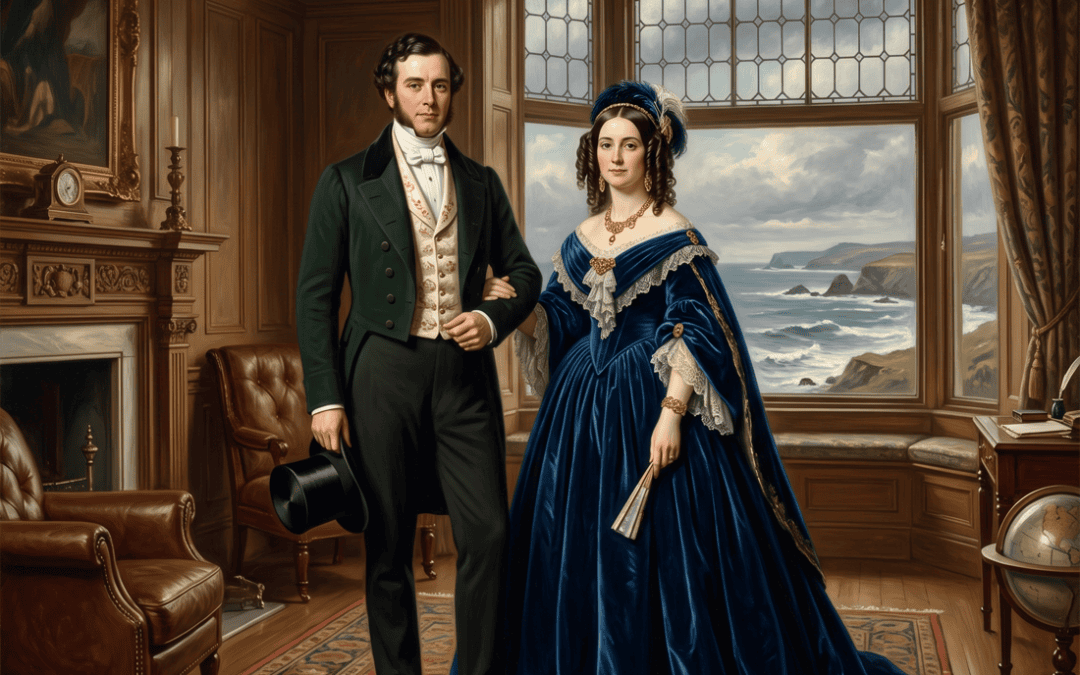
On 4 December 1820, when both were just nineteen years old, William George Hay and Lady Elizabeth FitzClarence married at the fashionable Anglican church of St George’s, Hanover Square, in Westminster. This high-profile union of the young nineteen-year-old Earl and the King’s daughter immediately became the talk of London society.
The marriage was a brilliant social coup. Elizabeth’s royal parentage immediately propelled the young Earl into the highest echelons of British political and courtly life. When Elizabeth’s father became King William IV in 1830, the Earl’s influence grew boundsfold. He was appointed Master of the Horse to Queen Adelaide (serving from 1830 to 1834) and was sworn into the Privy Council in 1831. That same year, he was created Baron Kilmarnock in the Peerage of the United Kingdom, granting him a permanent, hereditary seat in the House of Lords.
The Earl’s political rise continued under the Whig administrations and into the reign of Queen Victoria. His distinguished offices included:
- Master of the Buckhounds (1835–1839)
- Lord Steward of the Household (1839–1841)
- Knight Marischal of Scotland (1832–1846)
- Lord-Lieutenant of Aberdeenshire (1836–1846)
Additionally, his social magnificence was recognized with prestigious honours; he was made a Knight of the Thistle (KT) and a Knight Grand Cross of the Royal Guelphic Order of Hanover (GCH).
Rebuilding New Slains Castle: Grand Illusions in Pink Granite
William George Hay was a man completely confident in his aristocratic power, believing his family’s influence would endure forever. In 1822, during King George IV’s historic visit to Edinburgh, he had nearly bankrupted himself with the sheer extravagance of his pageantry as Lord High Constable. Needing an ancestral seat that matched his lofty self-image and his wife’s royal standing, the Earl embarked on his most ambitious—and financially devastating—project: the complete remodelling of New Slains Castle.
Perched dramatically on the precipitous sea cliffs of the Aberdeenshire coast near Cruden Bay, the castle had been the seat of the Earls of Erroll since the late sixteenth century. In 1836, the 18th Earl hired the prominent Aberdeen-based architect John Smith (who would also construct Balmoral Castle for Queen Victoria) to transform the coastal fortress into a grand nineteenth-century country house.
Under Smith’s direction, the castle was cloaked in a magnificent Scots Baronial and neo-Tudor style. It was faced with elegant, ashlar-dressed pink Peterhead granite, boasting elaborate diamond chimney stacks, large bay windows, a double-height library, and an imposing entrance porch flanked by octagonal buttresses.
However, the Earl was far from rich. To create the illusion of a massive, sprawling palace, Smith cleverly incorporated the existing stable block into the main structure. Furthermore, while William George proudly claimed to have “rebuilt” the castle, the work was largely cosmetic, building over the bones of the older 1597 tower house.
This boundless extravagance and their lavish high-society lifestyle placed a crushing, irreversible financial strain on the Hay family fortunes. It permanently weighed on the estate’s finances, sowing the seeds that would force their grandson, the 20th Earl, to sell the beloved ancestral seat in 1916.
Family and Historical Legacy
Despite their courtly duties and architectural distractions, Elizabeth and William George raised a prominent family of four children who married into elite British circles:
- Lady Ida Harriet Augusta Hay (1821–1867): Married Charles Noel, 2nd Earl of Gainsborough (then Viscount Campden). She served as one of Queen Victoria’s bridesmaids. Her descendants include the Earls of Gainsborough and the Marquesses of Bute.
- William Henry Hay, 19th Earl of Erroll (1823–1891): Inherited his father’s titles and married Eliza Amelia Gore.
- Lady Agnes Georgiana Elizabeth Hay (1829–1869): Married James Duff, 5th Earl Fife. Their son, Alexander Duff, 1st Duke of Fife, made a grand royal marriage to Princess Louise, the daughter of King Edward VII.
- Lady Alice Mary Emily Hay (1835–1881): Married Charles Edward Louis Casimir Stuart (Count d’Albanie).
Through this extensive lineage, the 18th Earl and Countess of Erroll are ancestors to several major historical and political figures. Most notably, former British Prime Minister David Cameron is a direct descendant of the couple through King William IV, making him a distant cousin to Queen Elizabeth II.
A Sombre and Dramatic End
The grand lives of the Earl and Countess came to early, relatively tragic conclusions.
On 19 April 1846, William George Hay died in London at the age of 45 from complications of diabetes. He was buried in the peaceful churchyard of St Mary’s Church in Wimbledon.
Elizabeth survived her husband by nearly a decade, but her final moments were marked by dramatic family devotion. In January 1856, while already quite ill herself, she received word that her beloved brother, Lord Adolphus FitzClarence, was lying on his deathbed in London. Leaving the north of Scotland immediately, she desperately travelled south to reach him.
However, her condition worsened rapidly during the arduous journey. She was forced to halt in Edinburgh, where her symptoms became critical. Her sister, Lady Mary Fox, rushed from London by express train to be at her side, joining other family members including her daughter, Lady Agnes Duff, and her sister-in-law, Lady Augustus FitzClarence.
On 16 January 1856, just one day shy of her 55th birthday, Lady Elizabeth FitzClarence died of congestion of the brain in Edinburgh. In accordance with her wishes, she was brought south to London and buried alongside her husband in St Mary’s Churchyard, Wimbledon.