
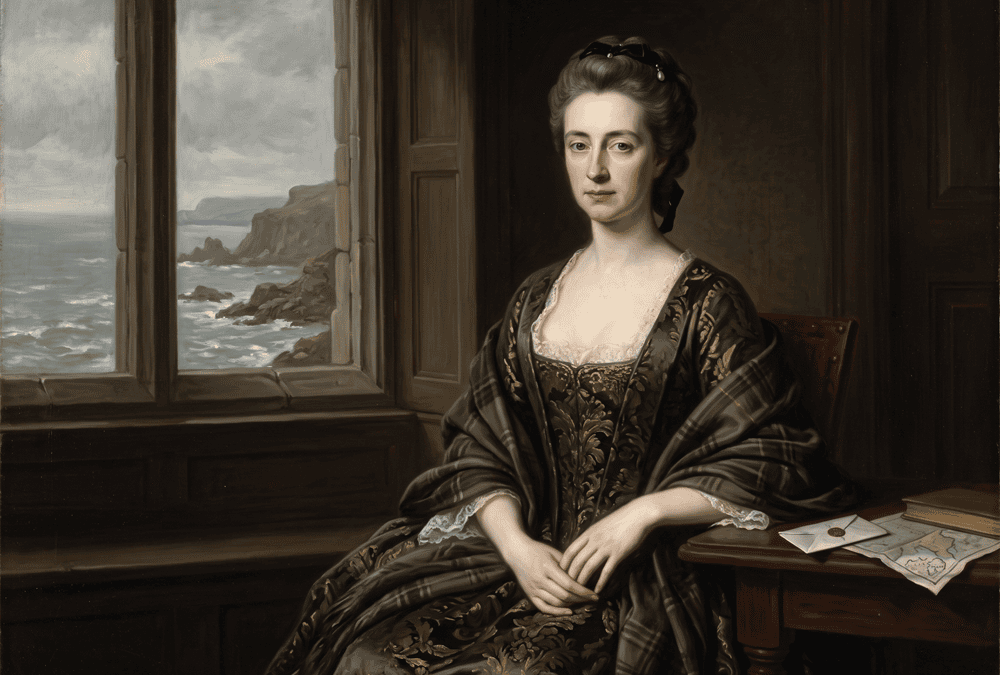
The High Constable’s Secret War: The Life and Legacy of Mary Hay, 14th Countess of Erroll
The Crucible of Lineage: Heritage and the Drummond Influence
The strategic significance of Mary Hay’s birth resided in the formidable confluence of the Houses of Hay and Drummond, a lineage that rendered her a protagonist in the Stuart cause not by mere choice, but by dynastic inevitability. As the daughter of John Hay, 12th Earl of Erroll, and Lady Anne Drummond, Mary was the inheritor of a political and intellectual tradition that defined the “First Scottish Enlightenment.” Her mother, Lady Anne, was far more than a mere noblewoman; she was a naturalist who contributed to Robert Sibbald’s Scotia Illustrata and a participant in the broader European Republic of Letters, providing entries for Pierre Bayle’s seminal Dictionaire Historique. It was here, in the synthesis of her mother’s scientific rigor and her clandestine role as “the soul of the King’s affairs in Scotland,” that Mary’s own methodology was forged. She did not merely learn “tricks” of the trade; she inherited an intellectual framework for espionage that utilized the precise observation of a naturalist and the meticulous logic of an Enlightenment scholar.
This heritage was tempered in the fires of Jacobite sacrifice. Mary’s maternal uncles, the Dukes of Perth and Melfort, were the architects of Stuart policy in exile, while the tragic arc of her brother Charles, the 13th Earl, underscored the high stakes of their loyalty. Charles’s imprisonment in Edinburgh Castle and his subsequent death in 1717 without an heir left the House of Hay at a precipice. Yet, from this void emerged an unexpected resolution as Mary stepped forward to claim a mantle traditionally reserved for the masculine line, transforming the grief of her family into a sharp instrument of political survival.
Suo Jure: The Peerage and the Lord High Constableship
Upon succeeding to her family’s titles suo jure in 1717, Mary Hay occupied a position of extraordinary jurisdictional power. As the 14th Countess of Erroll, 18th Hereditary Lord High Constable of Scotland, and Knight Marischal, she was the highest-ranking officer of the Scottish Household, technically the superior of every peer in the realm during royal assemblies. In an era where female agency was often restricted to the domestic sphere, Mary’s possession of an ancient, hereditary office associated with military command and judicial oversight—holding the power to try cases of riot and bloodshed within four miles of the King’s person—was a profound anomaly that she exploited with surgical precision.
This “theatre of power” was most masterfully staged during the coronation of King George II. Though the Hanoverian court might have preferred to ignore the Jacobite Countess, the legal reality of her hereditary right was immutable. Mary navigated the gendered constraints of the ceremony not by submission, but by the creation of a sophisticated “legal fiction,” appointing a male representative to exercise her physical duties in the procession while she maintained the authority of the office. This performance forced the Hanoverian state to formally acknowledge the legitimacy of a Stuart loyalist, asserting her dynastic continuity in the heart of the enemy’s ritual. This public assertion of legal standing created an indispensable shield; by reinforcing her status as a Great Officer of State, she secured the public legitimacy necessary to mask her private role as the primary architect of the Buchan coast’s clandestine war.
Marriage and Myth: The Duel at Delgaty
Mary’s marriage in 1722 to Alexander Falconer, a lawyer and son of the eminent judge Sir David Falconer, was a union of strategic convenience designed to bolster the Hay family’s regional alliances. In a profound assertion of her primacy as the head of her House, Alexander was required to take the surname Hay, effectively subsuming his identity into her patrimony. However, the domestic reality of this union was eclipsed by the “redoubtable and alarming” legend of the duel at Delgaty. Local tradition held that the young Countess, disguised as a man, challenged her future husband to a duel with the blade, a narrative that paints a portrait of a woman who would not be confined by the “armoured petticoats” of her station.
Whether literal fact or calculated myth-making, the story served a vital purpose. By allowing herself to be perceived as a woman of martial spirit and “alarming” character, Mary cultivated a public persona that intimidated local rivals and discouraged government intrusion. She was a woman who could be both the high-born Countess in coronation robes and the masculine combatant on the field, a duality that made her a terrifying enigma to the Hanoverian authorities. The practical utility of her marriage concluded with strategic timing; Alexander’s death in July 1745, on the absolute eve of the final Jacobite Rising, left Mary in sole, unencumbered command of the Hay resources just as the Prince’s standard was raised at Glenfinnan.
The Spymaster of New Slains Castle
As the 1745 Rising erupted, the Buchan coast became the vital artery of the Jacobite effort, and Mary Hay transformed New Slains Castle into the primary intelligence hub for the St. Germain connection. Utilizing the “linen signals” in the castle windows—a methodical signaling system pioneered by her mother—she facilitated the landing of French vessels and envoys who had been sailing directly to Slains for years. She negotiated secret agreements with naval officers to ensure that French aid and military intelligence reached the shore undetected, effectively bridging the gap between the exiled Stuart court and the Highland army.
The logistics of her operation were as scientific as they were secret. Once agents arrived at the coast, Mary utilized an “inland route” to Delgatie Castle, where she leveraged the structure’s secret passages and “hidey-holes” to conceal high-level operatives. Her recruitment efforts were equally ruthless; she mustered 200 to 300 men for the Prince’s cause. While traditional histories might speak of Jacobite “enthusiasm,” the reality at Slains was one of cold, feudal obligation. Mary conscripted many of these men “against their preference,” using the raw weight of her authority as Countess and Constable to force the “unwilling” into the ranks. Having mastered the tactical movements of armies and agents, she turned to the most unlikely of couriers to ensure the survival of her intelligence network.
The “Feel” as Courier: The Role of Jamie Fleeman
In the brutal environment of 18th-century warfare, where a single intercepted letter could mean the gallows, Mary Hay recognized the strategic value of the “simpleton.” Her most effective intelligence asset was James Fleming, known as Jamie Fleeman, the “Laird of Udny’s Fool.” Fleeman, the “last professional court jester in Scotland,” was described by local historian James Pratt as possessing an “indescribably striking” countenance, with a large round head and “fox-colour” hair that stood on end, as if he were “frightened out of his wits.” This perceived “absence of sound judgement” was Mary’s greatest weapon.
While government troops systematically searched the luggage of aristocratic travelers, Fleeman roamed the countryside with absolute immunity. He was dismissed as a harmless relic of a medieval past, yet he possessed a razor-sharp wit and iron loyalty. Mary leveraged this perception, using Fleeman to carry the most sensitive covert messages to rebels in hiding. This was the key to her survival: because she relied on the oral tradition and the physical invisibility of a “feel,” she avoided the paper trail that ruined her peers. Fleeman was the living conduit of her secret war, an asset who could bypass any Hanoverian blockade and ensure that her communications remained as ghostly as they were effective.
The Crafty Operator: Survival and Legal Manoeuvres
Mary Hay’s survival in the post-Culloden era was a masterpiece of legal and social agility. While her neighbors faced the forfeiture of their estates and the ruin of their lines, the Countess of Erroll remained a “crafty operator” who successfully masked her leadership role. Her survival was a calculated anomaly; Hanoverian authorities, though aware of her sympathies, found the prosecution of a high-ranking woman and Great Officer of State to be a judicial minefield. Her gender and her ancient titles provided a unique legal shield that more obvious male commanders lacked.
The final act of her political pragmatism came with the Heritable Jurisdictions (Scotland) Act of 1746. Recognizing that the old world was dying and that the British state was determined to dismantle feudal powers, Mary did not resist the inevitable. Instead, she entered into a cold, financial negotiation, securing £1,200 in compensation for the surrender of the special legal rights of Slains. By accepting this payment, she converted a fading feudal right into the hard currency needed to stabilize her House. This was not a surrender, but a final strategic retreat that ensured the Hay patrimony remained intact while the Highland culture around it was being systematically erased.
Death and the Reconciled Line
In her final years, Mary Hay faced the ultimate strategic dilemma: the lack of a direct heir. To preserve the House of Hay, she invoked the regrant of 1666, which allowed for the nomination of a successor. Her selection was a masterstroke of institutional reconciliation. She named James Boyd—later James Hay—the grandson of her sister Margaret. James was the son of William Boyd, 4th Earl of Kilmarnock, a Jacobite who had been executed for treason in 1746. Yet, James himself was a Hanoverian soldier who had fought for the King at Culloden.
By placing this “reconciled” heir into the Earldom, Mary ensured that the son of a Jacobite martyr, who was also a loyalist veteran, would become the 15th Earl. This was a sophisticated closure to the civil wars of her lifetime; it united the warring factions of Scotland within a single person. When Mary Hay died at Slains Castle on 19 August 1758, she left behind a House that was financially stable, legally secure, and dynastically reconciled. She remains the quintessential figure of the Jacobite era: a woman who utilized the ancient rights of a High Constable and the methodical intellect of the Enlightenment to master the intersections of gender, law, and espionage, ensuring that the House of Hay would endure as a permanent fixture of the Scottish nation.