
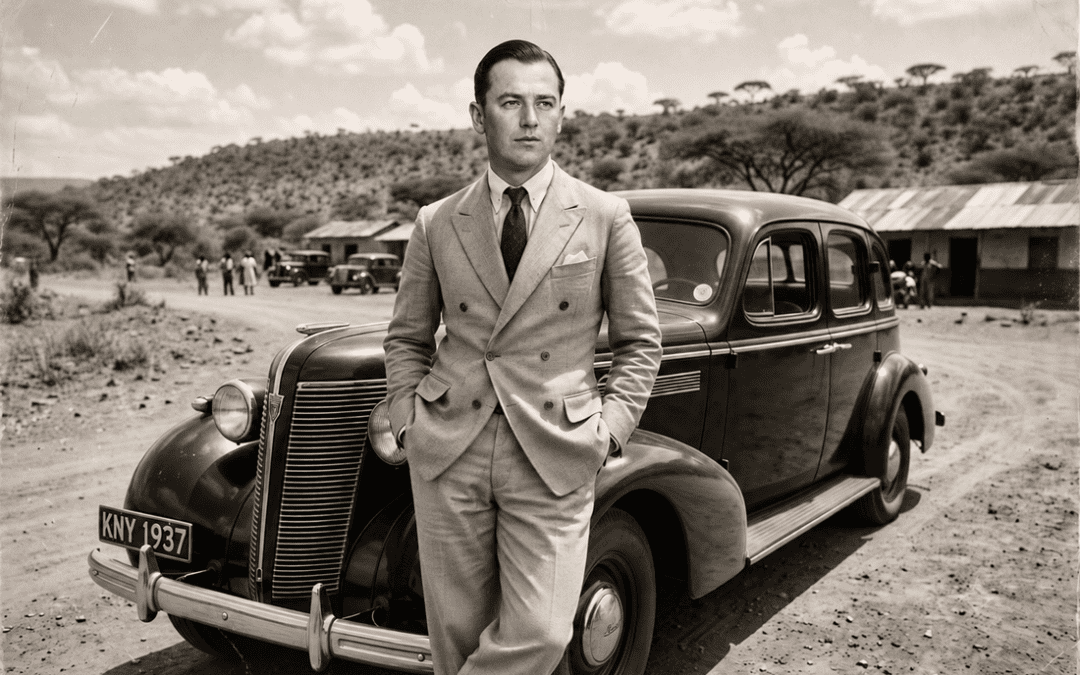
Josslyn Victor Hay: The Exiled Earl
The Architect of an African Babylon
Josslyn Victor Hay, the 22nd Earl of Erroll, stands in the shadow of history not merely as the victim of a sensational, unsolved murder, but as a chilling avatar of the post-war aristocratic identity crisis. As the traditional foundations of the British landed gentry were hollowed out by the twin voracities of death duties and a shifting social order, Hay looked toward the equator to construct a new, lawless sovereignty. His transition from a penniless peer in London to the undisputed “King” of Kenya’s Wanjohi Valley was a calculated reinvention, turning a remote colonial outpost into a hedonistic enclave for an elite that had lost its moral compass.
His life was defined by a stark, noirish paradox: a man of ancient Scottish lineage and high military standing who became the living personification of social transgression. He was a nobleman who possessed the veneer of imperial authority while revelling in a calculated affront to the lingering Victorian sensibilities of the colonial administration. This trajectory—from the hallowed halls of Eton to a blood-stained intersection on the Ngong Road—represents a spectacular descent, where the pursuit of relevance in a dying empire ended in total moral penury.
The Fractured Foundation: Youth, Eton, and Berlin
The early years of Josslyn Hay were shaped by the cold reality that, in the twentieth century, a title without an estate was merely a ghost of power. The Hay family’s lack of wealth necessitated a departure from the leisurely paths of their ancestors; the Earls of Erroll were forced to “develop careers,” a necessity that Hay viewed with a mixture of pragmatism and resentment. This financial vacuum was symbolised by the fate of the family seat, Slains Castle, which had been sold by the 20th Earl in 1916 and subsequently dismantled for architectural salvage—a vulture-like end to a once-great house that left the young Hay a peer without a palace.
His institutional life was a series of abortive starts. Entering Eton in 1914, he was dismissed by 1916, a failure that would define his lifelong disdain for conventional authority. A brief attempt at respectability followed in Berlin between 1920 and 1922, where he served as an honorary attaché under Lord D’Abernon. While his father, Victor Hay, served as the High Commissioner to the Rhineland, Josslyn moved through the grey, cynical world of post-war German diplomacy. This period provided the young Hay with a sophisticated veneer of statecraft, yet it also taught him how to navigate the cracks of a crumbling social order. The economic pressure of his position likely served as the catalyst for his psychological development; without the rents of a vast estate to sustain him, Hay turned his romantic life into a predatory economic strategy, pursuing wealthy women as a means of maintaining a high-society existence his own coffers could no longer afford.
The Elopement and the Genesis of ‘Slains’
In 1923, Hay enacted his first great rebellion: the elopement with Lady Idina Sackville. It was a union born of a mutual quest for a lawless frontier, a calculated escape from the stifling constraints of a Britain still mourning its dead. For Hay, Idina was the ultimate stake—a woman of immense wealth and even greater notoriety.
The Sackville-Hay Union: Material and Social Stake
|
Idina’s Material and Social Stake
|
Hay’s Material and Social Stake
|
|---|---|
|
Immense wealth and global notoriety
|
Ancient Scottish Peerage (22nd Earl)
|
|
A history of “bolting” from marriages
|
Hereditary Lord High Constable of Scotland
|
|
The capital to fund a colonial kingdom
|
A reputation for sophisticated philandering
|
Arriving in the Wanjohi Valley in 1924, they established their homestead, a bungalow they had the audacity to name “Slains.” It was a pathetic, low-slung shadow of the dismantled castle in Aberdeenshire, yet within its walls, they birthed the “Happy Valley” set. Here, the green onyx bathtub from which Idina would receive guests became a symbol of their “African Babylon.” Their pioneer existence was characterised by a dark, decadent choreography of drug abuse and spouse-swapping, establishing a cultural signature of hedonism that masked a profound existential rot.
The Ramsay-Hill Incident and the Move to Oserian
By the close of the 1920s, Hay’s blatant disregard for the thin social pretences of the colony began to alienate even his fellow sybarites. His affair with Molly Ramsay-Hill led to a divorce from Idina in 1929, but it was the public resolution of this romance that truly shattered his standing among the “white hunter” elite. At the Nairobi Railway Station, Molly’s husband, Cyril Ramsay-Hill, publicly horsewhipped the Earl—a visceral humiliation that marked Erroll not as a romantic hero, but as a cad who lacked the discretion required by his station.
Hay married Molly in 1930 and moved to the “Oserian” estate, but the tragedy inherent in the set soon claimed her. In 1939, Molly died of a lethal cocktail of alcohol, morphine, and heroin. Her death was the logical conclusion of the life they had built—a slow, chemical dissolution in the African sun. Seeking a new form of order through extremism, Hay pivoted from social hedonism to the rigid, ordered violence of Sir Oswald Mosley’s British Union of Fascists (BUF).
The Fascist Peer: BUF and the African Frontier
Hay’s aristocratic frustrations found a natural alignment with European fascism in the 1930s. Joining the BUF in 1934, he returned to Kenya to serve as president of the Convention of Associations. He saw in fascism a way to restore the lost authority of his class, yet he occupied a treacherous dual identity. By 1941, despite his fascist sympathies, he was a Captain in the Kenya Regiment and served as the Military Secretary for East Africa.
This positioning was a cinematic recipe for disaster. Erroll was a fascist sympathiser with access to sensitive military intelligence during a global war against the Axis powers. His presence in the colonial administration created a toxic climate of suspicion, making him a person of intense interest to security services. The line between a decadent peer and a potential traitor began to blur, providing a grim political backdrop for the romance that would lead to his end: his affair with Diana, Lady Delves Broughton.
Ngong Road: The Anatomy of a Murder
On 24 January 1941, the volatility of the Happy Valley set reached its fatal climax. Josslyn Hay was found shot to death in his car at an intersection outside Nairobi. The murder followed a very public affair with Diana, whose husband, Sir “Jock” Delves Broughton, had ostensibly consented to the romance under the terms of a cynical prenuptial agreement.
The investigation yielded three primary theories, each darker than the last:
- The Broughton Case: Jock Broughton was tried and acquitted, yet evidence unearthed in 2007 strongly implicates him, suggesting his “consent” was merely a mask for a murderous rage.
- The de Janzé Factor: Alice de Janzé, known as the “wicked Madonna,” was a former lover with a history of shooting paramours. Her behaviour at the morgue—whispering “Now you are mine forever” over Erroll’s corpse—and a revolver found hidden under stones on her property suggest a morbid, possessive motive.
- The MI5 Theory: Given Erroll’s BUF ties and his sensitive military role, some suggest his death was a state-sanctioned execution. The government’s decision to destroy the suicide notes left by Alice de Janzé, citing “damaging revelations of a social and political nature,” lends significant weight to the idea of a broader conspiracy to bury the Earl’s secrets alongside him.
The Aftermath: Suicide and the Severed Titles
The “curse” of the Erroll investigation triggered a final collapse of the Happy Valley set. Alice de Janzé, suffering from uterine cancer and the psychological weight of the murder, took her own life on 30 September 1941. She used the same weapon she had once turned on her lover, Raymond de Trafford, finally succeeding in her long-held desire for self-destruction. The destruction of her final letters ensured that the “damaging revelations” of the Wanjohi Valley would remain the province of rumour and shadow.
The death of the 22nd Earl resulted in a permanent fracturing of the Hay family honours. The Earldom of Erroll passed to his only daughter, Diana, who became the 23rd Countess. However, the Barony of Kilmarnock—restricted to male heirs—passed to Josslyn’s brother, Gilbert Boyd, who would remain the uncle to the new Countess. This split of titles symbolised the final disintegration of the status Hay had tried so desperately to preserve through scandal and extremism. Josslyn Victor Hay remains a ghost of a vanished empire—a man who sought a kingdom in the sun, only to find a shallow grave in the red African soil.