A Royalist Giant with a Rebel Heart: The Life of James Hay, 15th Earl of Erroll
The history of 18th-century Scotland is often written in the stark colors of political division—Jacobite versus Hanoverian, rebel versus loyalist. Yet, few individuals embody the complex, deeply personal contradictions of this turbulent era as fully as James Hay, the 15th Earl of Erroll. Known in his youth as Lord Boyd and later succeeding to one of Scotland’s most ancient peerages, he was a man of colossal physical stature, profound familial tragedy, and quiet, heroic compassion.
His life story is not merely a chronicle of aristocratic succession, but a dramatic narrative of a family torn apart by civil war, a secret act of battlefield mercy, and a carefully choreographed rise to the peak of British royal society.
Early Life and Ancestral Roots
Born as James Boyd in Falkirk, Scotland, in the spring of 1726 (sources record his birth on either April 20, April 29, or December 20 of that year), he was the eldest son of William Boyd, the 4th Earl of Kilmarnock, and Lady Anne Livingstone. Through his mother, James was connected to some of Scotland’s most illustrious families, including the Earls of Linlithgow, Callendar, and Erroll [4].
From 1728 until 1746, he bore the courtesy title of Lord Boyd, reflecting his status as heir to the Kilmarnock earldom. Despite these noble expectations, the shadow of rebellion hung over his family. His maternal grandfather, James Livingstone, had participated in the failed 1715 Jacobite Rising, resulting in the forfeiture of his titles and estates [24]. This historical precedent of ruin would soon repeat itself in an even more devastating fashion.
A Family Divided: The 1745 Rebellion
The outbreak of the 1745 Jacobite Rebellion forced the Boyd family into a tragic polarization [63]. Driven by an ardent devotion to the Stuart cause, James’s father, Lord Kilmarnock, took up arms for the “Young Pretender,” Prince Charles Edward Stuart, eventually commanding the Prince’s Horse Grenadier Guards. In contrast, James and his younger brother William remained steadfastly loyal to the Hanoverian Crown of King George II. James took up a commission in the British army, serving in the Scots Fusiliers.
This political chasm culminated on the bloody moor of the Battle of Culloden on April 16, 1746. James fought on the victorious Government side, directly opposing the Jacobite forces that included his own father. In the chaotic aftermath of the battle, Lord Kilmarnock was captured by Government forces.
A poignant and enduring legend from the battlefield recounts that James, spotting his captured father being led away bareheaded (having lost his hat during the fighting), stepped forward in front of his fellow soldiers and silently placed his own hat upon his father’s head. It was a final, touching gesture of filial respect; the two men would never see each other again.
Lord Kilmarnock was taken to London, tried for high treason before the House of Peers, and convicted. On August 18, 1746 (some sources note 1747), he was beheaded on Great Tower Hill. Because of his father’s conviction, the Kilmarnock honours and estates were forfeited to the Crown, leaving James disinherited and carrying the heavy social stigma of being a traitor’s son.
A Secret Mercy: The Prisoners’ Stone
While James Boyd officially served as a loyal Government officer, his heart was not immune to the suffering of his fellow countrymen. The most remarkable, yet long-hidden, episode of his life occurred in the immediate aftermath of Culloden.
Following the battle, seventeen wounded Jacobite prisoners were dragged to the dungeons of Culloden House, where they languished in agony for two days. They were subsequently loaded into a cart and taken deep into the nearby Culloden Woods to be executed at a large boulder known today as The Prisoners’ Stone.
The prisoners were shot at close range, but miraculously, one man survived: a young Jacobite named John Fraser. Fraser lay wounded and bleeding amongst the bodies when James Boyd (Lord Boyd) arrived at the scene. Recognizing the young man’s plight and defying the brutal retributive policies of the Duke of Cumberland, Boyd personally intervened. He secured a safe hiding place for Fraser and arranged for his medical care, enabling him to spend three months recovering in safety until he was eventually able to walk on crutches and escape.
This extraordinary act of mercy, recorded on an incredibly rare 1746 handbill (of which only three copies are known to survive today), reveals that even in the midst of civil war, Boyd possessed a profound moral courage that transcended political allegiance.
Inheriting the Earldom of Erroll
Despite the stain of his father’s treason, James’s loyalty to the Crown eventually allowed him to rebuild his family’s fortunes. In 1751, he was permitted to recover the Kilmarnock lands, though the title of Earl of Kilmarnock remained forfeited. Seeking to resolve the substantial debts left by his late father, James sold the family’s ancestral seat, the ruined Dean Castle, to the Earl of Glencairn. During this transitional period, he also served as the Grand Master of the Grand Lodge of Scotland from 1751 to 1752.
A dramatic turning point occurred on August 19, 1758, when his maternal great-aunt, Mary Hay, the 14th Countess of Erroll, passed away without issue. James inherited her titles and estates, becoming the 15th Earl of Erroll. In accordance with the strict traditions of the Erroll peerage, he legally changed his surname from Boyd to Hay.
Irony laced this succession: his great-aunt Mary had been a formidable, highly active Jacobite secret agent who had used the family seat, Slains Castle, as a primary northern intelligence hub and smuggling base for the exiled Stuart court. Now, her loyalist great-nephew was to take her place.
Lord High Constable and the Coronation of George III
Along with the Erroll earldom, James inherited the ancient and highly prestigious office of Lord High Constable of Scotland. This hereditary ceremonial office, granted to the Hay family by King Robert the Bruce in 1314, carries immense honor. In the Scottish order of precedence, the Lord High Constable ranks above all peers, second only to the royal family. The Constable traditionally commanded the King’s bodyguards, held the keys to Parliament House, and enjoyed the right to sit on the right side of the monarch during Parliament.
On September 22, 1761, the Earl of Erroll officiated in his capacity as Constable at the Coronation of King George III in London. Standing at an imposing height (well over six feet), his physical presence in his lavish coronation robes left a profound impression on the assembly.
The famous man of letters Horace Walpole, writing of the event to a friend, described Erroll as looking like “one of the giants in the Guildhall,” yet noted that his towering stature was accompanied by “the most unaffected affability” and a remarkable softness of address. Similarly, the legendary Dr. Samuel Johnson would later liken the Earl’s majestic, commanding figure to Sarpedon, the famous, heroic son of Zeus from Homer’s Iliad.
The Reynolds Portrait: Visualizing Loyalty
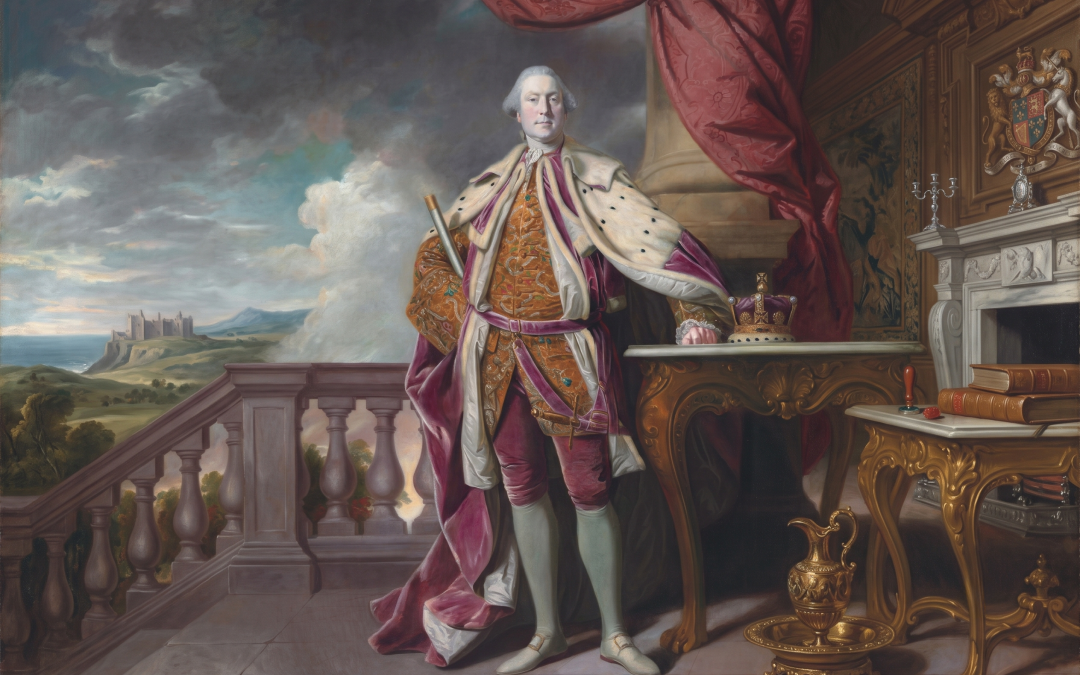
In March and April of 1762, the celebrated English portraitist Sir Joshua Reynolds painted a magnificent, full-length portrait of the Earl. The painting depicts Erroll in his splendid coronation robes, holding the baton of the Lord High Constable of Scotland in his right hand.
This masterpiece, which hung proudly in the dining room of Slains Castle, was far more than a simple piece of vanity. It was a carefully crafted piece of political propaganda. By presenting himself in the full, glorious regalia of his constitutional office, James Hay was visually asserting his unshakeable loyalty to the Hanoverian Crown. The portrait successfully erased the lingering trauma and social taint of his father’s execution, establishing the Earl not as the son of a executed rebel, but as the ultimate, giant guardian of the British establishment.
(Interestingly, although Reynolds charged 100 guineas for the commission, the bill remained unpaid at the Earl’s death in 1778, and was only settled by his estate in 1783.)
Later Career and a Famous Literary Visit
As a leading figure of the Scottish peerage, the Earl active participated in national affairs [26]. He served as the Rector of the University of Glasgow from 1761 to 1763. From 1770 until 1774, he sat in the House of Lords as a Tory Representative Peer, representing the Scottish nobility in the British Parliament. He also held the office of Lord of Police for Scotland from 1770 until his death.
In August 1773, Dr. Samuel Johnson and his biographer James Boswell embarked on their famous tour of the Highlands and Hebrides. On the evening of August 24, they arrived at Slains Castle, the Earl’s clifftop seat perched dramatically on the Aberdeenshire cliffs. The travellers were warmly received, having been invited to stay the night.
Boswell was deeply enchanted by his host, writing in his journal:
“I was excessively pleased with Lord Erroll. His stately person and agreeable countenance, with the most unaffected affability, gave me high satisfaction… I could with the most perfect honesty expatiate on Lord Erroll’s good qualities as if I was bribed to do it.”
This historic encounter cemented the Earl’s reputation as a model of the enlightened, polite, yet grandly traditional Scottish aristocrat.
Personal Life, Family, and Legacy
James Hay married twice and fathered a large, vibrant family.
- Rebecca Lockhart (married September 15, 1749; died 1761): The daughter of Alexander Lockhart, Lord Covington. Together, they had one daughter:
- Lady Mary Hay (born 1754), who married General John Scott of Balcomie.
- Isabella Carr (married 1762; died 1808): The daughter of Sir William Carr of Etal, Northumberland. Isabella was a celebrated beauty who was also painted by Sir Joshua Reynolds. Together, they had twelve children, including:
- George Hay, 16th Earl of Erroll (1767–1798), who succeeded his father.
- William Hay, 17th Earl of Erroll (1772–1819), who succeeded his brother.
- Lady Charlotte Hay (1763–1800)
- Lady Augusta Hay (1766–1822)
- Lady Flaminia Hay (1774–1821)
Through his descendants, the Earl’s legacy endured. His grandson, William George Hay, the 18th Earl of Erroll, married Lady Elizabeth FitzClarence (the illegitimate daughter of King William IV) and was created Baron Kilmarnock in the peerage of the United Kingdom in 1831, officially bringing the old Kilmarnock name back into the family’s formal honours.
On July 3, 1778, James Hay passed away at Callendar House at the age of 52. Though his life was relatively short, it was extraordinarily full. He had navigated the wreckage of a treasonous inheritance, survived a brutal civil war, performed a legendary act of battlefield mercy, and restored his family to the highest echelons of British society. He remains one of the most compelling, giant figures of 18th-century Scotland.