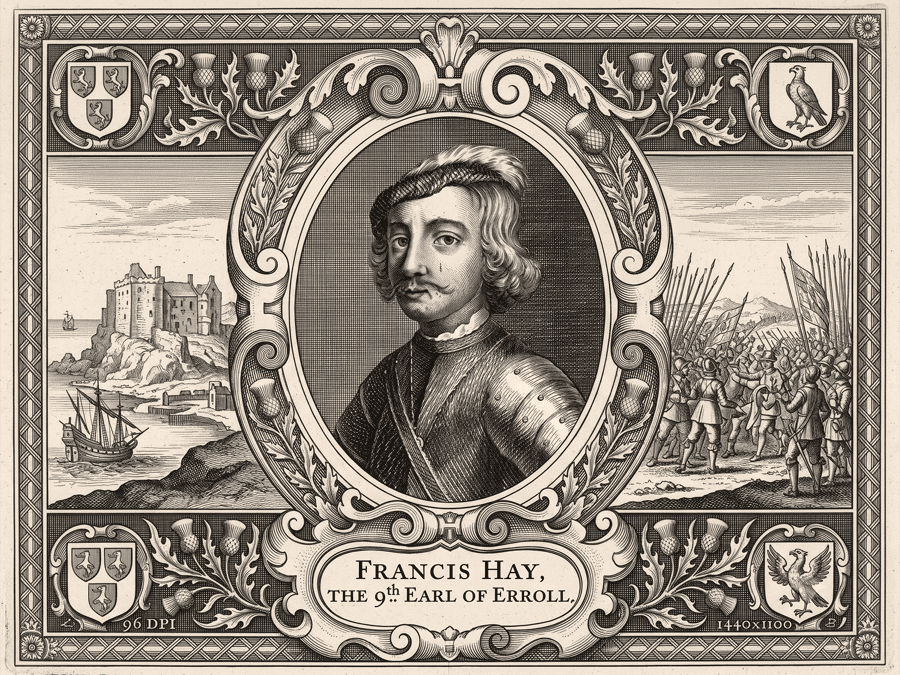
Francis Hay, 9th Earl of Erroll: A Life of Faith, Rebellion, and Reconstruction
Among the turbulent nobility of late sixteenth and early seventeenth-century Scotland, few figures epitomise the high-stakes intersection of religious conviction, treasonous intrigue, and political survival as vividly as Francis Hay (1564–1631), the 9th Earl of Erroll. As a staunch Roman Catholic in a post-Reformation nation dominated by an increasingly powerful Presbyterian Kirk, Erroll’s life was a dramatic saga of secret conspiracies, military triumph against overwhelming odds, royal vengeance, and ultimate restoration.
Inherited Prestige and the Seat of Power
Born in 1564, Francis Hay succeeded to one of the most prestigious titles and offices in the Kingdom of Scotland. Along with the earldom of Erroll, he inherited the ancient, hereditary office of Lord High Constable of Scotland. Originally granted to his ancestor Sir Gilbert Hay by King Robert the Bruce in 1308 to recognise his unwavering loyalty during the Wars of Independence, the office placed the Earls of Erroll first in rank behind the royal family.
With this high office came the spectacular family seat of Old Slains Castle. Perched on a jagged, wind-beaten cliff on the Aberdeenshire coast near Collieston, the fortress was a symbol of the family’s immense power and sophistication. Far from a simple, rugged tower house, archaeological remains suggest a site of great wealth and architectural refinement, including imported marble decorations and a grand “tourney ground” situated within its defensive ditch. It was from this clifftop stronghold that the young Earl would navigate the shifting political sands of a nation divided by faith.
The Spanish Blanks Conspiracy
By the late 1580s, the religious divide among the Scottish nobility was acute. While the Presbyterian Church of Scotland held formal ascendancy, a powerful faction of northern Catholic lords actively sought to reverse the Reformation. Francis Hay, having converted to Catholicism, aligned himself closely with George Gordon, the 6th Earl of Huntly, and William Douglas, the 10th Earl of Angus.
In late 1592, their counter-reformation plotting erupted into a national crisis known as the Spanish Blanks conspiracy. George Kerr, a Scottish Catholic priest bound for Spain, was intercepted and arrested on the Isle of Cumbrae. In his possession, authorities discovered a chest containing letters and, most alarmingly, eight blank sheets of paper signed with the seals and signatures of Erroll, Huntly, Angus, and Sir Patrick Gordon of Auchindoun.
Under torture in the Edinburgh tollbooth, Kerr confessed that the blank sheets were to be filled in by Jesuit agents in Spain—notably Father William Crichton—outlining a detailed plan for a Spanish invasion. The plot proposed that a Spanish force of 30,000 men would land on the west coast of Scotland, near Kirkcudbright or the River Clyde, to subvert the Protestant establishment, restore the Catholic mass, and assist James VI in securing the English throne from Queen Elizabeth I. The discovery threw King James into a diplomatic and political quandary. Pressed heavily by English ambassadors and Kirk leaders who demanded immediate trials for treason, James declared the Catholic lords outlaws, and their lands and possessions were forfeited to the crown.
Clash at Ben Rinnes: The Battle of Glenlivet
Rather than surrendering to royal authority, Erroll and his co-conspirators retreated to their northern strongholds and went to ground. In response, King James reluctantly commissioned Archibald Campbell, the 7th Earl of Argyll, to lead a Protestant army of suppression. In October 1594, Argyll marched north with an imposing force of between 6,000 and 7,000 men, composed of various Highland clans and a contingent of disciplined Irish arquebusiers.
The two armies clashed high on the slopes of Ben Rinnes on 3 October 1594 in what became known as the Battle of Glenlivet. Huntly and Erroll assembled a much smaller force of roughly 1,500 cavalry and 2,000 infantry. Despite being heavily outnumbered, the Catholic forces held distinct tactical advantages: they possessed experienced, heavily armoured horsemen, and they deployed six light cannons—marking the first recorded use of artillery in a battle so far north in the Highlands.
The battle began with a devastating cannon barrage that decapitated a notable MacNeill leader, spreading superstitious panic and causing a large portion of Argyll’s vanguard to flee. Seizing the moment, Erroll and Auchindoun led a fierce vanguard charge of 200 to 300 horsemen directly into Argyll’s lines. The fighting was exceptionally brutal, characterized by close-quarters combat with two-handed swords and axes. During the desperate melee, Erroll’s horsemen were briefly surrounded by Argyll’s missile troops. While Sir Patrick Gordon of Auchindoun was slain, Erroll fought on courageously, losing his cavalry standard but surviving despite suffering bullet wounds to his arm and an arrow wound to his thigh. Huntly’s horsemen subsequently flanked the Protestant forces, turning the engagement into a complete rout of Argyll’s army.
Royal Vengeance, Exile, and the Ruin of Old Slains
Though victorious at Glenlivet, the Catholic lords knew they could not risk open warfare against the King himself. When James VI marched north in person later that October, Huntly and Erroll chose not to engage the royal army, instead retreating further north to Caithness.
A vengeful King James arrived in Aberdeen and ordered immediate retribution. On 29 October 1594, the King commanded that the ancestral castles of the rebel lords be demolished. While Huntly’s castle at Strathbogie suffered relatively little structural damage, Erroll’s beloved Old Slains Castle was blasted to smithereens with gunpowder purchased by the King. The spectacular clifftop fortress, which had stood for nearly three centuries as the proud seat of Clan Hay, was reduced to crumbling, desolate ruins.
Left with no other option, the countesses of Huntly and Erroll negotiated terms of departure. Under a £40,000 caution, Erroll and Huntly agreed to leave Scotland. They entered temporary exile in March 1595, traveling across Flanders, Germany, and Italy.
Restoration and the Birth of New Slains
The exile of the rebel lords was relatively brief. James VI, ever the pragmatic politician, was eager to pacify the north and prevent the Kirk from gaining too much power. He made it known that the Earls would be permitted to return and recover their estates under one strict condition: they must renounce their Catholic faith and submit to the Presbyterian Kirk.
Francis Hay returned to Scotland in secret in 1597. On 26 June 1597, both Erroll and Huntly signed the Protestant Confession of Faith in the Auld Kirk of Aberdeen. Having made their peace with both the King and the Kirk, they received full royal pardons, and in December 1597, the Parliament of Scotland formally reduced their forfeitures, restoring their lands, honours, and offices.
With his estates restored, Erroll faced the task of rebuilding his life. Opting not to reconstruct the ruined Old Slains, he chose a new site four miles to the north in his barony of Cruden. There, he took an existing tower house known as the Tower of Bowness (Bowness Castle) and extended it into a grand, L-plan residence. This building formed the nucleus of “New Slains Castle,” which would be dramatically expanded by his descendants in subsequent centuries into a spectacular courtyard palace.
Francis Hay lived out the remainder of his days in his new clifftop home, serving as Lord High Constable of Scotland until his death in 1631. Today, while only a single crumbling wall remains of his original seat at Oldcastle, the spectacular ruins of New Slains stand as a lasting monument to the resilience and rebuilding of a remarkable Renaissance nobleman.