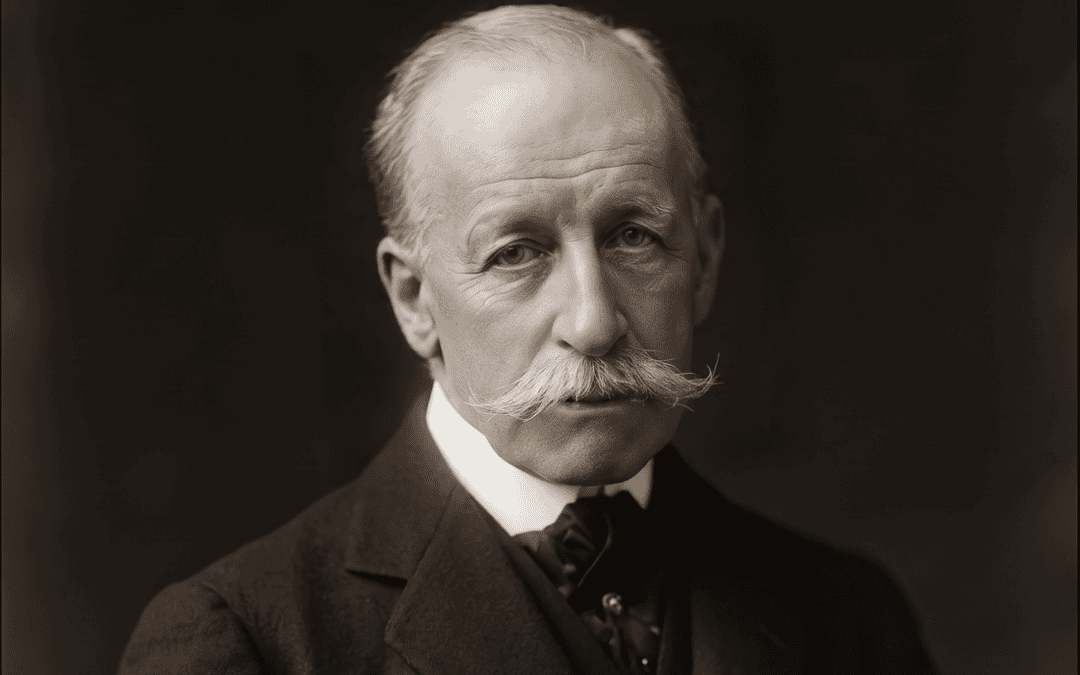
The Last Lord of Slains:
Charles Gore Hay and the Tragic Twilight of a Highland Castle

Standing upon the jagged, salt-sprayed cliffs of Aberdeenshire, the gaunt ruins of Slains Castle dominate the skyline like a stone ghost. For over three centuries, this was the seat of the Earls of Erroll, the hereditary Lord High Constables of Scotland. Yet, at the dawn of the 20th century, this immense legacy met its most formidable foe—not a rival clan or an invading army, but the cold mathematics of the modern economy. Charles Gore Hay, the 20th Earl of Erroll, was a man of impeccable royal pedigree and distinguished military service, yet he became the protagonist of a bittersweet tragedy: the lord who witnessed the “taxman’s axe” fell his ancestral home.
A Lineage of Kings: The Pedigree of Charles Gore Hay
Charles Gore Hay was born into the very heart of the British establishment. His family tree was a tapestry of royal blood and martial glory, connecting him directly to the throne and the most pivotal moments of 19th-century history. To understand the 20th Earl is to understand the immense weight of the crown he indirectly carried; he was not merely a peer, but a godson of Queen Victoria herself, a distinction that solidified his place within the inner sanctum of the Empire.
The Royal and Martial Ancestry of the 20th Earl
|
Source of Lineage
|
Key Figure / Historical Significance
|
|---|---|
|
Paternal Great-grandfather
|
King William IV: The Earl was a direct descendant via the King’s illegitimate daughter, Elizabeth FitzClarence.
|
|
Maternal Grandfather
|
General Sir Charles Stephen Gore: A distinguished officer and Waterloo veteran (son of the 2nd Earl of Arran).
|
|
Hereditary Title
|
Lord High Constable of Scotland: The highest-ranking peer in Scotland, traditionally responsible for the King’s safety.
|
|
Royal Connection
|
Queen Victoria: The Earl was a godson of the Queen, placing him at the epicenter of the British establishment.
|
Gifted with such a storied birthright and the expectations of the Victorian court, Hay was destined for a life defined by the twin pillars of the British aristocracy: the military and the state.
From Paardeberg to Parliament: A Life of Service
The 20th Earl did not merely inherit titles; he earned his standing through a rigorous career that shifted between the biting winds of the South African veldt and the hushed, velvet-draped chambers of Westminster. His life was a balancing act between the grit of a soldier and the grace of a statesman.
- The Boer War Hero: Following the outbreak of the Second Boer War in 1899, Hay volunteered for active service with the Imperial Yeomanry. He fought at the Battle of Paardeberg and the Battle of Faber’s Put, eventually commanding a yeomanry brigade as a brigadier general.
- The Conservative Statesman: In the political sphere, he served as a Lord-in-Waiting (government whip) under Arthur Balfour from 1903 to 1905. In 1901, he was appointed a Knight of the Thistle, Scotland’s highest order of chivalry.
- The WWI Major-General: Even in the twilight of his career, Hay answered the call during the Great War, commanding the 65th (2nd Lowland) Division between 1915 and 1916.
His international standing was mirrored by a “remarkable collection of foreign medals,” symbols of a life spent in the service of the Crown. However, while the Earl’s personal prestige was at its zenith, the silent corridors of his family home were beginning to echo with the sounds of financial decay.
The Architecture of Ambition: A Tale of Two Castles
The Slains name belongs to two distinct locations, each representing a different era of Hay history. The transition from one to the other is a chronicle of survival, royal vengeance, and eventual grandiosity.
Old Slains vs. New Slains
- Old Slains: A 13th-century fortress near Collieston. In a fit of royal rage, King James VI personally oversaw its destruction with gunpowder in 1594 after the 9th Earl backed a Catholic plot.
- New Slains (Bowness): The irony of Scottish history is swift; by 1597, the Earl was forgiven. Unable to rebuild the shattered Old Slains, he moved four miles north to the Tower of Bowness. This ancient tower remains the hidden core of the current ruin, which was encased in granite in 1838 by the 18th Earl and architect John Smith.
To wander the ruins today is to explore a “maze of passageways” where one finds an eclectic blend of masonry—from the rough, older granite and “medieval red brick” of the 17th century to the smooth, imposing granite facing of the 19th. The castle utilized the “abyss to the west” as a natural, impassable moat, but while the walls were built to withstand the North Sea gales, the financial foundations were crumbling into the surf.
1916: The End of a 300-Year Dynasty
In 1916, the unthinkable happened. Charles Gore Hay was forced to sell the 7,200-acre Slains estate and its contents, ending over three centuries of Hay residency. This was not a sudden collapse, but a surrender to three economic “villains” that were then dismantling the Highland social structure:
- Agricultural Depression: The surrounding farmlands, once the lifeblood of the earldom, were no longer productive enough to support the castle’s immense overhead.
- WWI Inflation: The Great War sent the costs of labor and maintenance skyrocketing, making the upkeep of a 14-bedroom mansion an impossible dream.
- Death Duties: The newly introduced inheritance tax struck a terminal blow, forcing the liquidation of ancestral lands to satisfy the state.
The sale marked the end of the Hay era at Slains, as the keys were handed from a legendary lineage to the cold, pragmatic hands of industrial “new money.”
The Ghost Years: Abandonment and the Taxman’s Toll
The castle’s new owner was Sir John Ellerman, a secretive and unimaginably wealthy shipping magnate. Ellerman represented the antithesis of the Hay legacy; where the Earls saw a home, he saw a line item.
“A man of cold financial pragmatism, Sir John Ellerman viewed the castle purely as a profit opportunity. In a final insult to the Hay family’s 300-year residency, he famously never even troubled to visit the estate he owned.”
In 1925, Ellerman ordered the de-roofing of the castle to escape property taxes, effectively sentencing the grand structure to a slow death by the elements. The salvage was brutal:
- The grand granite steps were ripped out and relocated to the Aberdeen Music Hall, where they are still trodden by concert-goers today.
- The 14 bedrooms, the stables, and the sprawling tennis and croquet lawns were left to the encroaching weeds.
- The basement kitchens, once warm with the glow of firepits, became hollow shells of damp stone.
Conclusion: The Dracula Connection & The Living Legacy
Though Slains is now a hollow shell, its atmospheric decay has cemented its place in the Gothic imagination. For 17 years, the author Bram Stoker visited Cruden Bay, drawing inspiration from the castle’s “dreadful abyss.”
Did You Know?
Slains Castle is widely cited as the primary inspiration for the castle in Dracula. Stoker famously envisioned the Count crawling down the castle walls “face down, with his cloak spreading around him like great wings” while staring at these very cliffs. Beyond Dracula, Stoker used Cruden Bay as the setting for his 1902 novel The Mystery of the Sea, as well as several short stories.
Today, Slains Castle remains a “magical” landmark—a monument where the academic rigour of history meets the haunting beauty of literature. It is a bittersweet reminder of a time when the Earls of Erroll stood as the high protectors of the coast, before the granite gave way to the taxman’s axe.
Web-Ready Tips for the Aspiring Explorer
The Atmospheric Approach: For the most evocative experience, park by the Congregational Kirk (church) in Cruden Bay. From there, take the ¾ mile coastal walk. The transition from the shelter of the woodland to the spectacular, windswept cliff-edge view of the ruin is breathtaking.
Literary Pilgrimage: Visit the Kilmarnock Arms Hotel in the village. Bram Stoker stayed here during his many visits, and the hotel remains a repository for the history of both the 19th Earl and the Count.
Safety Warning: The castle is a ruin in a “dangerous state.” Exercise extreme caution near the cliff edges and within the internal passageways and basement works, where the salt-crusted stone can be deceptively slick.