The Naturalist Spymaster of New Slains Castle
Lady Anne Drummond (1656–1719): The Naturalist Countess who Masterminded Scotland’s Jacobite Espionage
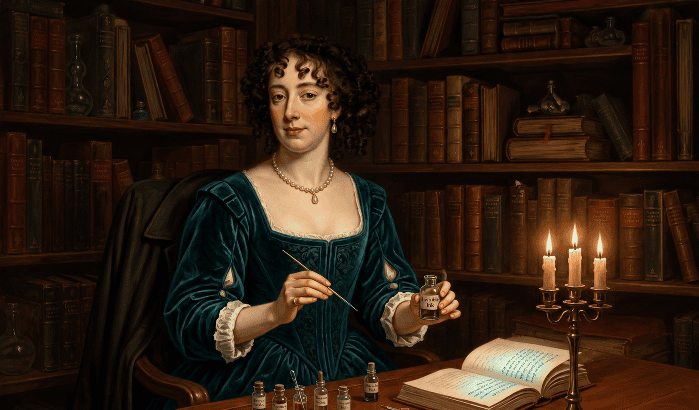
Lady Anne Drummond, Countess of Erroll, was one of the most remarkable figures of early eighteenth-century Scotland, leading an extraordinary and highly dangerous double life. To the polite world, she was a pioneering intellectual and naturalist who contributed to reference books on the history and fauna of Scotland. Beneath this respectable veneer, however, she was a formidable Jacobite conspirator and spymaster who converted her home, New Slains Castle, into a central node of clandestine intelligence between Scotland and France.
Family and Noble Heritage
She was born Anne Drummond on 5 January 1656, the youngest child of James Drummond, 3rd Earl of Perth, and his wife Lady Anne Drummond, who tragically died as a result of the childbirth. She came from an illustrious and politically powerful Scottish family. Her brother, James Drummond, served as the Lord Chancellor of Scotland under King James VII (James II of England), while her other brother, John Drummond, was the Secretary of State.
On 1 October 1674, she married John Hay, who succeeded as the 12th Earl of Erroll that same year. Following her marriage, she was formally known as Lady Anne Drummond, Countess of Erroll, though she signed her letters with the shortened form, “Anne Erroll”. Together, they had four surviving children: Charles, Thomas, Mary, and Margaret. Both Charles and Mary would eventually inherit the earldom and continue the family’s deep commitment to the Jacobite movement.
Contributions to Natural History and Literature
During the 1680s, Lady Anne established her reputation as a gifted naturalist and illustrator. She submitted texts and detailed plates to Sir Robert Sibbald’s Scotia Illustrata, a landmark collaborative natural history book published in 1684. Lady Anne’s contributions included illustrations of the redwing and the black-winged stilt (or goosander), alongside textual descriptions of a fin whale and a sea eagle eyrie.
In addition to her work in natural history, she was an accomplished writer. Most notably, she contributed two articles on her family history to Pierre Bayle’s famed Dictionnaire Historique et Critique, a cornerstone text of the Early European Enlightenment, and she is believed to have penned several other articles concerning Scotland for the dictionary.
The “Secret Post Office” of New Slains Castle
Following the deposition of King James VII/II, Lady Anne dedicated her keen intellect to the underground Jacobite movement. She transformed her home, the clifftop fortress of New Slains Castle, into a clandestine “secret post office” and the premier northern hub for Jacobite communications and espionage. Between 1704 and 1708, she served as the primary representative in Scotland for the exiled James Francis Edward Stuart and the Jacobite Court at St Germain. Simon Fraser, the future Lord Lovat, famously described her as “the soul of the King’s affairs in Scotland”.
In this role, Lady Anne coordinated a vast intelligence network, distributing correspondence to co-conspirators and corresponding with Queen Mary of Modena regarding the Scottish Jacobites’ terms. To evade government authorities, she wrote her secret missives in invisible ink made from lemon juice, disguising them as routine household letters. These encrypted messages were then smuggled across the sea to France, hidden inside commercial shipments of Aberdeen salmon. New Slains Castle was ideally situated for espionage, receiving all French envoys and vessels sent to Scotland during this period, which sailed directly to the isolated castle cliffs.
Lady Anne was also responsible for gathering military intelligence. In April 1705, she sent three emissaries to sound out the Highlanders, the Catholics, and the Episcopalians regarding a potential rising. While the first two factions were ready to fight, the Episcopalian Archbishop of Glasgow raised difficulties regarding the promises made by James Stuart to the Pope and the King of France. This dangerous network came at a steep financial price; the Erroll estate provided the money and horses necessary to maintain correspondence throughout the kingdom, plunging the family into great debt.
The Double Agent on the High Seas: Gaining Over Captain Gordon
Lady Anne’s most ingenious exploit was her successful recruitment of Captain Thomas Gordon, the commander of the Scottish Navy frigate Royal Mary, which was commissioned by the government to guard the coast. Recognizing his strategic importance, Lady Anne gained Captain Gordon over to the Jacobite cause, persuading him to protect French vessels rather than capture them.
In August 1705, when the French frigate Audacious (carrying the Jacobite emissary Colonel Nathaniel Hooke) was anchored within musket shot of Slains Castle, Captain Gordon’s warship appeared to the south. Lady Anne calmly sent a gentleman in a cutter to request that the captain take another course, a request with which Gordon immediately complied.
To prevent future accidents, fourteen secret signals were agreed upon between Captain Gordon and Mr. Carron, the commander of the French vessel. If Gordon encountered the French ship, specific flags would be hoisted (such as a Holland ensign on the French main topmast and a Scots ensign on the mizen peak) to ensure Gordon would not pursue or concern himself with the vessel.
Lady Anne twice hosted Nathaniel Hooke at New Slains Castle in 1705 and 1707. Hooke, who used linen signals hung in the castle’s seaward windows to communicate with her, was deeply impressed, describing her as “a lady of about fifty, with a sound, penetrating mind. All the Jacobites have confidence in her”.
This maritime conspiracy continued under Lady Anne’s son, Charles, the 13th Earl. In June 1707, Captain Gordon concerted with the Earl to steer clear of a French frigate commanded by M. de Ligondez, which was carrying Colonel Hooke back to France. When Gordon’s ships gave chase to de Ligondez’s frigate, the French captain displayed the agreed signal. Gordon immediately fired a gun to recall his companion frigate, which complied with reluctance, allowing Hooke to escape safely to Dunkirk. The intelligence gathered by Hooke during these visits directly facilitated the 1708 Franco-Jacobite invasion attempt.
Later Years and Legacy
In her final years, Lady Anne retired to her country house at Delgatie, where she died in or before August 1719. She outlived her husband and all of her children except for her daughter, Mary.
The Jacobite cause at New Slains Castle did not die with her. Her daughter, Mary Hay, succeeded as the 14th Countess of Erroll in 1717 and became a formidable secret agent in her own right. Inspired by her mother’s example, Mary transformed Slains Castle into the premier northern hub for Jacobite intelligence during the 1745 Rebellion, successfully recruiting local regiments for Prince Charles Edward Stuart and hiding foreign agents in the secret passages of Delgatie Castle. Lady Anne Drummond’s legacy lived on through the continued defiance and bravery of her family, cementing her place as one of Scotland’s most brilliant and daring historical figures.
(Acknowledgement: This work makes use of material from Unquenched Rage: The Jacobites of North East Scotland, 1688-1708, by Mike Shepherd, published in 2024.)