
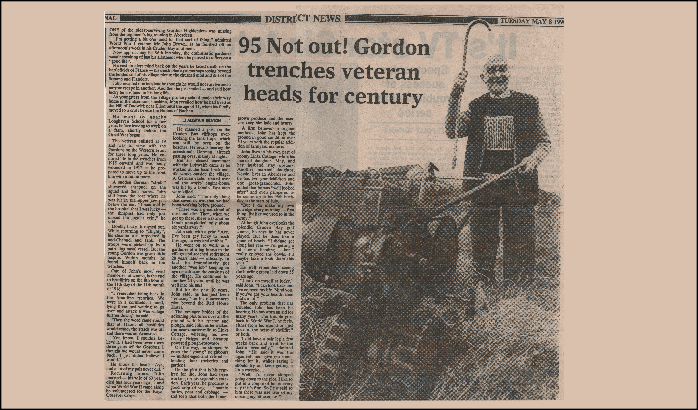
By ALISTAIR BEATON 8th May 1990
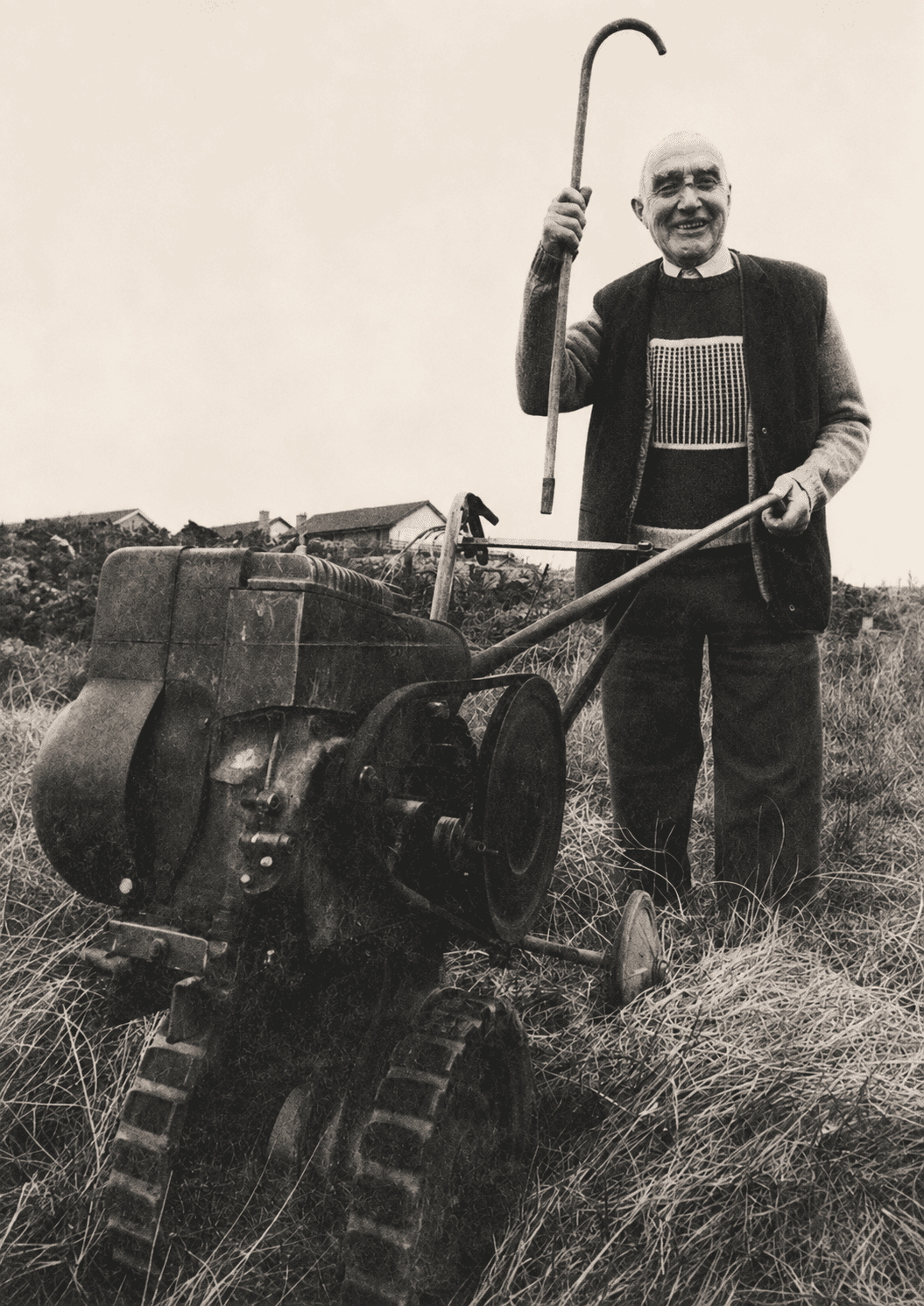
John Brown, photographed in his Cruden Bay allotment as he approached his 96th birthday. A Gordon Highlander veteran of the First World War, he remained active in the garden every day, believing that fresh air, exercise and home-grown produce were the keys to a long and happy life.
One of the oldest-surviving Gordon Highlanders was missing from the regiment’s big reunion in Aberdeen.
“I’m getting a bit o’er auld for that sort of thing,” admitted World War I veteran Mr John Brown, as he finished off an afternoon’s work in his Cruden Bay allotment.
Now approaching his 96th birthday, the enthusiastic gardener wasn’t speaking of just his allotment when he paused to reflect on a “good life”.
He cast an alert mind back on the years he faced death on the battlefields of France—his quick blue eyes perhaps seeing beyond the tended soil of his village plot to the churned mud and dirt of the Somme and Flanders.
John recalled one incident he thought he would not survive and a narrow escape in another. And then he just smiled—and said how lucky he has been in his long life.
As youngsters from the village primary school made their way home in the afternoon sunshine, John recalled how he had lived at the Hill of Dudwick near Ellon until the age of 11, when his family moved to a croft beside the Bullers o’ Buchan.
He went to nearby Longhaven School for a few years before leaving to work on a farm, shortly before the Great War began.
The veteran enlisted at 19 and was to serve with the Gordons on the Western Front for three long years. He endured life in the trenches from 1915 onward and was badly wounded in 1917 as he prepared to move up to the front line with a ration party.
A sudden German “strafe” showered shrapnel on the squad and their horses. John still bears the scar where he was hit in the upper jaw just below the ear.
“I was told in the hospital that I was lucky—the shrapnel had only just missed the jugular vein,” he said.
Doubly lucky, it turned out.
While returning to “Blighty”, his steamer was torpedoed in mid-Channel and sank. The troops were picked up by a patrolling naval vessel. But the young Gordon was given little respite. Within months, he found himself back in the trenches.
One of John’s most vivid memories, of course, is the end to hostilities on the 11th hour of the 11th day of the 11th month of 1918.
“I remember being back in the front-line trenches. We were in a cornfield, I mind, lying there just waiting to go over and attack a wee village further down,” he said.
“Then the word came round that at 11 a.m. all hostilities would cease, the attack was off and there was an Armistice.
“You know, I couldna believe it. I had been ower there three years wi’ the Gordons. I thought we would never come back. I jist didna believe I would.”
He shook his head.
“Aye, and a lot of my pals never did.”
Returning home, John married—his wife of 60 years died just four years ago—and when World War II came along he volunteered for the Royal Observer Corps.
He manned a post on the Cruden Bay clifftops overlooking the tank traps, which can still be seen on the beaches. He recalls hearing the occasional German aircraft passing over, mainly at night.
But his closest encounter with the Luftwaffe came as he worked at the local brick-and-tile works outside the village.
A German raider roared over and the works’ engine house was hit by a bomb. Two men were killed.
John said:
“The only thing that saved us was that we had been working below ground.
“There was a great cloud of dust and dirt. Then, when we got up there, there was another bomb unexploded only about six yards away.”
John said with a grin:
“Aye, I’ve been gey lucky to reach this age, ae wey and anither.”
He went on to work as a gardener at a big house in the village and reached retirement 20 years later—officially.
In fact, he immediately got another “wee job” keeping an eye on cattle on the outskirts of the village. He continued for another 20 years, until he was well into his 80s.
But for the past 10 years, John said, he has just been “relaxing” on his quarter-acre plot beyond the Red House Hotel.
The younger holder of the adjoining plot turns over all the ground with his tractor and plough, said John as he walked the near quarter-mile to Links Cottage, wheeling his own trusty Briggs & Stratton-powered plough-rotavator.
On the way, he stopped to greet the “young” neighbours—middle-aged and retired—tending their rockeries and gardens.
On the plot that is his rent-free for life, John had been working on his vegetable rotation.
Each year he produces a good crop of vegetables—mainly tatties, peas and cabbage—and feels that both the home-grown produce and the exercise keep him hale and hearty.
A firm believer in organic methods, John has kept the ground in good condition over 30 years with the regular addition of farmyard manure.
John lives in his own part of roomy Links Cottage, while his married daughter, May, and her husband stay upstairs.
Another married daughter, Nessie, lives in Aberdeen and he has two grandchildren and one great-grandchild.
John added that he was “well looked after” and even pampered as he came up to his 96th birthday at the start of July.
“But I do make my own porridge every morning—first thing, just like we used to in the Army.”
Although John overlooks the splendid Cruden Bay golf course, he says he has never played.
But he does like a game of bowls.
“I didnae get along last year—I’m getting a bit slow at bending—but I really enjoyed the bowls. I’ll maybe take a look doon this year.”
He well remembers seeing the bowling green laid down 55 years ago.
“I look on myself as lucky,” said John.
“I can look back and I’ve enjoyed my life. Mind you, if you’ve got your health, then that’s a lot.”
The only problem that has troubled John has been his hearing.
He has worn an aid for many years. The trouble goes back to World War I, he feels, either from his wound or “jist the din, the noise o’ shellfire”—or both.
“I did have a sair leg a few weeks back and went to the doctor eventually,” admitted John.
“He said it was the ligament, and gave me something for it, whiles saying I should try an’ keep getting a little exercise.
“Well, I’d never stopped going down to the plot. I like to put in a couple of hours every day if it’s fine. So I jist said to him there was nae fear of my missing my bit exercise.”